

306
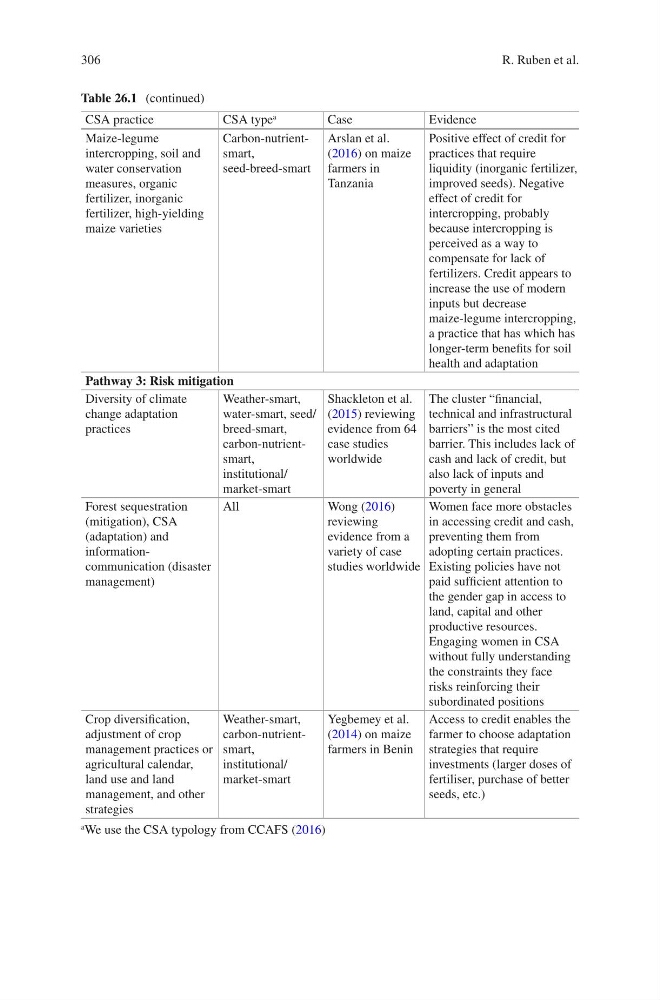
Table 26.1 (continued)
CSA practice
CSA type
a
Case
Evidence
Maize-legume
intercropping, soil and
water conservation
measures, organic
fertilizer, inorganic
fertilizer, high-yielding
maize varieties
Carbon-nutrientsmart,
seed-breed-smart
Arslan et al.
(2016) on maize
farmers in
Tanzania
Positive effect of credit for
practices that require
liquidity (inorganic fertilizer,
improved seeds). Negative
effect of credit for
intercropping, probably
because intercropping is
perceived as a way to
compensate for lack of
fertilizers. Credit appears to
increase the use of modern
inputs but decrease
maize-legume intercropping,
a practice that has which has
longer-term benefits for soil
health and adaptation
Pathway 3: Risk mitigation
Diversity of climate
change adaptation
practices
Weather-smart,
water-smart, seed/
breed-smart,
carbon-nutrientsmart,
institutional/
market-smart
Shackleton et al.
(2015) reviewing
evidence from 64
case studies
worldwide
The cluster “financial,
technical and infrastructural
barriers” is the most cited
barrier. This includes lack of
cash and lack of credit, but
also lack of inputs and
poverty in general
Forest sequestration
(mitigation), CSA
(adaptation) and
informationcommunication (disaster
management)
All
Wong (2016)
reviewing
evidence from a
variety of case
studies worldwide
Women face more obstacles
in accessing credit and cash,
preventing them from
adopting certain practices.
Existing policies have not
paid sufficient attention to
the gender gap in access to
land, capital and other
productive resources.
Engaging women in CSA
without fully understanding
the constraints they face
risks reinforcing their
subordinated positions
Crop diversification,
adjustment of crop
management practices or
agricultural calendar,
land use and land
management, and other
strategies
Weather-smart,
carbon-nutrientsmart,
institutional/
market-smart
Yegbemey et al.
(2014) on maize
farmers in Benin
Access to credit enables the
farmer to choose adaptation
strategies that require
investments (larger doses of
fertiliser, purchase of better
seeds, etc.)
a We use the CSA typology from CCAFS (2016)
R. Ruben et al.
Table 26.1 (continued)
CSA practice
CSA type
a
Case
Evidence
Maize-legume
intercropping, soil and
water conservation
measures, organic
fertilizer, inorganic
fertilizer, high-yielding
maize varieties
Carbon-nutrientsmart,
seed-breed-smart
Arslan et al.
(2016) on maize
farmers in
Tanzania
Positive effect of credit for
practices that require
liquidity (inorganic fertilizer,
improved seeds). Negative
effect of credit for
intercropping, probably
because intercropping is
perceived as a way to
compensate for lack of
fertilizers. Credit appears to
increase the use of modern
inputs but decrease
maize-legume intercropping,
a practice that has which has
longer-term benefits for soil
health and adaptation
Pathway 3: Risk mitigation
Diversity of climate
change adaptation
practices
Weather-smart,
water-smart, seed/
breed-smart,
carbon-nutrientsmart,
institutional/
market-smart
Shackleton et al.
(2015) reviewing
evidence from 64
case studies
worldwide
The cluster “financial,
technical and infrastructural
barriers” is the most cited
barrier. This includes lack of
cash and lack of credit, but
also lack of inputs and
poverty in general
Forest sequestration
(mitigation), CSA
(adaptation) and
informationcommunication (disaster
management)
All
Wong (2016)
reviewing
evidence from a
variety of case
studies worldwide
Women face more obstacles
in accessing credit and cash,
preventing them from
adopting certain practices.
Existing policies have not
paid sufficient attention to
the gender gap in access to
land, capital and other
productive resources.
Engaging women in CSA
without fully understanding
the constraints they face
risks reinforcing their
subordinated positions
Crop diversification,
adjustment of crop
management practices or
agricultural calendar,
land use and land
management, and other
strategies
Weather-smart,
carbon-nutrientsmart,
institutional/
market-smart
Yegbemey et al.
(2014) on maize
farmers in Benin
Access to credit enables the
farmer to choose adaptation
strategies that require
investments (larger doses of
fertiliser, purchase of better
seeds, etc.)
a We use the CSA typology from CCAFS (2016)
R. Ruben et al.