

18
and Zimbabwe, show rapid and statistically significant decreases in precipitation.
By contrast, South Africa and limited parts of East and North Africa have experienced increased rainfall. At the same time, increased temperatures are leading to
higher rates of evapotranspiration, which produces drier soil conditions (Girvetz
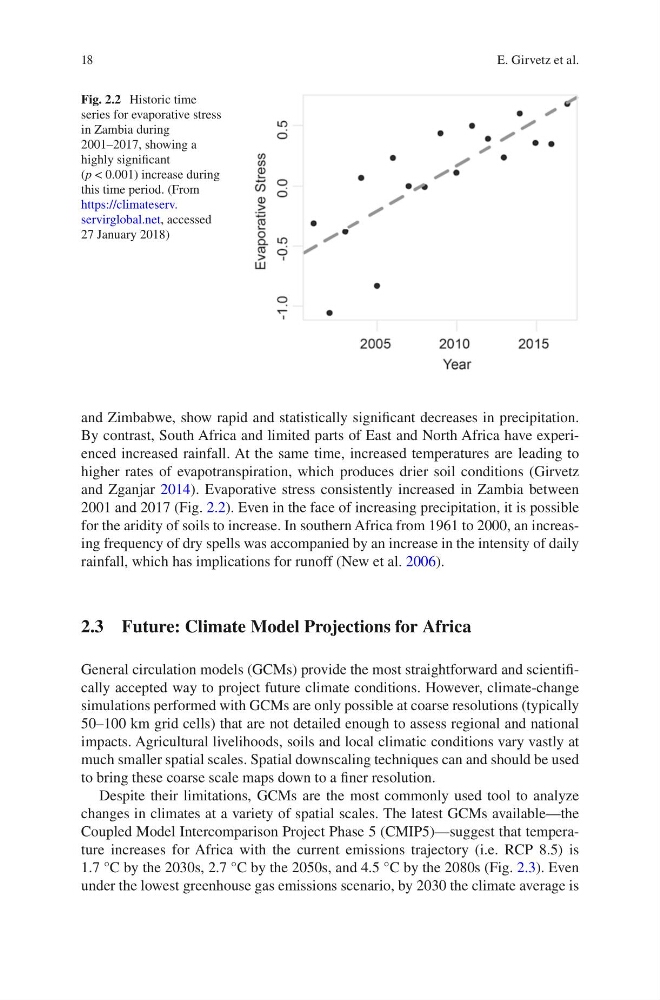
and Zganjar 2014). Evaporative stress consistently increased in Zambia between
2001 and 2017 (Fig. 2.2). Even in the face of increasing precipitation, it is possible
for the aridity of soils to increase. In southern Africa from 1961 to 2000, an increasing frequency of dry spells was accompanied by an increase in the intensity of daily
rainfall, which has implications for runoff (New et al. 2006).
2.3 Future: Climate Model Projections for Africa
General circulation models (GCMs) provide the most straightforward and scientifically accepted way to project future climate conditions. However, climate-change
simulations performed with GCMs are only possible at coarse resolutions (typically
50–100 km grid cells) that are not detailed enough to assess regional and national
impacts. Agricultural livelihoods, soils and local climatic conditions vary vastly at
much smaller spatial scales. Spatial downscaling techniques can and should be used
to bring these coarse scale maps down to a finer resolution.
Despite their limitations, GCMs are the most commonly used tool to analyze
changes in climates at a variety of spatial scales. The latest GCMs available—the
Coupled Model Intercomparison Project Phase 5 (CMIP5)—suggest that temperature increases for Africa with the current emissions trajectory (i.e. RCP 8.5) is
1.7 °C by the 2030s, 2.7 °C by the 2050s, and 4.5 °C by the 2080s (Fig. 2.3). Even
under the lowest greenhouse gas emissions scenario, by 2030 the climate average is
Fig. 2.2 Historic time
series for evaporative stress
in Zambia during
2001–2017, showing a
highly significant
(p < 0.001) increase during
this time period. (From
https://climateserv.
servirglobal.net, accessed
27 January 2018)
E. Girvetz et al.
and Zimbabwe, show rapid and statistically significant decreases in precipitation.
By contrast, South Africa and limited parts of East and North Africa have experienced increased rainfall. At the same time, increased temperatures are leading to
higher rates of evapotranspiration, which produces drier soil conditions (Girvetz
and Zganjar 2014). Evaporative stress consistently increased in Zambia between
2001 and 2017 (Fig. 2.2). Even in the face of increasing precipitation, it is possible
for the aridity of soils to increase. In southern Africa from 1961 to 2000, an increasing frequency of dry spells was accompanied by an increase in the intensity of daily
rainfall, which has implications for runoff (New et al. 2006).
2.3 Future: Climate Model Projections for Africa
General circulation models (GCMs) provide the most straightforward and scientifically accepted way to project future climate conditions. However, climate-change
simulations performed with GCMs are only possible at coarse resolutions (typically
50–100 km grid cells) that are not detailed enough to assess regional and national
impacts. Agricultural livelihoods, soils and local climatic conditions vary vastly at
much smaller spatial scales. Spatial downscaling techniques can and should be used
to bring these coarse scale maps down to a finer resolution.
Despite their limitations, GCMs are the most commonly used tool to analyze
changes in climates at a variety of spatial scales. The latest GCMs available—the
Coupled Model Intercomparison Project Phase 5 (CMIP5)—suggest that temperature increases for Africa with the current emissions trajectory (i.e. RCP 8.5) is
1.7 °C by the 2030s, 2.7 °C by the 2050s, and 4.5 °C by the 2080s (Fig. 2.3). Even
under the lowest greenhouse gas emissions scenario, by 2030 the climate average is
Fig. 2.2 Historic time
series for evaporative stress
in Zambia during
2001–2017, showing a
highly significant
(p < 0.001) increase during
this time period. (From
https://climateserv.
servirglobal.net, accessed
27 January 2018)
E. Girvetz et al.