

237
Creating the county climate risk profile for Nyandarua involved identifying
major value-chain commodities, the key climate risks each faces and the adaptation
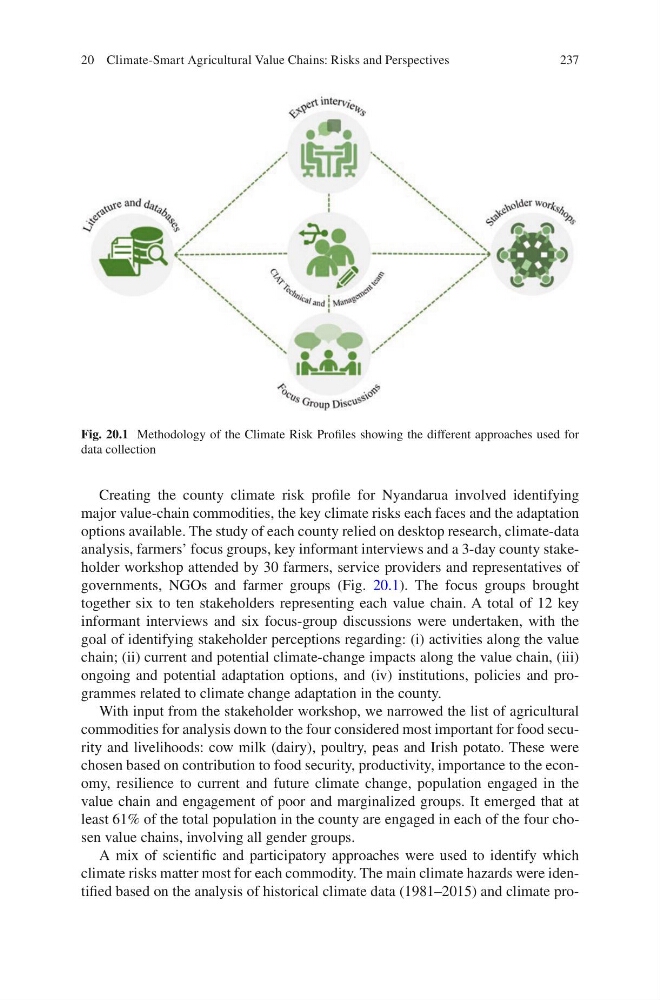
options available. The study of each county relied on desktop research, climate-data
analysis, farmers’ focus groups, key informant interviews and a 3-day county stakeholder workshop attended by 30 farmers, service providers and representatives of
governments, NGOs and farmer groups (Fig. 20.1). The focus groups brought
together six to ten stakeholders representing each value chain. A total of 12 key
informant interviews and six focus-group discussions were undertaken, with the
goal of identifying stakeholder perceptions regarding: (i) activities along the value
chain; (ii) current and potential climate-change impacts along the value chain, (iii)
ongoing and potential adaptation options, and (iv) institutions, policies and programmes related to climate change adaptation in the county.
With input from the stakeholder workshop, we narrowed the list of agricultural
commodities for analysis down to the four considered most important for food security and livelihoods: cow milk (dairy), poultry, peas and Irish potato. These were
chosen based on contribution to food security, productivity, importance to the economy, resilience to current and future climate change, population engaged in the
value chain and engagement of poor and marginalized groups. It emerged that at
least 61% of the total population in the county are engaged in each of the four chosen value chains, involving all gender groups.
A mix of scientific and participatory approaches were used to identify which
climate risks matter most for each commodity. The main climate hazards were identified based on the analysis of historical climate data (1981–2015) and climate proFig. 20.1 Methodology of the Climate Risk Profiles showing the different approaches used for
data collection
20 Climate-Smart Agricultural Value Chains: Risks and Perspectives
Creating the county climate risk profile for Nyandarua involved identifying
major value-chain commodities, the key climate risks each faces and the adaptation
options available. The study of each county relied on desktop research, climate-data
analysis, farmers’ focus groups, key informant interviews and a 3-day county stakeholder workshop attended by 30 farmers, service providers and representatives of
governments, NGOs and farmer groups (Fig. 20.1). The focus groups brought
together six to ten stakeholders representing each value chain. A total of 12 key
informant interviews and six focus-group discussions were undertaken, with the
goal of identifying stakeholder perceptions regarding: (i) activities along the value
chain; (ii) current and potential climate-change impacts along the value chain, (iii)
ongoing and potential adaptation options, and (iv) institutions, policies and programmes related to climate change adaptation in the county.
With input from the stakeholder workshop, we narrowed the list of agricultural
commodities for analysis down to the four considered most important for food security and livelihoods: cow milk (dairy), poultry, peas and Irish potato. These were
chosen based on contribution to food security, productivity, importance to the economy, resilience to current and future climate change, population engaged in the
value chain and engagement of poor and marginalized groups. It emerged that at
least 61% of the total population in the county are engaged in each of the four chosen value chains, involving all gender groups.
A mix of scientific and participatory approaches were used to identify which
climate risks matter most for each commodity. The main climate hazards were identified based on the analysis of historical climate data (1981–2015) and climate proFig. 20.1 Methodology of the Climate Risk Profiles showing the different approaches used for
data collection
20 Climate-Smart Agricultural Value Chains: Risks and Perspectives