

231
climate change without directly intervening at the farm level. These companies seek
multi-site risk mitigation and origin information to inform global strategy and collaborative solutions, often through sector platforms (Private Sector Consultation
2018).
Given the different needs of the actors with varying roles in the supply chain,
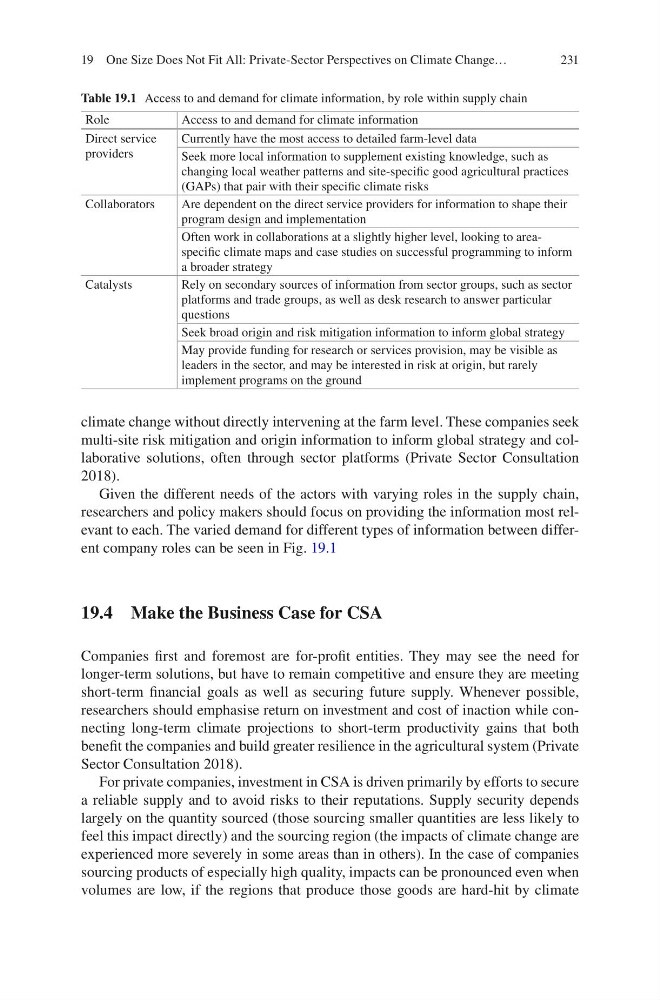
researchers and policy makers should focus on providing the information most relevant to each. The varied demand for different types of information between different company roles can be seen in Fig. 19.1
19.4 Make the Business Case for CSA
Companies first and foremost are for-profit entities. They may see the need for
longer- term solutions, but have to remain competitive and ensure they are meeting
short-term financial goals as well as securing future supply. Whenever possible,
researchers should emphasise return on investment and cost of inaction while connecting long-term climate projections to short-term productivity gains that both
benefit the companies and build greater resilience in the agricultural system (Private
Sector Consultation 2018).
For private companies, investment in CSA is driven primarily by efforts to secure
a reliable supply and to avoid risks to their reputations. Supply security depends
largely on the quantity sourced (those sourcing smaller quantities are less likely to
feel this impact directly) and the sourcing region (the impacts of climate change are
experienced more severely in some areas than in others). In the case of companies
sourcing products of especially high quality, impacts can be pronounced even when
volumes are low, if the regions that produce those goods are hard-hit by climate
Table 19.1 Access to and demand for climate information, by role within supply chain
Role
Access to and demand for climate information
Direct service
providers
Currently have the most access to detailed farm-level data
Seek more local information to supplement existing knowledge, such as
changing local weather patterns and site-specific good agricultural practices
(GAPs) that pair with their specific climate risks
Collaborators
Are dependent on the direct service providers for information to shape their
program design and implementation
Often work in collaborations at a slightly higher level, looking to areaspecific climate maps and case studies on successful programming to inform
a broader strategy
Catalysts
Rely on secondary sources of information from sector groups, such as sector
platforms and trade groups, as well as desk research to answer particular
questions
Seek broad origin and risk mitigation information to inform global strategy
May provide funding for research or services provision, may be visible as
leaders in the sector, and may be interested in risk at origin, but rarely
implement programs on the ground
19 One Size Does Not Fit All: Private-Sector Perspectives on Climate Change…
climate change without directly intervening at the farm level. These companies seek
multi-site risk mitigation and origin information to inform global strategy and collaborative solutions, often through sector platforms (Private Sector Consultation
2018).
Given the different needs of the actors with varying roles in the supply chain,
researchers and policy makers should focus on providing the information most relevant to each. The varied demand for different types of information between different company roles can be seen in Fig. 19.1
19.4 Make the Business Case for CSA
Companies first and foremost are for-profit entities. They may see the need for
longer- term solutions, but have to remain competitive and ensure they are meeting
short-term financial goals as well as securing future supply. Whenever possible,
researchers should emphasise return on investment and cost of inaction while connecting long-term climate projections to short-term productivity gains that both
benefit the companies and build greater resilience in the agricultural system (Private
Sector Consultation 2018).
For private companies, investment in CSA is driven primarily by efforts to secure
a reliable supply and to avoid risks to their reputations. Supply security depends
largely on the quantity sourced (those sourcing smaller quantities are less likely to
feel this impact directly) and the sourcing region (the impacts of climate change are
experienced more severely in some areas than in others). In the case of companies
sourcing products of especially high quality, impacts can be pronounced even when
volumes are low, if the regions that produce those goods are hard-hit by climate
Table 19.1 Access to and demand for climate information, by role within supply chain
Role
Access to and demand for climate information
Direct service
providers
Currently have the most access to detailed farm-level data
Seek more local information to supplement existing knowledge, such as
changing local weather patterns and site-specific good agricultural practices
(GAPs) that pair with their specific climate risks
Collaborators
Are dependent on the direct service providers for information to shape their
program design and implementation
Often work in collaborations at a slightly higher level, looking to areaspecific climate maps and case studies on successful programming to inform
a broader strategy
Catalysts
Rely on secondary sources of information from sector groups, such as sector
platforms and trade groups, as well as desk research to answer particular
questions
Seek broad origin and risk mitigation information to inform global strategy
May provide funding for research or services provision, may be visible as
leaders in the sector, and may be interested in risk at origin, but rarely
implement programs on the ground
19 One Size Does Not Fit All: Private-Sector Perspectives on Climate Change…