

230
19.3 Tailor Information to Companies’ Position in Supply
Chain
Because food and beverage companies adopt different CSA strategies based largely
on their position within the supply chain, researchers and policymakers should seek
to tailor information and resources to suit individual needs.
Based on our research, we divided actors in the supply chain into three different
categories
2
: (i) “direct service providers” (those providing services to smallholder
farmers) such as ECOM Agroindustrial Corp. Ltd., (ii) “collaborators” (those working with direct service providers to deliver services to smallholder farmers), such as
JDE, and (iii) “catalysts” (those working at a high level on climate issues with a
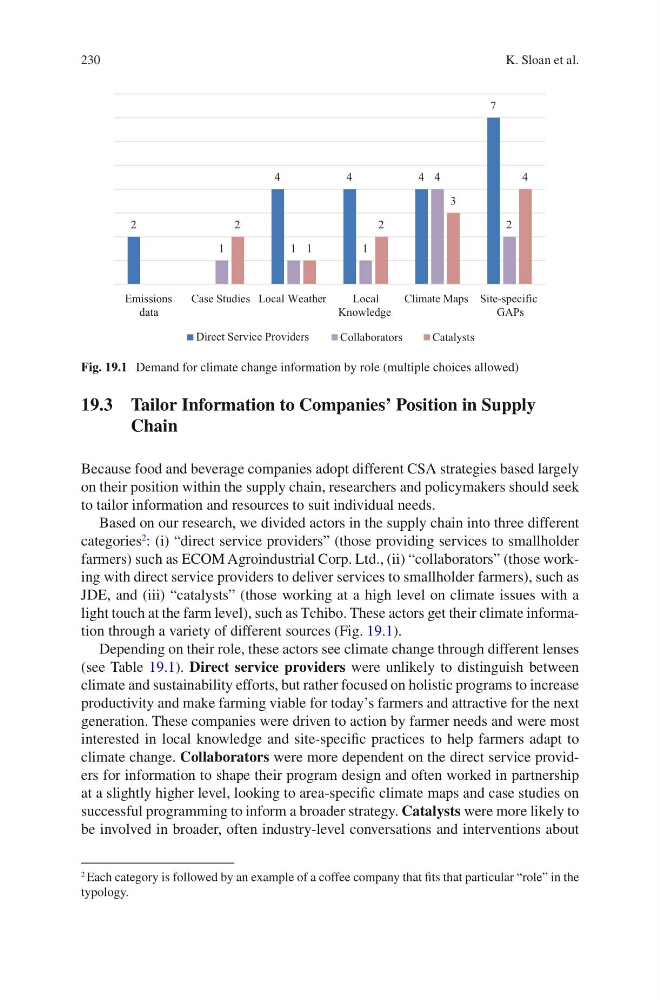
light touch at the farm level), such as Tchibo. These actors get their climate information through a variety of different sources (Fig. 19.1).
Depending on their role, these actors see climate change through different lenses
(see Table 19.1). Direct service providers were unlikely to distinguish between
climate and sustainability efforts, but rather focused on holistic programs to increase
productivity and make farming viable for today’s farmers and attractive for the next
generation. These companies were driven to action by farmer needs and were most
interested in local knowledge and site-specific practices to help farmers adapt to
climate change. Collaborators were more dependent on the direct service providers for information to shape their program design and often worked in partnership
at a slightly higher level, looking to area-specific climate maps and case studies on
successful programming to inform a broader strategy. Catalysts were more likely to
be involved in broader, often industry-level conversations and interventions about
2 Each category is followed by an example of a coffee company that fits that particular “role” in the
typology.
2
4
4
4
7
1
1
1
4
2
2
1
2
3
4
Emissions
data
Case Studies Local Weather
L ocal
Knowledge
Climate Maps Site-specific
GAPs
Collaborators
Catalysts
Direct Service Providers
Fig. 19.1 Demand for climate change information by role (multiple choices allowed)
K. Sloan et al.
19.3 Tailor Information to Companies’ Position in Supply
Chain
Because food and beverage companies adopt different CSA strategies based largely
on their position within the supply chain, researchers and policymakers should seek
to tailor information and resources to suit individual needs.
Based on our research, we divided actors in the supply chain into three different
categories
2
: (i) “direct service providers” (those providing services to smallholder
farmers) such as ECOM Agroindustrial Corp. Ltd., (ii) “collaborators” (those working with direct service providers to deliver services to smallholder farmers), such as
JDE, and (iii) “catalysts” (those working at a high level on climate issues with a
light touch at the farm level), such as Tchibo. These actors get their climate information through a variety of different sources (Fig. 19.1).
Depending on their role, these actors see climate change through different lenses
(see Table 19.1). Direct service providers were unlikely to distinguish between
climate and sustainability efforts, but rather focused on holistic programs to increase
productivity and make farming viable for today’s farmers and attractive for the next
generation. These companies were driven to action by farmer needs and were most
interested in local knowledge and site-specific practices to help farmers adapt to
climate change. Collaborators were more dependent on the direct service providers for information to shape their program design and often worked in partnership
at a slightly higher level, looking to area-specific climate maps and case studies on
successful programming to inform a broader strategy. Catalysts were more likely to
be involved in broader, often industry-level conversations and interventions about
2 Each category is followed by an example of a coffee company that fits that particular “role” in the
typology.
2
4
4
4
7
1
1
1
4
2
2
1
2
3
4
Emissions
data
Case Studies Local Weather
L ocal
Knowledge
Climate Maps Site-specific
GAPs
Collaborators
Catalysts
Direct Service Providers
Fig. 19.1 Demand for climate change information by role (multiple choices allowed)
K. Sloan et al.