

184
15.4 Implications for Development
This study assessed the drivers behind the adoption of stress-tolerant varieties and
their impact on farmers’ welfare. The results showed that household size, access to
agricultural information from NGOs, perception of future changes in climate, number of years’ resident in the village and asset index all have a positive influence on
the propensity to adopt stress-tolerant varieties. Further results show that stresstolerant varieties have the potential of increasing net crop income within a range of
USD 500–864 per hectare per year, corresponding to an 18–32% increase. Our
empirical results suggest the need to implement a bundled solution in scaling up the
adoption of stress-tolerant varieties. Specifically, a bundled solution that includes
the strengthened capacity of households to own farm assets and increased access to
agricultural and weather information (relying on pathways reinforced by trust and
social networks) can be effective for adaptation to climatic risks in northern Uganda.
The findings support the view that, in a similar way, CSA interventions are contextspecific as are the pathways for scaling up the adoption of these interventions.
Overall, in harmony with existing literature, the adoption of stress-tolerant varieties
as CSA technologies can be a corridor to improving the welfare of farm households
in northern Uganda.
Acknowledgements This work was carried out by the International Center for Tropical
Agriculture as part of the CGIAR Research Program on Climate Change, Agriculture and Food
Security. The project, Increasing Food Security and Farming System Resilience in East Africa
through Wide-Scale Adoption of Climate-Smart Agricultural Practices, is funded with support
from the International Fund for Agriculture Development.
References
Adepoju AO, Obayelu OA (2013) Livelihood diversification and welfare of rural households in
Ondo State. Nigeria J Dev Agricult Econ 5(12):482–489
Asayehegn GK, Temple L, Sanchez B et al (2017) Perception of climate change and farm level
adaptation choices in central Kenya. Cahiers Agricult 26(2):1–11
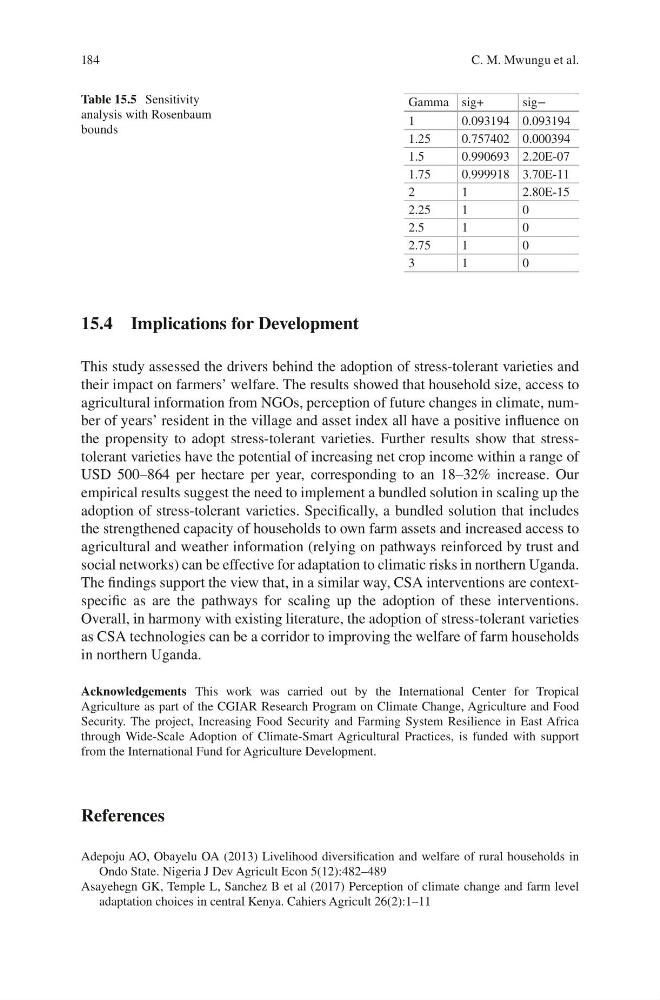
Table 15.5 Sensitivity
analysis with Rosenbaum
bounds
Gamma sig+
sig−
1
0.093194 0.093194
1.25
0.757402 0.000394
1.5
0.990693 2.20E-07
1.75
0.999918 3.70E-11
2
1
2.80E-15
2.25
1
0
2.5
1
0
2.75
1
0
3
1
0
C. M. Mwungu et al.
15.4 Implications for Development
This study assessed the drivers behind the adoption of stress-tolerant varieties and
their impact on farmers’ welfare. The results showed that household size, access to
agricultural information from NGOs, perception of future changes in climate, number of years’ resident in the village and asset index all have a positive influence on
the propensity to adopt stress-tolerant varieties. Further results show that stresstolerant varieties have the potential of increasing net crop income within a range of
USD 500–864 per hectare per year, corresponding to an 18–32% increase. Our
empirical results suggest the need to implement a bundled solution in scaling up the
adoption of stress-tolerant varieties. Specifically, a bundled solution that includes
the strengthened capacity of households to own farm assets and increased access to
agricultural and weather information (relying on pathways reinforced by trust and
social networks) can be effective for adaptation to climatic risks in northern Uganda.
The findings support the view that, in a similar way, CSA interventions are contextspecific as are the pathways for scaling up the adoption of these interventions.
Overall, in harmony with existing literature, the adoption of stress-tolerant varieties
as CSA technologies can be a corridor to improving the welfare of farm households
in northern Uganda.
Acknowledgements This work was carried out by the International Center for Tropical
Agriculture as part of the CGIAR Research Program on Climate Change, Agriculture and Food
Security. The project, Increasing Food Security and Farming System Resilience in East Africa
through Wide-Scale Adoption of Climate-Smart Agricultural Practices, is funded with support
from the International Fund for Agriculture Development.
References
Adepoju AO, Obayelu OA (2013) Livelihood diversification and welfare of rural households in
Ondo State. Nigeria J Dev Agricult Econ 5(12):482–489
Asayehegn GK, Temple L, Sanchez B et al (2017) Perception of climate change and farm level
adaptation choices in central Kenya. Cahiers Agricult 26(2):1–11
Table 15.5 Sensitivity
analysis with Rosenbaum
bounds
Gamma sig+
sig−
1
0.093194 0.093194
1.25
0.757402 0.000394
1.5
0.990693 2.20E-07
1.75
0.999918 3.70E-11
2
1
2.80E-15
2.25
1
0
2.5
1
0
2.75
1
0
3
1
0
C. M. Mwungu et al.