

157
Results of this intercropping experiment showed key challenges in understanding what is and isn’t CSA. Productivity in farmer-managed baby trials in three villages (Laikala, Mlali and Chitego) ranged from 1.2 to 3.2 t ha
−1
(>150%), suggesting
variations in site and weather conditions. Laikala and Mlali are lower potential sites
due to greater degradation while Chitego is a higher potential site for crop production (Kimaro et al. 2015). Overall, maize yield in baby trials across sites was 50%
higher than the farmer practice yield of 1.5 t ha
−1
in the same areas (Kimaro et al.
2012). However, productivity benefits were by no means universal across all planting arrangements and agroecologies. Apart from an intercropping combination—on
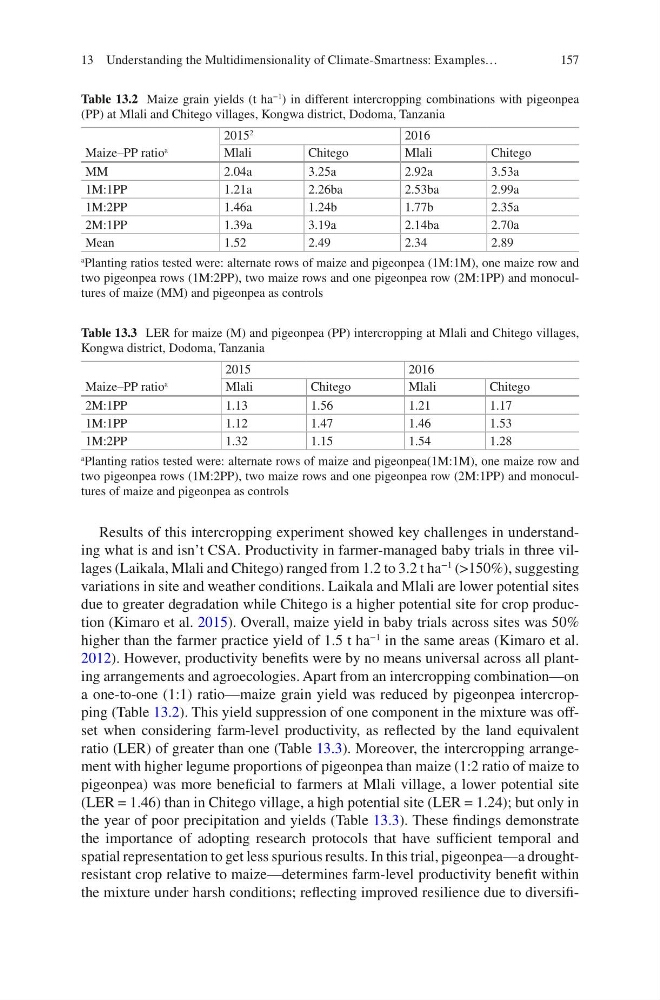
a one-to-one (1:1) ratio—maize grain yield was reduced by pigeonpea intercropping (Table 13.2). This yield suppression of one component in the mixture was offset when considering farm-level productivity, as reflected by the land equivalent
ratio (LER) of greater than one (Table 13.3). Moreover, the intercropping arrangement with higher legume proportions of pigeonpea than maize (1:2 ratio of maize to
pigeonpea) was more beneficial to farmers at Mlali village, a lower potential site
(LER = 1.46) than in Chitego village, a high potential site (LER = 1.24); but only in
the year of poor precipitation and yields (Table 13.3). These findings demonstrate
the importance of adopting research protocols that have sufficient temporal and
spatial representation to get less spurious results. In this trial, pigeonpea—a droughtresistant crop relative to maize—determines farm-level productivity benefit within
the mixture under harsh conditions; reflecting improved resilience due to diversifiTable 13.2 Maize grain yields (t ha
−1 ) in different intercropping combinations with pigeonpea
(PP) at Mlali and Chitego villages, Kongwa district, Dodoma, Tanzania
Maize–PP ratio
a
2015
2
2016
Mlali
Chitego
Mlali
Chitego
MM
2.04a
3.25a
2.92a
3.53a
1M:1PP
1.21a
2.26ba
2.53ba
2.99a
1M:2PP
1.46a
1.24b
1.77b
2.35a
2M:1PP
1.39a
3.19a
2.14ba
2.70a
Mean
1.52
2.49
2.34
2.89
a
Planting ratios tested were: alternate rows of maize and pigeonpea (1M:1M), one maize row and
two pigeonpea rows (1M:2PP), two maize rows and one pigeonpea row (2M:1PP) and monocultures of maize (MM) and pigeonpea as controls
Table 13.3 LER for maize (M) and pigeonpea (PP) intercropping at Mlali and Chitego villages,
Kongwa district, Dodoma, Tanzania
Maize–PP ratio
a
2015
2016
Mlali
Chitego
Mlali
Chitego
2M:1PP
1.13
1.56
1.21
1.17
1M:1PP
1.12
1.47
1.46
1.53
1M:2PP
1.32
1.15
1.54
1.28
a Planting ratios tested were: alternate rows of maize and pigeonpea(1M:1M), one maize row and
two pigeonpea rows (1M:2PP), two maize rows and one pigeonpea row (2M:1PP) and monocultures of maize and pigeonpea as controls
13 Understanding the Multidimensionality of Climate-Smartness: Examples…
Results of this intercropping experiment showed key challenges in understanding what is and isn’t CSA. Productivity in farmer-managed baby trials in three villages (Laikala, Mlali and Chitego) ranged from 1.2 to 3.2 t ha
−1
(>150%), suggesting
variations in site and weather conditions. Laikala and Mlali are lower potential sites
due to greater degradation while Chitego is a higher potential site for crop production (Kimaro et al. 2015). Overall, maize yield in baby trials across sites was 50%
higher than the farmer practice yield of 1.5 t ha
−1
in the same areas (Kimaro et al.
2012). However, productivity benefits were by no means universal across all planting arrangements and agroecologies. Apart from an intercropping combination—on
a one-to-one (1:1) ratio—maize grain yield was reduced by pigeonpea intercropping (Table 13.2). This yield suppression of one component in the mixture was offset when considering farm-level productivity, as reflected by the land equivalent
ratio (LER) of greater than one (Table 13.3). Moreover, the intercropping arrangement with higher legume proportions of pigeonpea than maize (1:2 ratio of maize to
pigeonpea) was more beneficial to farmers at Mlali village, a lower potential site
(LER = 1.46) than in Chitego village, a high potential site (LER = 1.24); but only in
the year of poor precipitation and yields (Table 13.3). These findings demonstrate
the importance of adopting research protocols that have sufficient temporal and
spatial representation to get less spurious results. In this trial, pigeonpea—a droughtresistant crop relative to maize—determines farm-level productivity benefit within
the mixture under harsh conditions; reflecting improved resilience due to diversifiTable 13.2 Maize grain yields (t ha
−1 ) in different intercropping combinations with pigeonpea
(PP) at Mlali and Chitego villages, Kongwa district, Dodoma, Tanzania
Maize–PP ratio
a
2015
2
2016
Mlali
Chitego
Mlali
Chitego
MM
2.04a
3.25a
2.92a
3.53a
1M:1PP
1.21a
2.26ba
2.53ba
2.99a
1M:2PP
1.46a
1.24b
1.77b
2.35a
2M:1PP
1.39a
3.19a
2.14ba
2.70a
Mean
1.52
2.49
2.34
2.89
a
Planting ratios tested were: alternate rows of maize and pigeonpea (1M:1M), one maize row and
two pigeonpea rows (1M:2PP), two maize rows and one pigeonpea row (2M:1PP) and monocultures of maize (MM) and pigeonpea as controls
Table 13.3 LER for maize (M) and pigeonpea (PP) intercropping at Mlali and Chitego villages,
Kongwa district, Dodoma, Tanzania
Maize–PP ratio
a
2015
2016
Mlali
Chitego
Mlali
Chitego
2M:1PP
1.13
1.56
1.21
1.17
1M:1PP
1.12
1.47
1.46
1.53
1M:2PP
1.32
1.15
1.54
1.28
a Planting ratios tested were: alternate rows of maize and pigeonpea(1M:1M), one maize row and
two pigeonpea rows (1M:2PP), two maize rows and one pigeonpea row (2M:1PP) and monocultures of maize and pigeonpea as controls
13 Understanding the Multidimensionality of Climate-Smartness: Examples…