

156
consumed 23% less firewood, which resulted in a reduction in fuelwood collection
time (32%) as well as cooking time (20%) (Uckert et al. 2017). However, firewood
and time consumption vary between different foods cooked (Hafner et al. 2018).
The reduction of GHG emissions (carbon monoxide, carbon dioxide and particulate
organic matter) by the ICS technology, relative to TSF, ranged from 60% to 62%
(Sererya 2016). The costs of fuelwood used in ICS and TSF in Dodoma is estimated
at Tanzanian Shilling (TZS) 15,984 (United States Dollar (USD) 7.2) and TZS
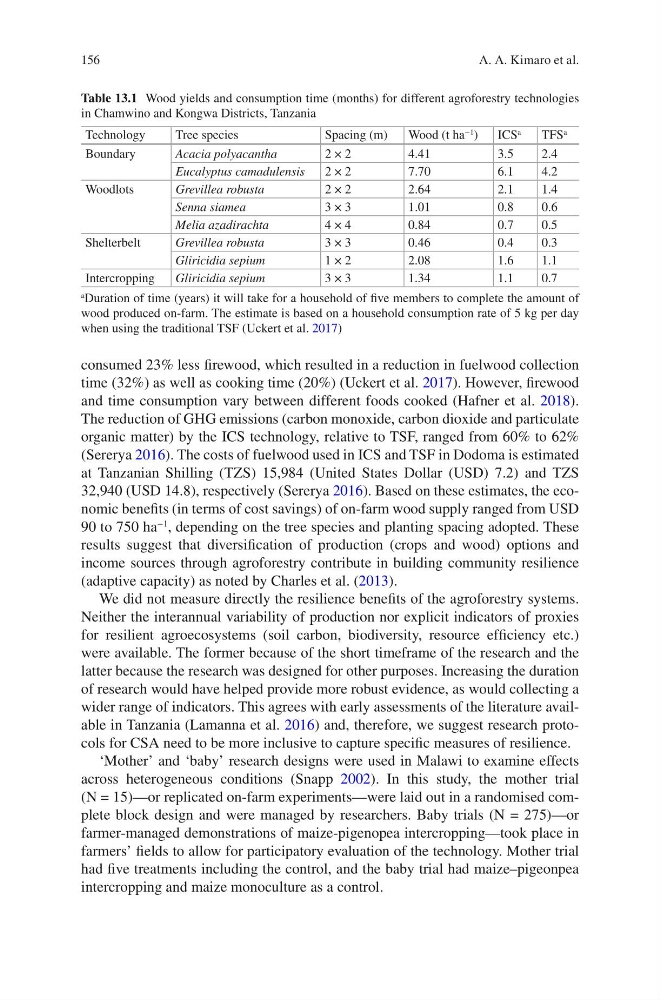
32,940 (USD 14.8), respectively (Sererya 2016). Based on these estimates, the economic benefits (in terms of cost savings) of on-farm wood supply ranged from USD
90 to 750 ha
−1
, depending on the tree species and planting spacing adopted. These
results suggest that diversification of production (crops and wood) options and
income sources through agroforestry contribute in building community resilience
(adaptive capacity) as noted by Charles et al. (2013).
We did not measure directly the resilience benefits of the agroforestry systems.
Neither the interannual variability of production nor explicit indicators of proxies
for resilient agroecosystems (soil carbon, biodiversity, resource efficiency etc.)
were available. The former because of the short timeframe of the research and the
latter because the research was designed for other purposes. Increasing the duration
of research would have helped provide more robust evidence, as would collecting a
wider range of indicators. This agrees with early assessments of the literature available in Tanzania (Lamanna et al. 2016) and, therefore, we suggest research protocols for CSA need to be more inclusive to capture specific measures of resilience.
‘Mother’ and ‘baby’ research designs were used in Malawi to examine effects
across heterogeneous conditions (Snapp 2002). In this study, the mother trial
(N = 15)—or replicated on-farm experiments—were laid out in a randomised complete block design and were managed by researchers. Baby trials (N = 275)—or
farmer-managed demonstrations of maize-pigenopea intercropping—took place in
farmers’ fields to allow for participatory evaluation of the technology. Mother trial
had five treatments including the control, and the baby trial had maize–pigeonpea
intercropping and maize monoculture as a control.
Table 13.1 Wood yields and consumption time (months) for different agroforestry technologies
in Chamwino and Kongwa Districts, Tanzania
Technology
Tree species
Spacing (m)
Wood (t ha
−1
)
ICS
a
TFS
a
Boundary
Acacia polyacantha
2 × 2
4.41
3.5
2.4
Eucalyptus camadulensis
2 × 2
7.70
6.1
4.2
Woodlots
Grevillea robusta
2 × 2
2.64
2.1
1.4
Senna siamea
3 × 3
1.01
0.8
0.6
Melia azadirachta
4 × 4
0.84
0.7
0.5
Shelterbelt
Grevillea robusta
3 × 3
0.46
0.4
0.3
Gliricidia sepium
1 × 2
2.08
1.6
1.1
Intercropping
Gliricidia sepium
3 × 3
1.34
1.1
0.7
a
Duration of time (years) it will take for a household of five members to complete the amount of
wood produced on-farm. The estimate is based on a household consumption rate of 5 kg per day
when using the traditional TSF (Uckert et al. 2017)
A. A. Kimaro et al.
consumed 23% less firewood, which resulted in a reduction in fuelwood collection
time (32%) as well as cooking time (20%) (Uckert et al. 2017). However, firewood
and time consumption vary between different foods cooked (Hafner et al. 2018).
The reduction of GHG emissions (carbon monoxide, carbon dioxide and particulate
organic matter) by the ICS technology, relative to TSF, ranged from 60% to 62%
(Sererya 2016). The costs of fuelwood used in ICS and TSF in Dodoma is estimated
at Tanzanian Shilling (TZS) 15,984 (United States Dollar (USD) 7.2) and TZS
32,940 (USD 14.8), respectively (Sererya 2016). Based on these estimates, the economic benefits (in terms of cost savings) of on-farm wood supply ranged from USD
90 to 750 ha
−1
, depending on the tree species and planting spacing adopted. These
results suggest that diversification of production (crops and wood) options and
income sources through agroforestry contribute in building community resilience
(adaptive capacity) as noted by Charles et al. (2013).
We did not measure directly the resilience benefits of the agroforestry systems.
Neither the interannual variability of production nor explicit indicators of proxies
for resilient agroecosystems (soil carbon, biodiversity, resource efficiency etc.)
were available. The former because of the short timeframe of the research and the
latter because the research was designed for other purposes. Increasing the duration
of research would have helped provide more robust evidence, as would collecting a
wider range of indicators. This agrees with early assessments of the literature available in Tanzania (Lamanna et al. 2016) and, therefore, we suggest research protocols for CSA need to be more inclusive to capture specific measures of resilience.
‘Mother’ and ‘baby’ research designs were used in Malawi to examine effects
across heterogeneous conditions (Snapp 2002). In this study, the mother trial
(N = 15)—or replicated on-farm experiments—were laid out in a randomised complete block design and were managed by researchers. Baby trials (N = 275)—or
farmer-managed demonstrations of maize-pigenopea intercropping—took place in
farmers’ fields to allow for participatory evaluation of the technology. Mother trial
had five treatments including the control, and the baby trial had maize–pigeonpea
intercropping and maize monoculture as a control.
Table 13.1 Wood yields and consumption time (months) for different agroforestry technologies
in Chamwino and Kongwa Districts, Tanzania
Technology
Tree species
Spacing (m)
Wood (t ha
−1
)
ICS
a
TFS
a
Boundary
Acacia polyacantha
2 × 2
4.41
3.5
2.4
Eucalyptus camadulensis
2 × 2
7.70
6.1
4.2
Woodlots
Grevillea robusta
2 × 2
2.64
2.1
1.4
Senna siamea
3 × 3
1.01
0.8
0.6
Melia azadirachta
4 × 4
0.84
0.7
0.5
Shelterbelt
Grevillea robusta
3 × 3
0.46
0.4
0.3
Gliricidia sepium
1 × 2
2.08
1.6
1.1
Intercropping
Gliricidia sepium
3 × 3
1.34
1.1
0.7
a
Duration of time (years) it will take for a household of five members to complete the amount of
wood produced on-farm. The estimate is based on a household consumption rate of 5 kg per day
when using the traditional TSF (Uckert et al. 2017)
A. A. Kimaro et al.