

146
are projected to decline with climate change in the region, especially in Malawi
(Ramirez-Villegas and Thornton 2015).
Existing evidence is also limited on integrated crop and livestock systems,
because 93% of the data were on crops while only 3.5% on livestock. Almost all of
the data on livestock were on improved diets, with a little on improved breeds. Some
of the most commonly mentioned regional livestock adaptation strategies, such as
pasture management technologies and animal housing, are absent from the data set.
This is an important gap to be filled as these technologies are also relevant for the
mitigation pillar of CSA.
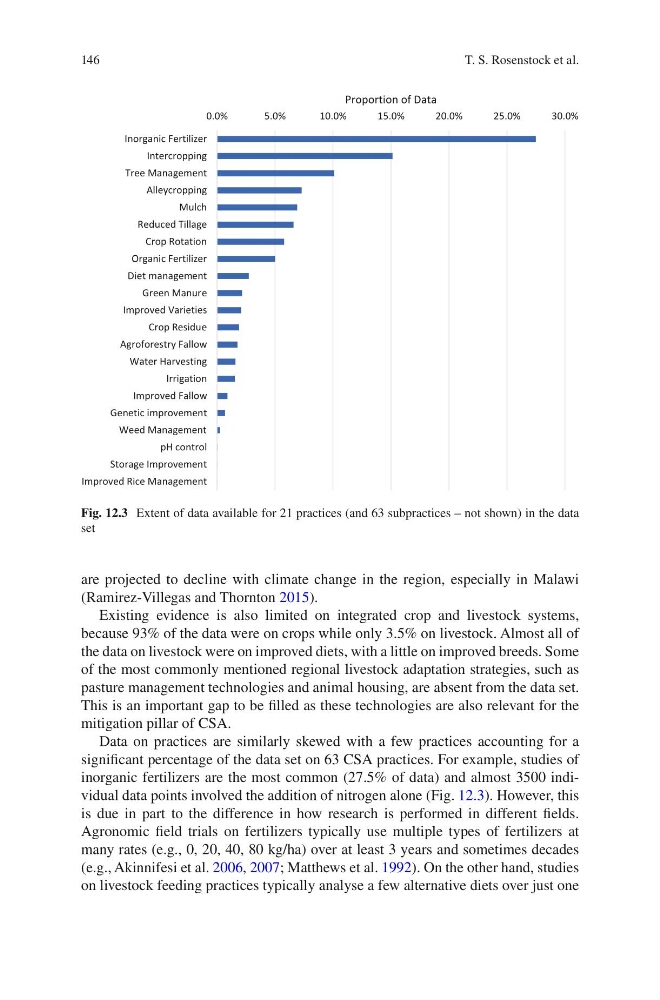
Data on practices are similarly skewed with a few practices accounting for a
significant percentage of the data set on 63 CSA practices. For example, studies of
inorganic fertilizers are the most common (27.5% of data) and almost 3500 individual data points involved the addition of nitrogen alone (Fig. 12.3). However, this
is due in part to the difference in how research is performed in different fields.
Agronomic field trials on fertilizers typically use multiple types of fertilizers at
many rates (e.g., 0, 20, 40, 80 kg/ha) over at least 3 years and sometimes decades
(e.g., Akinnifesi et al. 2006, 2007; Matthews et al. 1992). On the other hand, studies
on livestock feeding practices typically analyse a few alternative diets over just one
0.0%
5.0%
10.0%
15.0%
2 0.0%
25.0%
3 0.0%
Inorganic Fertilizer
Intercropping
Tree Management
Alleycropping
Mulch
Reduced Tillage
Crop Rotation
Organic Fertilizer
Diet management
Green Manure
Improved Varieties
Crop Residue
Agroforestry Fallow
Water Harvesting
Irrigation
Improved Fallow
Genetic improvement
Weed Management
pH control
Storage Improvement
Improved Rice Management
Proportion of Data
Fig. 12.3 Extent of data available for 21 practices (and 63 subpractices – not shown) in the data
set
T. S. Rosenstock et al.
are projected to decline with climate change in the region, especially in Malawi
(Ramirez-Villegas and Thornton 2015).
Existing evidence is also limited on integrated crop and livestock systems,
because 93% of the data were on crops while only 3.5% on livestock. Almost all of
the data on livestock were on improved diets, with a little on improved breeds. Some
of the most commonly mentioned regional livestock adaptation strategies, such as
pasture management technologies and animal housing, are absent from the data set.
This is an important gap to be filled as these technologies are also relevant for the
mitigation pillar of CSA.
Data on practices are similarly skewed with a few practices accounting for a
significant percentage of the data set on 63 CSA practices. For example, studies of
inorganic fertilizers are the most common (27.5% of data) and almost 3500 individual data points involved the addition of nitrogen alone (Fig. 12.3). However, this
is due in part to the difference in how research is performed in different fields.
Agronomic field trials on fertilizers typically use multiple types of fertilizers at
many rates (e.g., 0, 20, 40, 80 kg/ha) over at least 3 years and sometimes decades
(e.g., Akinnifesi et al. 2006, 2007; Matthews et al. 1992). On the other hand, studies
on livestock feeding practices typically analyse a few alternative diets over just one
0.0%
5.0%
10.0%
15.0%
2 0.0%
25.0%
3 0.0%
Inorganic Fertilizer
Intercropping
Tree Management
Alleycropping
Mulch
Reduced Tillage
Crop Rotation
Organic Fertilizer
Diet management
Green Manure
Improved Varieties
Crop Residue
Agroforestry Fallow
Water Harvesting
Irrigation
Improved Fallow
Genetic improvement
Weed Management
pH control
Storage Improvement
Improved Rice Management
Proportion of Data
Fig. 12.3 Extent of data available for 21 practices (and 63 subpractices – not shown) in the data
set
T. S. Rosenstock et al.