

123
10.5 Implications for Development
As African nations’ economies transform, as people move from the countryside to
the cities, and as new production, processing and communication technologies
develop, there are new opportunities to integrate perennial NOC into food systems.
These arise through new ways of processing and producing food and for informing
consumer choices, as well as through the greater incomes of at least some consumers (Dawson et al. 2018b). This integration of perennial NOC aligns closely with the
United Nations Sustainable Development Goals to reduce poverty, promote the
accessibility and use of nutritious foods, and contribute to the food security of growing cities.
In this paper, we have indicated for eastern and southern Africa how greater use
of perennial NOC foods could help support food system resilience at subnational
and national levels. We have also given examples of production-based interventions
to promote the integration of these crops into food systems that take account of
climate change. As well as supporting production improvements by better selection
and breeding through initiatives such as the AOCC, a focus on delivering planting
A) Current
B ) 2055 RCP 4.5
Uganda
Kenya
Tanzania
Uganda
Tanzania
Kenya
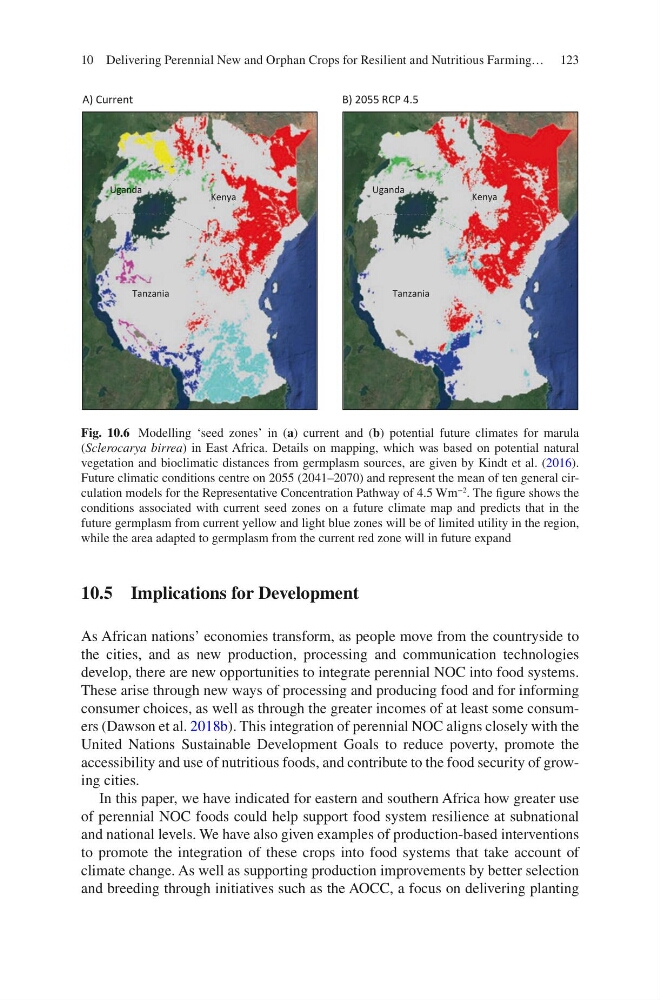
Fig. 10.6 Modelling ‘seed zones’ in (a) current and (b) potential future climates for marula
(Sclerocarya birrea) in East Africa. Details on mapping, which was based on potential natural
vegetation and bioclimatic distances from germplasm sources, are given by Kindt et al. (2016).
Future climatic conditions centre on 2055 (2041–2070) and represent the mean of ten general circulation models for the Representative Concentration Pathway of 4.5 Wm
−2
. The figure shows the
conditions associated with current seed zones on a future climate map and predicts that in the
future germplasm from current yellow and light blue zones will be of limited utility in the region,
while the area adapted to germplasm from the current red zone will in future expand
10 Delivering Perennial New and Orphan Crops for Resilient and Nutritious Farming…
10.5 Implications for Development
As African nations’ economies transform, as people move from the countryside to
the cities, and as new production, processing and communication technologies
develop, there are new opportunities to integrate perennial NOC into food systems.
These arise through new ways of processing and producing food and for informing
consumer choices, as well as through the greater incomes of at least some consumers (Dawson et al. 2018b). This integration of perennial NOC aligns closely with the
United Nations Sustainable Development Goals to reduce poverty, promote the
accessibility and use of nutritious foods, and contribute to the food security of growing cities.
In this paper, we have indicated for eastern and southern Africa how greater use
of perennial NOC foods could help support food system resilience at subnational
and national levels. We have also given examples of production-based interventions
to promote the integration of these crops into food systems that take account of
climate change. As well as supporting production improvements by better selection
and breeding through initiatives such as the AOCC, a focus on delivering planting
A) Current
B ) 2055 RCP 4.5
Uganda
Kenya
Tanzania
Uganda
Tanzania
Kenya
Fig. 10.6 Modelling ‘seed zones’ in (a) current and (b) potential future climates for marula
(Sclerocarya birrea) in East Africa. Details on mapping, which was based on potential natural
vegetation and bioclimatic distances from germplasm sources, are given by Kindt et al. (2016).
Future climatic conditions centre on 2055 (2041–2070) and represent the mean of ten general circulation models for the Representative Concentration Pathway of 4.5 Wm
−2
. The figure shows the
conditions associated with current seed zones on a future climate map and predicts that in the
future germplasm from current yellow and light blue zones will be of limited utility in the region,
while the area adapted to germplasm from the current red zone will in future expand
10 Delivering Perennial New and Orphan Crops for Resilient and Nutritious Farming…