

103
The TC plantlets are transferred to a screen-house to produce minitubers (G1) using
sand hydroponics or aeroponics. The minitubers are then planted in the field to produce G2 seed in standard seed sizes. The next phase in the seed production process
involves bulking tubers. After two to three generations of field multiplication, the
seed can be certified. In those countries without operational certification systems,
seed multipliers obtain starter material from the National Agricultural Research
System (NARS). Informal systems rely on seed multipliers multiplying certified
seed for an additional one or two seasons to make quality seed locally available to
farmers (Fig. 9.1).
The seed potato planting rate is 2 t/ha and seeds are often sold at farm gates,
which means the expansion of improved seed systems is vital to ensuring farmers
can access quality seed. Agro-dealers do not distribute seed potato due to its bulk
and perishability, and few businesses have invested in certified seed because of high
resource and human capacity requirements. To fill the gap in the supply of quality
seed at the local level, informal seed multipliers (ISM) are now beginning to
diversify.
9.3.1.3 Diversifying Seed Potato Systems
The supply of certified seed in Kenya is limited, therefore many farmers use unmarketable ware potatoes as seed, which they source either on farm or from local markets. This perpetuates the cycle of low yields, as there is no input of quality seed to
flush out the diseased (Bentley et al. 2016). To improve localised access to quality
seed, ISM in four Kenyan counties (Elgeyo-Marakwet, Nandi, Meru and Uasin
Gishu counties) were trained in seed potato multiplication, quality control and
record keeping, to support their seed production businesses. The ISMs invested in
certified seed potato as starter material which would then multiply. Their transport
costs were covered initially, and reduced as the ISM’s businesses developed.
In the first 18 months, 220 ISM sold 322 tonnes of quality seed, enough for 1700
farmers to plant 160 ha. The ISM’s mean gross margins over three seasons of seed
potato sales ranged from 2000 to 4000 USD/ha (International Potato Center 2017c).
Establishing these ISM seed businesses also greatly benefitted the farmers, who
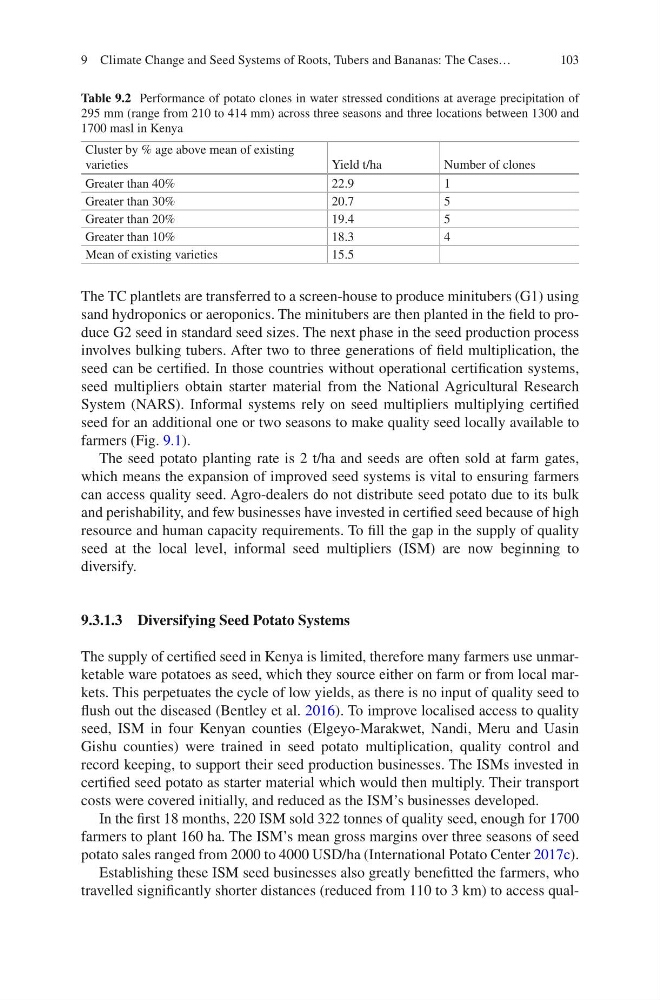
travelled significantly shorter distances (reduced from 110 to 3 km) to access qualTable 9.2 Performance of potato clones in water stressed conditions at average precipitation of
295 mm (range from 210 to 414 mm) across three seasons and three locations between 1300 and
1700 masl in Kenya
Cluster by % age above mean of existing
varieties
Yield t/ha
Number of clones
Greater than 40%
22.9
1
Greater than 30%
20.7
5
Greater than 20%
19.4
5
Greater than 10%
18.3
4
Mean of existing varieties
15.5
9 Climate Change and Seed Systems of Roots, Tubers and Bananas: The Cases…
The TC plantlets are transferred to a screen-house to produce minitubers (G1) using
sand hydroponics or aeroponics. The minitubers are then planted in the field to produce G2 seed in standard seed sizes. The next phase in the seed production process
involves bulking tubers. After two to three generations of field multiplication, the
seed can be certified. In those countries without operational certification systems,
seed multipliers obtain starter material from the National Agricultural Research
System (NARS). Informal systems rely on seed multipliers multiplying certified
seed for an additional one or two seasons to make quality seed locally available to
farmers (Fig. 9.1).
The seed potato planting rate is 2 t/ha and seeds are often sold at farm gates,
which means the expansion of improved seed systems is vital to ensuring farmers
can access quality seed. Agro-dealers do not distribute seed potato due to its bulk
and perishability, and few businesses have invested in certified seed because of high
resource and human capacity requirements. To fill the gap in the supply of quality
seed at the local level, informal seed multipliers (ISM) are now beginning to
diversify.
9.3.1.3 Diversifying Seed Potato Systems
The supply of certified seed in Kenya is limited, therefore many farmers use unmarketable ware potatoes as seed, which they source either on farm or from local markets. This perpetuates the cycle of low yields, as there is no input of quality seed to
flush out the diseased (Bentley et al. 2016). To improve localised access to quality
seed, ISM in four Kenyan counties (Elgeyo-Marakwet, Nandi, Meru and Uasin
Gishu counties) were trained in seed potato multiplication, quality control and
record keeping, to support their seed production businesses. The ISMs invested in
certified seed potato as starter material which would then multiply. Their transport
costs were covered initially, and reduced as the ISM’s businesses developed.
In the first 18 months, 220 ISM sold 322 tonnes of quality seed, enough for 1700
farmers to plant 160 ha. The ISM’s mean gross margins over three seasons of seed
potato sales ranged from 2000 to 4000 USD/ha (International Potato Center 2017c).
Establishing these ISM seed businesses also greatly benefitted the farmers, who
travelled significantly shorter distances (reduced from 110 to 3 km) to access qualTable 9.2 Performance of potato clones in water stressed conditions at average precipitation of
295 mm (range from 210 to 414 mm) across three seasons and three locations between 1300 and
1700 masl in Kenya
Cluster by % age above mean of existing
varieties
Yield t/ha
Number of clones
Greater than 40%
22.9
1
Greater than 30%
20.7
5
Greater than 20%
19.4
5
Greater than 10%
18.3
4
Mean of existing varieties
15.5
9 Climate Change and Seed Systems of Roots, Tubers and Bananas: The Cases…