

Atomic Force Microscopy-Based Force Spectroscopy …
589
raise in cantilever deflection and the repulsive contact force. Subsequently, adhesive
forces keep the tip in contact with the sample surface during the retraction of tip from
the sample surface. Just like ‘jump into contact’ which is very important feature of
approach curve, during retraction also, whenever the vertical motion of the cantilever
overcomes adhesive forces between the tip and sample, this bond gets broken and the
tip moves away from the sample (sometimes also termed as ‘jump off contact’). The
force-distance curves in liquid medium also shows similar features based on the same
guiding principle as for the curves in air. However, the approach curve exhibits the
different shape of curvature, which represented the subtle increment in the strength
and making it extremely hard to set up the ‘jump into contact’ point. This happens
because the minimum deflection of the cantilever results from the initial compression
of the surface. Ultimately, the delay on the response of the system revealed, while
the repulsive forces remove the contact between the tip and the sample surface. The
elasticity of the sample or the effect of long-range forces might be the reason for
such delay, which results in different force curve responses [8, 9].
3 Types of Forces
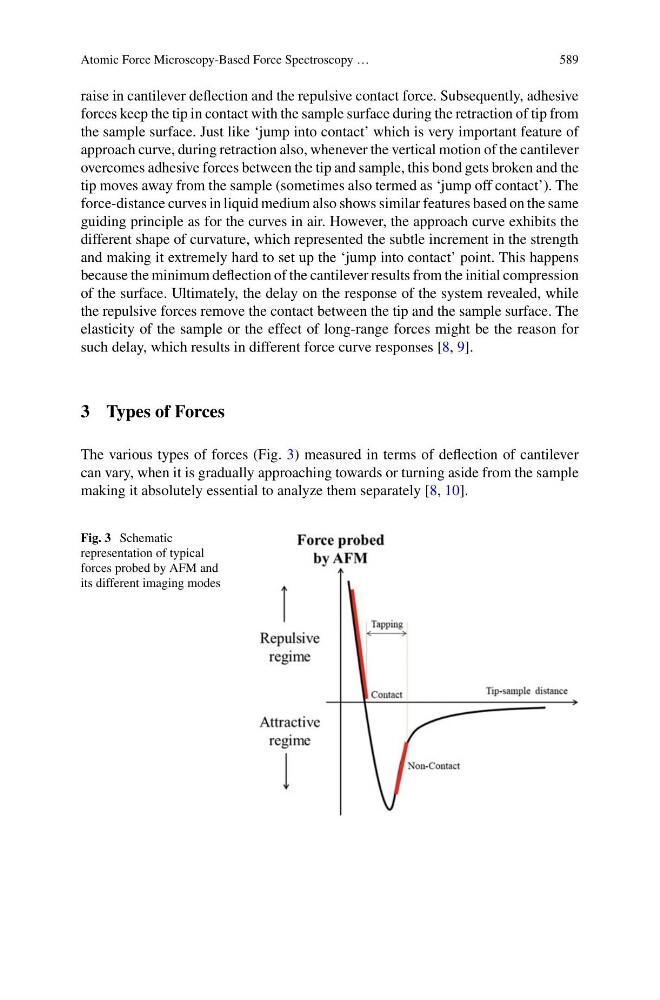
The various types of forces (Fig. 3) measured in terms of deflection of cantilever
can vary, when it is gradually approaching towards or turning aside from the sample
making it absolutely essential to analyze them separately [8, 10].
Fig. 3 Schematic
representation of typical
forces probed by AFM and
its different imaging modes
589
raise in cantilever deflection and the repulsive contact force. Subsequently, adhesive
forces keep the tip in contact with the sample surface during the retraction of tip from
the sample surface. Just like ‘jump into contact’ which is very important feature of
approach curve, during retraction also, whenever the vertical motion of the cantilever
overcomes adhesive forces between the tip and sample, this bond gets broken and the
tip moves away from the sample (sometimes also termed as ‘jump off contact’). The
force-distance curves in liquid medium also shows similar features based on the same
guiding principle as for the curves in air. However, the approach curve exhibits the
different shape of curvature, which represented the subtle increment in the strength
and making it extremely hard to set up the ‘jump into contact’ point. This happens
because the minimum deflection of the cantilever results from the initial compression
of the surface. Ultimately, the delay on the response of the system revealed, while
the repulsive forces remove the contact between the tip and the sample surface. The
elasticity of the sample or the effect of long-range forces might be the reason for
such delay, which results in different force curve responses [8, 9].
3 Types of Forces
The various types of forces (Fig. 3) measured in terms of deflection of cantilever
can vary, when it is gradually approaching towards or turning aside from the sample
making it absolutely essential to analyze them separately [8, 10].
Fig. 3 Schematic
representation of typical
forces probed by AFM and
its different imaging modes