

Ellipsometry Techniques and Its Advanced Applications …
551
is capable of obtaining all the Stokes vectors in a single measurement. In addition, RCE shows wavelength dependence due to light wavelength dependence of its
compensator.
2.2.3 Phase-Modulation Ellipsometry (PME)
In this configuration, the compensator is replaced with a photoelastic modulator
(PEM) in front of an analyzer [3]. In PME, all the Stokes vectors can be obtained
by carrying at least two measurements due to presence of two distinct optical
configurations.
2.2.4 Infrared Ellipsometry
Infrared ellipsometry is used to characterize various IR vibrations (viz. local vibration
modes and photon modes including LO/TO phonons). IR ellipsometer has a light
source based on Fourier-transform infrared spectrometer (FTIR) along with RAE
and RCE configurations [3]. A light source and Michelson interferometer are the
main components of a FTIR.
2.2.5 Generalized Ellipsometry
It is a special mode of ellipsometry where polarization of light is achieved at different
angles to extract more details of a specimen upon measuring reflection in comparison to measurements carried out using single polarization state. In order to get an
idea about generalized ellipsometry (GE), it is essential to perceive the operational
principle of normal ellipsometry. In ellipsometry, a specimen is illuminated with sand p-polarized lights at a specific angle of incidence (Brewster angle) where the
sensitivity of measurement (i.e. the difference between the reflection coefficients
corresponding to s- and p-polarized lights) is observed to be maximum [16]. The
difference between the amplitude of reflection coefficients corresponding to s- and
p-polarized lights is aroused due to a significant difference in their electric dipole
radiation. Ellipsometry observes a variation in the amplitude and phase of reflected
light in terms of the amplitude ratio (Ψ ) and phase difference (Δ) between p- and
s-polarization, respectively for before and after their reflection measurements. For a
homogeneous specimen, refractive index and extinction coefficients can be directly
calculated with measured (Ψ , Δ) values by using Fresnel’s equations [17]. The
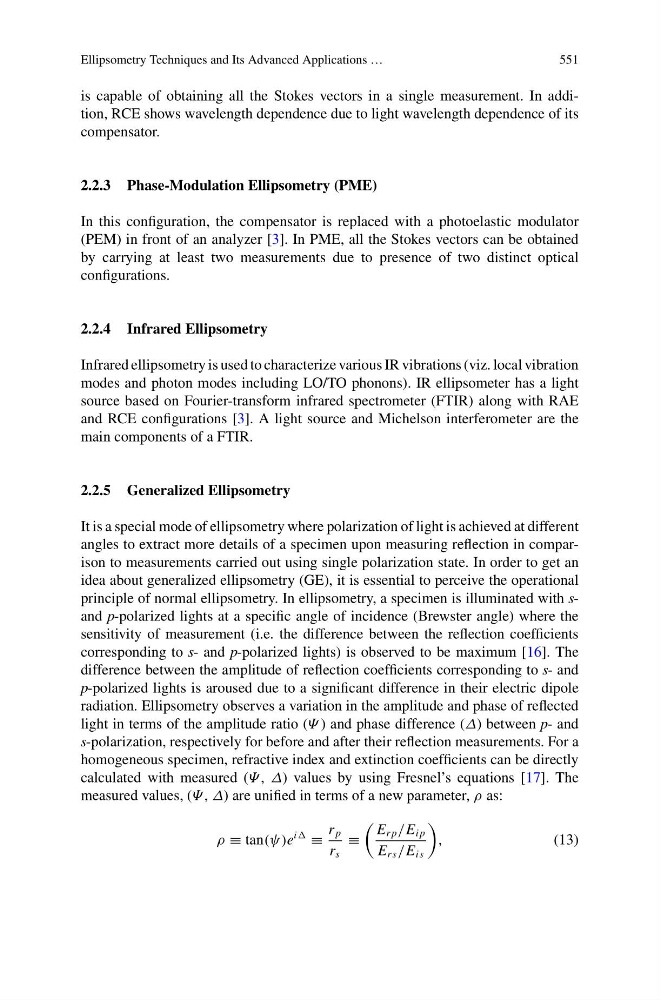
measured values, (Ψ , Δ) are unified in terms of a new parameter, ρ as:
ρ ≡ tan(ψ)e
i
≡
r p
r s
≡
E r p /E i p
E rs /E is
,
(13)
551
is capable of obtaining all the Stokes vectors in a single measurement. In addition, RCE shows wavelength dependence due to light wavelength dependence of its
compensator.
2.2.3 Phase-Modulation Ellipsometry (PME)
In this configuration, the compensator is replaced with a photoelastic modulator
(PEM) in front of an analyzer [3]. In PME, all the Stokes vectors can be obtained
by carrying at least two measurements due to presence of two distinct optical
configurations.
2.2.4 Infrared Ellipsometry
Infrared ellipsometry is used to characterize various IR vibrations (viz. local vibration
modes and photon modes including LO/TO phonons). IR ellipsometer has a light
source based on Fourier-transform infrared spectrometer (FTIR) along with RAE
and RCE configurations [3]. A light source and Michelson interferometer are the
main components of a FTIR.
2.2.5 Generalized Ellipsometry
It is a special mode of ellipsometry where polarization of light is achieved at different
angles to extract more details of a specimen upon measuring reflection in comparison to measurements carried out using single polarization state. In order to get an
idea about generalized ellipsometry (GE), it is essential to perceive the operational
principle of normal ellipsometry. In ellipsometry, a specimen is illuminated with sand p-polarized lights at a specific angle of incidence (Brewster angle) where the
sensitivity of measurement (i.e. the difference between the reflection coefficients
corresponding to s- and p-polarized lights) is observed to be maximum [16]. The
difference between the amplitude of reflection coefficients corresponding to s- and
p-polarized lights is aroused due to a significant difference in their electric dipole
radiation. Ellipsometry observes a variation in the amplitude and phase of reflected
light in terms of the amplitude ratio (Ψ ) and phase difference (Δ) between p- and
s-polarization, respectively for before and after their reflection measurements. For a
homogeneous specimen, refractive index and extinction coefficients can be directly
calculated with measured (Ψ , Δ) values by using Fresnel’s equations [17]. The
measured values, (Ψ , Δ) are unified in terms of a new parameter, ρ as:
ρ ≡ tan(ψ)e
i
≡
r p
r s
≡
E r p /E i p
E rs /E is
,
(13)