

546
M. Saini et al.
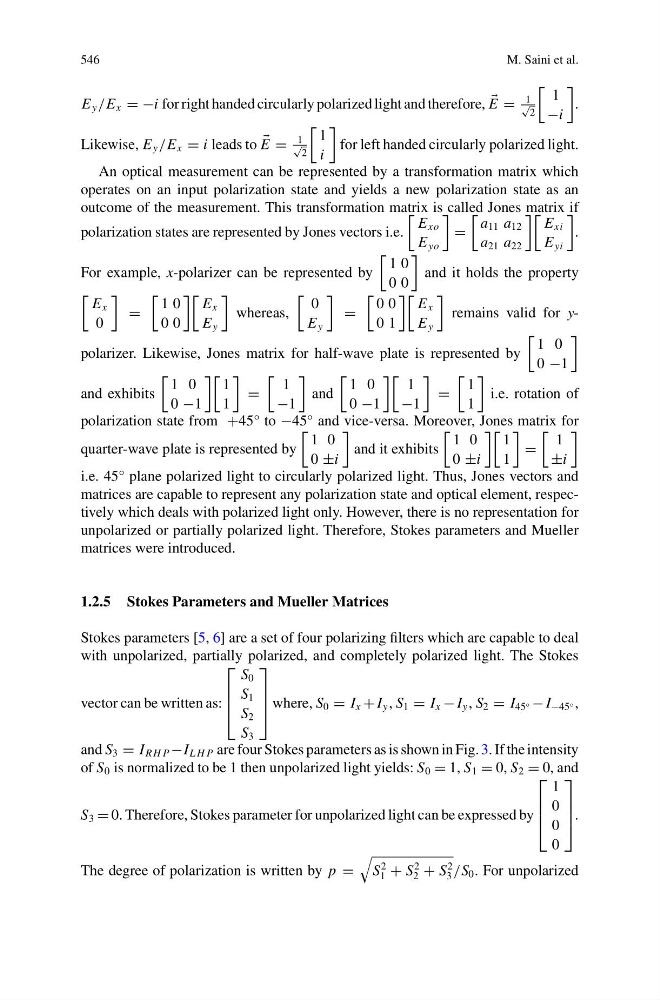
E y /E x = −i for right handed circularly polarized light and therefore,
E =
1
√
2
1
−i
.
Likewise, E y /E x = i leads to
E =
1
√
2
1
i
for left handed circularly polarized light.
An optical measurement can be represented by a transformation matrix which
operates on an input polarization state and yields a new polarization state as an
outcome of the measurement. This transformation matrix is called Jones matrix if
polarization states are represented by Jones vectors i.e.
E xo
E yo
=
a 11 a 12
a 21 a 22
E xi
E yi
.
For example, x-polarizer can be represented by
1 0
0 0
and it holds the property
E x
0
=
1 0
0 0
E x
E y
whereas,
0
E y
=
0 0
0 1
E x
E y
remains valid for ypolarizer. Likewise, Jones matrix for half-wave plate is represented by
1 0
0 −1
and exhibits
1 0
0 −1
1
1
=
1
−1
and
1 0
0 −1
1
−1
=
1
1
i.e. rotation of
polarization state from +45° to −45° and vice-versa. Moreover, Jones matrix for
quarter-wave plate is represented by
1 0
0 ±i
and it exhibits
1 0
0 ±i
1
1
=
1
±i
i.e. 45° plane polarized light to circularly polarized light. Thus, Jones vectors and
matrices are capable to represent any polarization state and optical element, respectively which deals with polarized light only. However, there is no representation for
unpolarized or partially polarized light. Therefore, Stokes parameters and Mueller
matrices were introduced.
1.2.5 Stokes Parameters and Mueller Matrices
Stokes parameters [5, 6] are a set of four polarizing filters which are capable to deal
with unpolarized, partially polarized, and completely polarized light. The Stokes
vector can be written as:
⎡
⎢
⎢
⎣
S 0
S 1
S 2
S 3
⎤
⎥
⎥
⎦ where, S 0 = I x + I y , S 1 = I x − I y , S 2 = I 45 ◦ − I −45 ◦ ,
and S 3 = I R H P −I L H P are four Stokes parameters as is shown in Fig. 3. If the intensity
of S 0 is normalized to be 1 then unpolarized light yields: S 0 = 1, S 1 = 0, S 2 = 0, and
S 3 = 0. Therefore, Stokes parameter for unpolarized light can be expressed by
⎡
⎢
⎢
⎣
1
0
0
0
⎤
⎥
⎥
⎦ .
The degree of polarization is written by p =
S
2
1 + S
2
2 + S
2
3 /S 0 . For unpolarized
M. Saini et al.
E y /E x = −i for right handed circularly polarized light and therefore,
E =
1
√
2
1
−i
.
Likewise, E y /E x = i leads to
E =
1
√
2
1
i
for left handed circularly polarized light.
An optical measurement can be represented by a transformation matrix which
operates on an input polarization state and yields a new polarization state as an
outcome of the measurement. This transformation matrix is called Jones matrix if
polarization states are represented by Jones vectors i.e.
E xo
E yo
=
a 11 a 12
a 21 a 22
E xi
E yi
.
For example, x-polarizer can be represented by
1 0
0 0
and it holds the property
E x
0
=
1 0
0 0
E x
E y
whereas,
0
E y
=
0 0
0 1
E x
E y
remains valid for ypolarizer. Likewise, Jones matrix for half-wave plate is represented by
1 0
0 −1
and exhibits
1 0
0 −1
1
1
=
1
−1
and
1 0
0 −1
1
−1
=
1
1
i.e. rotation of
polarization state from +45° to −45° and vice-versa. Moreover, Jones matrix for
quarter-wave plate is represented by
1 0
0 ±i
and it exhibits
1 0
0 ±i
1
1
=
1
±i
i.e. 45° plane polarized light to circularly polarized light. Thus, Jones vectors and
matrices are capable to represent any polarization state and optical element, respectively which deals with polarized light only. However, there is no representation for
unpolarized or partially polarized light. Therefore, Stokes parameters and Mueller
matrices were introduced.
1.2.5 Stokes Parameters and Mueller Matrices
Stokes parameters [5, 6] are a set of four polarizing filters which are capable to deal
with unpolarized, partially polarized, and completely polarized light. The Stokes
vector can be written as:
⎡
⎢
⎢
⎣
S 0
S 1
S 2
S 3
⎤
⎥
⎥
⎦ where, S 0 = I x + I y , S 1 = I x − I y , S 2 = I 45 ◦ − I −45 ◦ ,
and S 3 = I R H P −I L H P are four Stokes parameters as is shown in Fig. 3. If the intensity
of S 0 is normalized to be 1 then unpolarized light yields: S 0 = 1, S 1 = 0, S 2 = 0, and
S 3 = 0. Therefore, Stokes parameter for unpolarized light can be expressed by
⎡
⎢
⎢
⎣
1
0
0
0
⎤
⎥
⎥
⎦ .
The degree of polarization is written by p =
S
2
1 + S
2
2 + S
2
3 /S 0 . For unpolarized