

528
N. Yadav and R. Dhar
where, τ (= 1/ f c ) is the relaxation time. f c is the critical (or relaxation) frequency
at which dielectric loss reaches its maximum value. δε = ε(0)– ε(∞) is dielectric
increment. The permittivity has two borderline values: (1) when f → 0, then ε
≡
ε(0) is the static permittivity (also known as dielectric constant) and (2) when f
→ ∞, then ε
≡ ε(∞) is the limiting value of permittivity at high frequency. ε
is
equal to ε(∞) for non-polar compounds and lies in the range from 100 to 10
13 Hz
in the far infrared region. While, liquid crystals (LCs) and plastic crystals which
are polar materials show dielectric absorption in the microwave or radio frequency
region because of the reorientation of the permanent dipole moment. In circuit form,
this response includes a capacitance (ε(∞)C) which is connected in parallel to a
series combination of resistor (R) and capacitor (C s ≡ δεC). The capacitor stores
charge while the resistor models dissipative properties. τ, the relaxation time or time
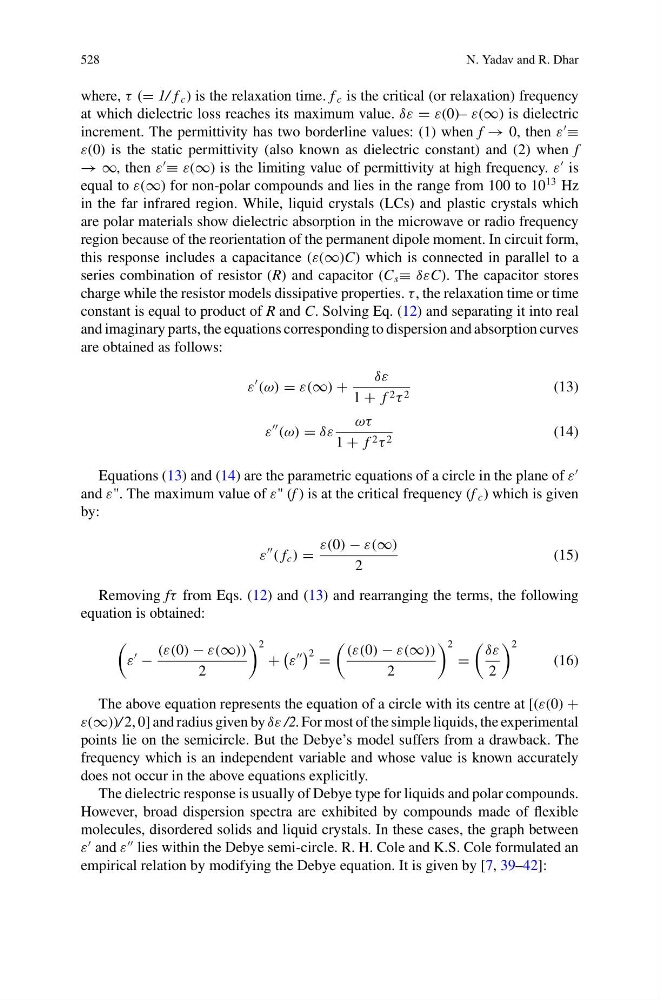
constant is equal to product of R and C. Solving Eq. (12) and separating it into real
and imaginary parts, the equations corresponding to dispersion and absorption curves
are obtained as follows:
ε
(ω) = ε(∞) +
δε
1 + f 2 τ 2
(13)
ε
(ω) = δε
ωτ
1 + f 2 τ 2
(14)
Equations (13) and (14) are the parametric equations of a circle in the plane of ε
and ε". The maximum value of ε" (f ) is at the critical frequency (f c ) which is given
by:
ε
( f c ) =
ε(0) − ε(∞)
2
(15)
Removing fτ from Eqs. (12) and (13) and rearranging the terms, the following
equation is obtained:
ε
−
(ε(0) − ε(∞))
2
2
+
ε
2 =
(ε(0) − ε(∞))
2
2
=
δε
2
2
(16)
The above equation represents the equation of a circle with its centre at [(ε(0) +
ε(∞))/ 2, 0] and radius given by δε /2. For most of the simple liquids, the experimental
points lie on the semicircle. But the Debye’s model suffers from a drawback. The
frequency which is an independent variable and whose value is known accurately
does not occur in the above equations explicitly.
The dielectric response is usually of Debye type for liquids and polar compounds.
However, broad dispersion spectra are exhibited by compounds made of flexible
molecules, disordered solids and liquid crystals. In these cases, the graph between
ε
and ε
lies within the Debye semi-circle. R. H. Cole and K.S. Cole formulated an
empirical relation by modifying the Debye equation. It is given by [7, 39–42]:
N. Yadav and R. Dhar
where, τ (= 1/ f c ) is the relaxation time. f c is the critical (or relaxation) frequency
at which dielectric loss reaches its maximum value. δε = ε(0)– ε(∞) is dielectric
increment. The permittivity has two borderline values: (1) when f → 0, then ε
≡
ε(0) is the static permittivity (also known as dielectric constant) and (2) when f
→ ∞, then ε
≡ ε(∞) is the limiting value of permittivity at high frequency. ε
is
equal to ε(∞) for non-polar compounds and lies in the range from 100 to 10
13 Hz
in the far infrared region. While, liquid crystals (LCs) and plastic crystals which
are polar materials show dielectric absorption in the microwave or radio frequency
region because of the reorientation of the permanent dipole moment. In circuit form,
this response includes a capacitance (ε(∞)C) which is connected in parallel to a
series combination of resistor (R) and capacitor (C s ≡ δεC). The capacitor stores
charge while the resistor models dissipative properties. τ, the relaxation time or time
constant is equal to product of R and C. Solving Eq. (12) and separating it into real
and imaginary parts, the equations corresponding to dispersion and absorption curves
are obtained as follows:
ε
(ω) = ε(∞) +
δε
1 + f 2 τ 2
(13)
ε
(ω) = δε
ωτ
1 + f 2 τ 2
(14)
Equations (13) and (14) are the parametric equations of a circle in the plane of ε
and ε". The maximum value of ε" (f ) is at the critical frequency (f c ) which is given
by:
ε
( f c ) =
ε(0) − ε(∞)
2
(15)
Removing fτ from Eqs. (12) and (13) and rearranging the terms, the following
equation is obtained:
ε
−
(ε(0) − ε(∞))
2
2
+
ε
2 =
(ε(0) − ε(∞))
2
2
=
δε
2
2
(16)
The above equation represents the equation of a circle with its centre at [(ε(0) +
ε(∞))/ 2, 0] and radius given by δε /2. For most of the simple liquids, the experimental
points lie on the semicircle. But the Debye’s model suffers from a drawback. The
frequency which is an independent variable and whose value is known accurately
does not occur in the above equations explicitly.
The dielectric response is usually of Debye type for liquids and polar compounds.
However, broad dispersion spectra are exhibited by compounds made of flexible
molecules, disordered solids and liquid crystals. In these cases, the graph between
ε
and ε
lies within the Debye semi-circle. R. H. Cole and K.S. Cole formulated an
empirical relation by modifying the Debye equation. It is given by [7, 39–42]: