

Impedance Spectroscopy
521
Table 1 The relationship between the four immittance functions
Z
Y
ε
M
Z
Z
Y −1
( jωC 0 )
−1 ε −1
( jωC 0 )
−1 M
Y
Z −1
Y
jωC 0 ε
j ωC 0 M −1
ε
( jωC 0 )
−1 Z −1
( jωC 0 )
−1 Y
ε
M −1
M
jωC 0 Z
jωC 0 Y −1
ε −1
M
IS is also known as immittance spectroscopy since it contains other important
immittance functions apart from impedance as discussed above. The complex quantity ε
* (f ) is measured and utilized for dielectric materials which indicate very low
or zero conductivity. All other quantities are important since they exhibit different
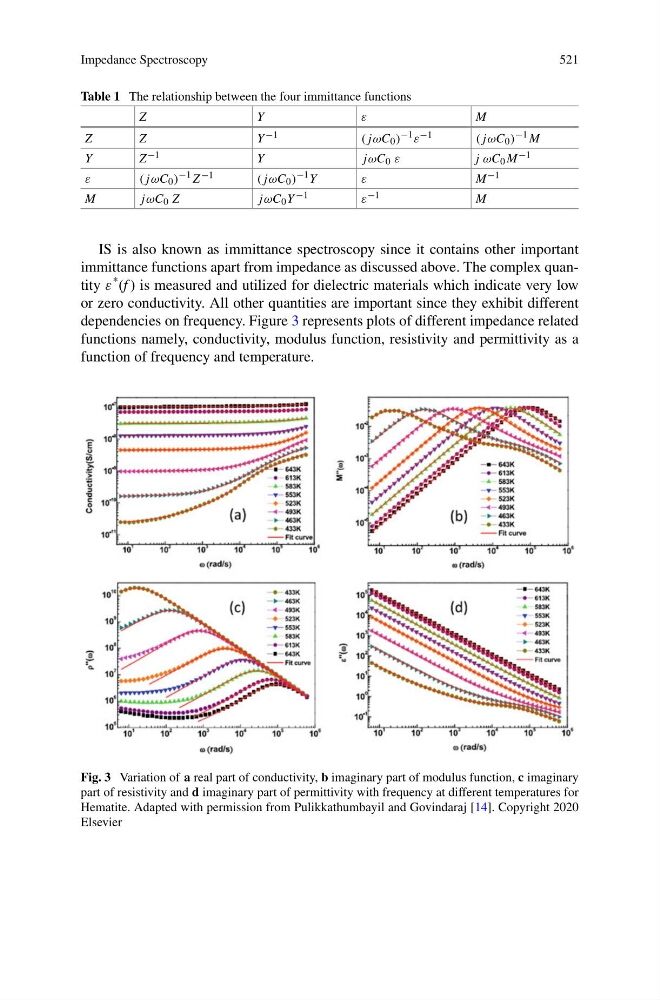
dependencies on frequency. Figure 3 represents plots of different impedance related
functions namely, conductivity, modulus function, resistivity and permittivity as a
function of frequency and temperature.
Fig. 3 Variation of a real part of conductivity, b imaginary part of modulus function, c imaginary
part of resistivity and d imaginary part of permittivity with frequency at different temperatures for
Hematite. Adapted with permission from Pulikkathumbayil and Govindaraj [14]. Copyright 2020
Elsevier
521
Table 1 The relationship between the four immittance functions
Z
Y
ε
M
Z
Z
Y −1
( jωC 0 )
−1 ε −1
( jωC 0 )
−1 M
Y
Z −1
Y
jωC 0 ε
j ωC 0 M −1
ε
( jωC 0 )
−1 Z −1
( jωC 0 )
−1 Y
ε
M −1
M
jωC 0 Z
jωC 0 Y −1
ε −1
M
IS is also known as immittance spectroscopy since it contains other important
immittance functions apart from impedance as discussed above. The complex quantity ε
* (f ) is measured and utilized for dielectric materials which indicate very low
or zero conductivity. All other quantities are important since they exhibit different
dependencies on frequency. Figure 3 represents plots of different impedance related
functions namely, conductivity, modulus function, resistivity and permittivity as a
function of frequency and temperature.
Fig. 3 Variation of a real part of conductivity, b imaginary part of modulus function, c imaginary
part of resistivity and d imaginary part of permittivity with frequency at different temperatures for
Hematite. Adapted with permission from Pulikkathumbayil and Govindaraj [14]. Copyright 2020
Elsevier