

504
M. Rashid et al.
carbonic hydroxyapatite (HAP) [53]. We just take the sample, cut in the shape of
rotor or make powder and pack it inside ssNMR rotor and experiments are recorded
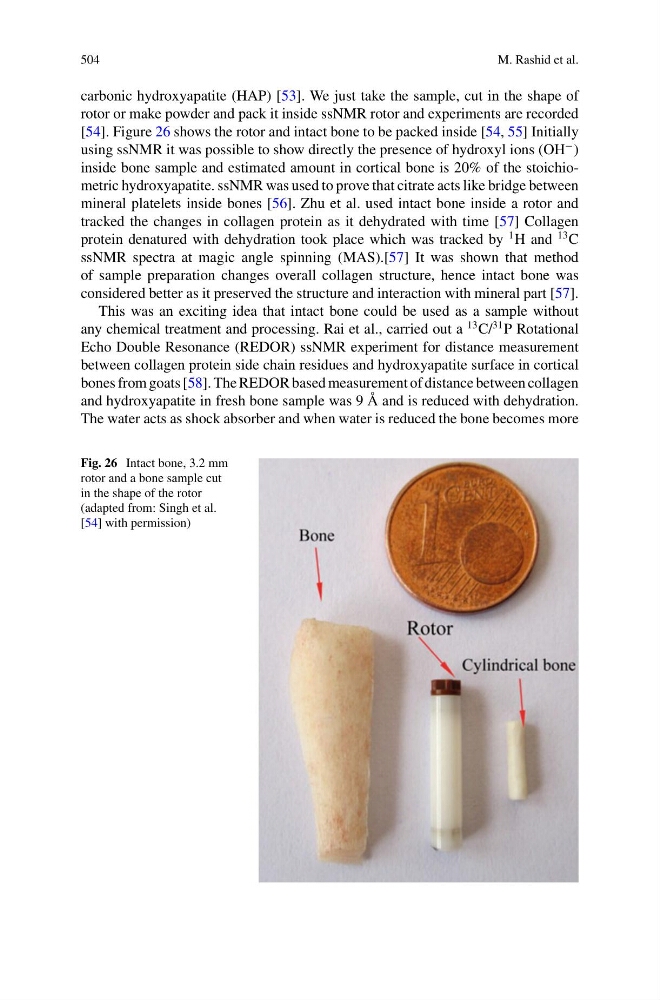
[54]. Figure 26 shows the rotor and intact bone to be packed inside [54, 55] Initially
using ssNMR it was possible to show directly the presence of hydroxyl ions (OH
− )
inside bone sample and estimated amount in cortical bone is 20% of the stoichiometric hydroxyapatite. ssNMR was used to prove that citrate acts like bridge between
mineral platelets inside bones [56]. Zhu et al. used intact bone inside a rotor and
tracked the changes in collagen protein as it dehydrated with time [57] Collagen
protein denatured with dehydration took place which was tracked by
1 H and
13 C
ssNMR spectra at magic angle spinning (MAS).[57] It was shown that method
of sample preparation changes overall collagen structure, hence intact bone was
considered better as it preserved the structure and interaction with mineral part [57].
This was an exciting idea that intact bone could be used as a sample without
any chemical treatment and processing. Rai et al., carried out a
13 C/
31 P Rotational
Echo Double Resonance (REDOR) ssNMR experiment for distance measurement
between collagen protein side chain residues and hydroxyapatite surface in cortical
bones from goats [58]. The REDOR based measurement of distance between collagen
and hydroxyapatite in fresh bone sample was 9 Å and is reduced with dehydration.
The water acts as shock absorber and when water is reduced the bone becomes more
Fig. 26 Intact bone, 3.2 mm
rotor and a bone sample cut
in the shape of the rotor
(adapted from: Singh et al.
[54] with permission)
M. Rashid et al.
carbonic hydroxyapatite (HAP) [53]. We just take the sample, cut in the shape of
rotor or make powder and pack it inside ssNMR rotor and experiments are recorded
[54]. Figure 26 shows the rotor and intact bone to be packed inside [54, 55] Initially
using ssNMR it was possible to show directly the presence of hydroxyl ions (OH
− )
inside bone sample and estimated amount in cortical bone is 20% of the stoichiometric hydroxyapatite. ssNMR was used to prove that citrate acts like bridge between
mineral platelets inside bones [56]. Zhu et al. used intact bone inside a rotor and
tracked the changes in collagen protein as it dehydrated with time [57] Collagen
protein denatured with dehydration took place which was tracked by
1 H and
13 C
ssNMR spectra at magic angle spinning (MAS).[57] It was shown that method
of sample preparation changes overall collagen structure, hence intact bone was
considered better as it preserved the structure and interaction with mineral part [57].
This was an exciting idea that intact bone could be used as a sample without
any chemical treatment and processing. Rai et al., carried out a
13 C/
31 P Rotational
Echo Double Resonance (REDOR) ssNMR experiment for distance measurement
between collagen protein side chain residues and hydroxyapatite surface in cortical
bones from goats [58]. The REDOR based measurement of distance between collagen
and hydroxyapatite in fresh bone sample was 9 Å and is reduced with dehydration.
The water acts as shock absorber and when water is reduced the bone becomes more
Fig. 26 Intact bone, 3.2 mm
rotor and a bone sample cut
in the shape of the rotor
(adapted from: Singh et al.
[54] with permission)