

Nuclear Magnetic Resonance Spectroscopy: Theory and Applications
503
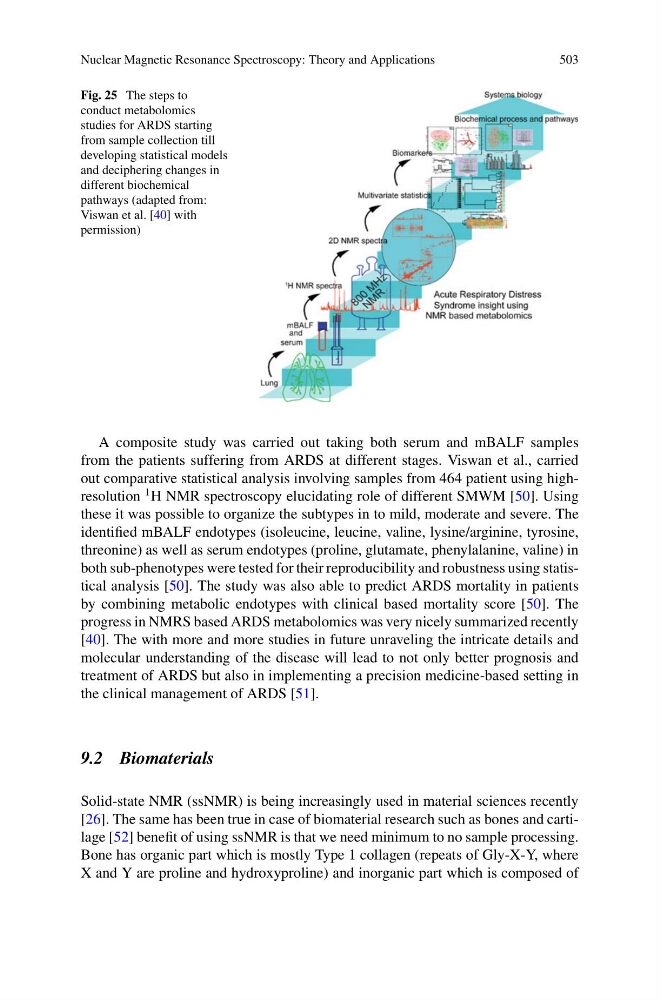
Fig. 25 The steps to
conduct metabolomics
studies for ARDS starting
from sample collection till
developing statistical models
and deciphering changes in
different biochemical
pathways (adapted from:
Viswan et al. [40] with
permission)
A composite study was carried out taking both serum and mBALF samples
from the patients suffering from ARDS at different stages. Viswan et al., carried
out comparative statistical analysis involving samples from 464 patient using highresolution
1 H NMR spectroscopy elucidating role of different SMWM [50]. Using
these it was possible to organize the subtypes in to mild, moderate and severe. The
identified mBALF endotypes (isoleucine, leucine, valine, lysine/arginine, tyrosine,
threonine) as well as serum endotypes (proline, glutamate, phenylalanine, valine) in
both sub-phenotypes were tested for their reproducibility and robustness using statistical analysis [50]. The study was also able to predict ARDS mortality in patients
by combining metabolic endotypes with clinical based mortality score [50]. The
progress in NMRS based ARDS metabolomics was very nicely summarized recently
[40]. The with more and more studies in future unraveling the intricate details and
molecular understanding of the disease will lead to not only better prognosis and
treatment of ARDS but also in implementing a precision medicine-based setting in
the clinical management of ARDS [51].
9.2 Biomaterials
Solid-state NMR (ssNMR) is being increasingly used in material sciences recently
[26]. The same has been true in case of biomaterial research such as bones and cartilage [52] benefit of using ssNMR is that we need minimum to no sample processing.
Bone has organic part which is mostly Type 1 collagen (repeats of Gly-X-Y, where
X and Y are proline and hydroxyproline) and inorganic part which is composed of
503
Fig. 25 The steps to
conduct metabolomics
studies for ARDS starting
from sample collection till
developing statistical models
and deciphering changes in
different biochemical
pathways (adapted from:
Viswan et al. [40] with
permission)
A composite study was carried out taking both serum and mBALF samples
from the patients suffering from ARDS at different stages. Viswan et al., carried
out comparative statistical analysis involving samples from 464 patient using highresolution
1 H NMR spectroscopy elucidating role of different SMWM [50]. Using
these it was possible to organize the subtypes in to mild, moderate and severe. The
identified mBALF endotypes (isoleucine, leucine, valine, lysine/arginine, tyrosine,
threonine) as well as serum endotypes (proline, glutamate, phenylalanine, valine) in
both sub-phenotypes were tested for their reproducibility and robustness using statistical analysis [50]. The study was also able to predict ARDS mortality in patients
by combining metabolic endotypes with clinical based mortality score [50]. The
progress in NMRS based ARDS metabolomics was very nicely summarized recently
[40]. The with more and more studies in future unraveling the intricate details and
molecular understanding of the disease will lead to not only better prognosis and
treatment of ARDS but also in implementing a precision medicine-based setting in
the clinical management of ARDS [51].
9.2 Biomaterials
Solid-state NMR (ssNMR) is being increasingly used in material sciences recently
[26]. The same has been true in case of biomaterial research such as bones and cartilage [52] benefit of using ssNMR is that we need minimum to no sample processing.
Bone has organic part which is mostly Type 1 collagen (repeats of Gly-X-Y, where
X and Y are proline and hydroxyproline) and inorganic part which is composed of