

Nuclear Magnetic Resonance Spectroscopy: Theory and Applications
501
systems to biological stimuli or genetic manipulation. The focus is on understanding
systemic change through time in complex multi cellular systems.” On the other hand,
“Metabolomics seeks an analytical description of complex biological samples, and
aims to characterize and quantify all the small molecules in such a sample” [34–36].
Metabolomics is also considered as the link between genotype and phenotype and can
help to fill the information gap [37]. It is latest in the series of genomics, proteomics
and transcriptomics. Essentially it involves the profiling of small metabolites present
in cells, tissue extracts, body fluids, blood serum etc. [36]. It also helps to establish
connectivity’s in different metabolic pathways and analyze the flux of metabolites in
response to stimuli or environmental changes [38]. There are two main techniques
widely used in this process, NMR spectroscopy and Mass spectroscopy (MS).
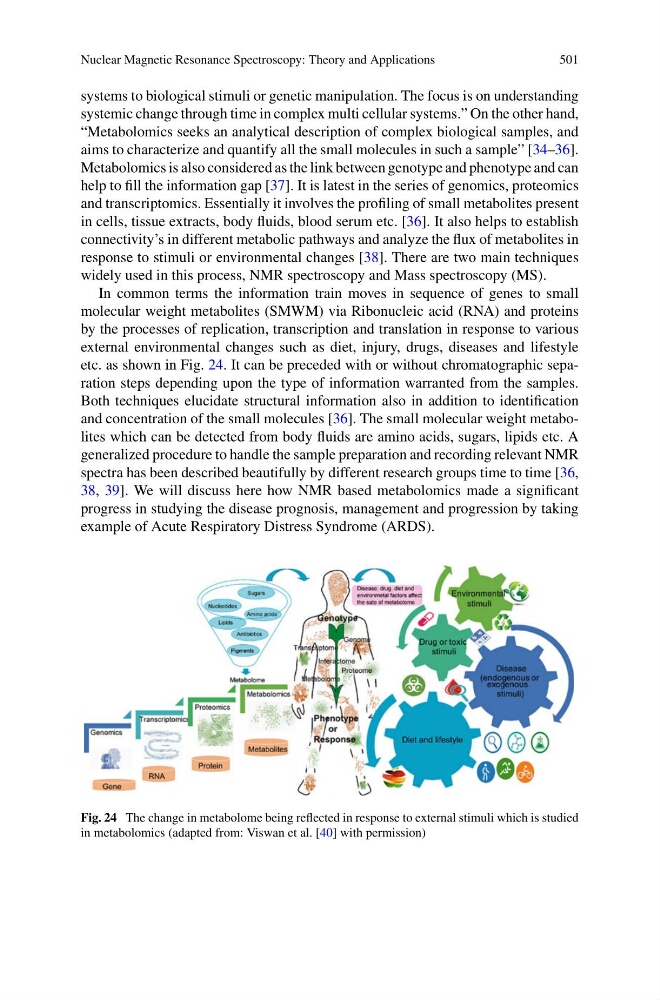
In common terms the information train moves in sequence of genes to small
molecular weight metabolites (SMWM) via Ribonucleic acid (RNA) and proteins
by the processes of replication, transcription and translation in response to various
external environmental changes such as diet, injury, drugs, diseases and lifestyle
etc. as shown in Fig. 24. It can be preceded with or without chromatographic separation steps depending upon the type of information warranted from the samples.
Both techniques elucidate structural information also in addition to identification
and concentration of the small molecules [36]. The small molecular weight metabolites which can be detected from body fluids are amino acids, sugars, lipids etc. A
generalized procedure to handle the sample preparation and recording relevant NMR
spectra has been described beautifully by different research groups time to time [36,
38, 39]. We will discuss here how NMR based metabolomics made a significant
progress in studying the disease prognosis, management and progression by taking
example of Acute Respiratory Distress Syndrome (ARDS).
Fig. 24 The change in metabolome being reflected in response to external stimuli which is studied
in metabolomics (adapted from: Viswan et al. [40] with permission)
501
systems to biological stimuli or genetic manipulation. The focus is on understanding
systemic change through time in complex multi cellular systems.” On the other hand,
“Metabolomics seeks an analytical description of complex biological samples, and
aims to characterize and quantify all the small molecules in such a sample” [34–36].
Metabolomics is also considered as the link between genotype and phenotype and can
help to fill the information gap [37]. It is latest in the series of genomics, proteomics
and transcriptomics. Essentially it involves the profiling of small metabolites present
in cells, tissue extracts, body fluids, blood serum etc. [36]. It also helps to establish
connectivity’s in different metabolic pathways and analyze the flux of metabolites in
response to stimuli or environmental changes [38]. There are two main techniques
widely used in this process, NMR spectroscopy and Mass spectroscopy (MS).
In common terms the information train moves in sequence of genes to small
molecular weight metabolites (SMWM) via Ribonucleic acid (RNA) and proteins
by the processes of replication, transcription and translation in response to various
external environmental changes such as diet, injury, drugs, diseases and lifestyle
etc. as shown in Fig. 24. It can be preceded with or without chromatographic separation steps depending upon the type of information warranted from the samples.
Both techniques elucidate structural information also in addition to identification
and concentration of the small molecules [36]. The small molecular weight metabolites which can be detected from body fluids are amino acids, sugars, lipids etc. A
generalized procedure to handle the sample preparation and recording relevant NMR
spectra has been described beautifully by different research groups time to time [36,
38, 39]. We will discuss here how NMR based metabolomics made a significant
progress in studying the disease prognosis, management and progression by taking
example of Acute Respiratory Distress Syndrome (ARDS).
Fig. 24 The change in metabolome being reflected in response to external stimuli which is studied
in metabolomics (adapted from: Viswan et al. [40] with permission)