

490
M. Rashid et al.
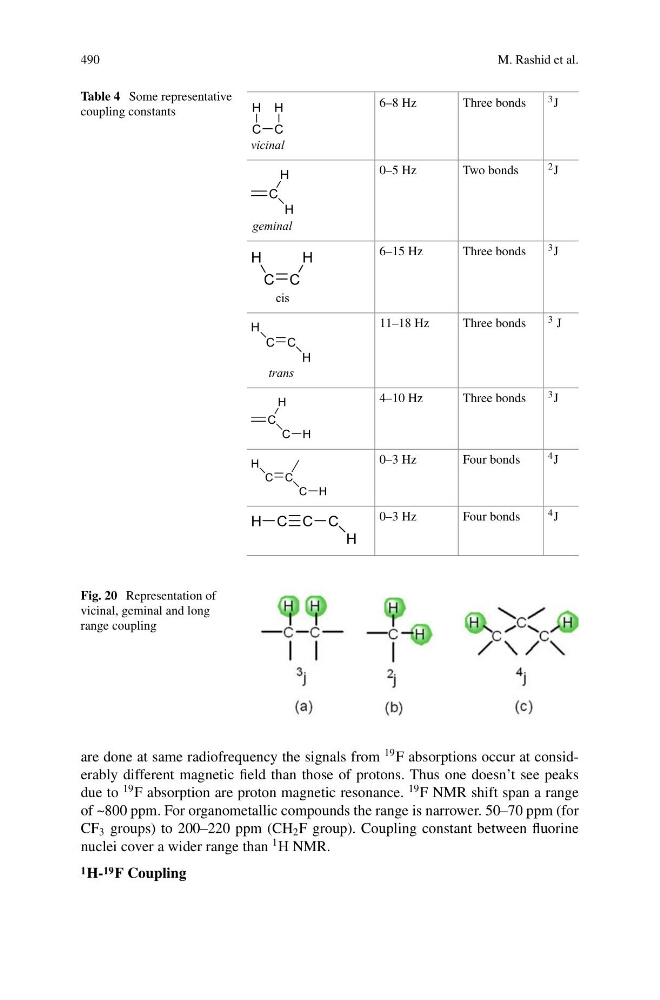
Table 4 Some representative
coupling constants
C C
H H
vicinal
6–8 Hz
Three bonds
3 J
C
H
H
geminal
0–5 Hz
Two bonds
2 J
C C
H
H
cis
6–15 Hz
Three bonds
3 J
C C
H
H
trans
11–18 Hz
Three bonds
3 J
C
H
C H
4–10 Hz
Three bonds
3 J
C C
H
C H
0–3 Hz
Four bonds
4 J
C C C
H
H
0–3 Hz
Four bonds
4 J
Fig. 20 Representation of
vicinal, geminal and long
range coupling
are done at same radiofrequency the signals from
19 F absorptions occur at considerably different magnetic field than those of protons. Thus one doesn’t see peaks
due to
19 F absorption are proton magnetic resonance.
19 F NMR shift span a range
of ~800 ppm. For organometallic compounds the range is narrower. 50–70 ppm (for
CF 3 groups) to 200–220 ppm (CH 2 F group). Coupling constant between fluorine
nuclei cover a wider range than
1 H NMR.
1 H- 19 F Coupling
M. Rashid et al.
Table 4 Some representative
coupling constants
C C
H H
vicinal
6–8 Hz
Three bonds
3 J
C
H
H
geminal
0–5 Hz
Two bonds
2 J
C C
H
H
cis
6–15 Hz
Three bonds
3 J
C C
H
H
trans
11–18 Hz
Three bonds
3 J
C
H
C H
4–10 Hz
Three bonds
3 J
C C
H
C H
0–3 Hz
Four bonds
4 J
C C C
H
H
0–3 Hz
Four bonds
4 J
Fig. 20 Representation of
vicinal, geminal and long
range coupling
are done at same radiofrequency the signals from
19 F absorptions occur at considerably different magnetic field than those of protons. Thus one doesn’t see peaks
due to
19 F absorption are proton magnetic resonance.
19 F NMR shift span a range
of ~800 ppm. For organometallic compounds the range is narrower. 50–70 ppm (for
CF 3 groups) to 200–220 ppm (CH 2 F group). Coupling constant between fluorine
nuclei cover a wider range than
1 H NMR.
1 H- 19 F Coupling