

Nuclear Magnetic Resonance Spectroscopy: Theory and Applications
489
4.3.1 Coupling Constant
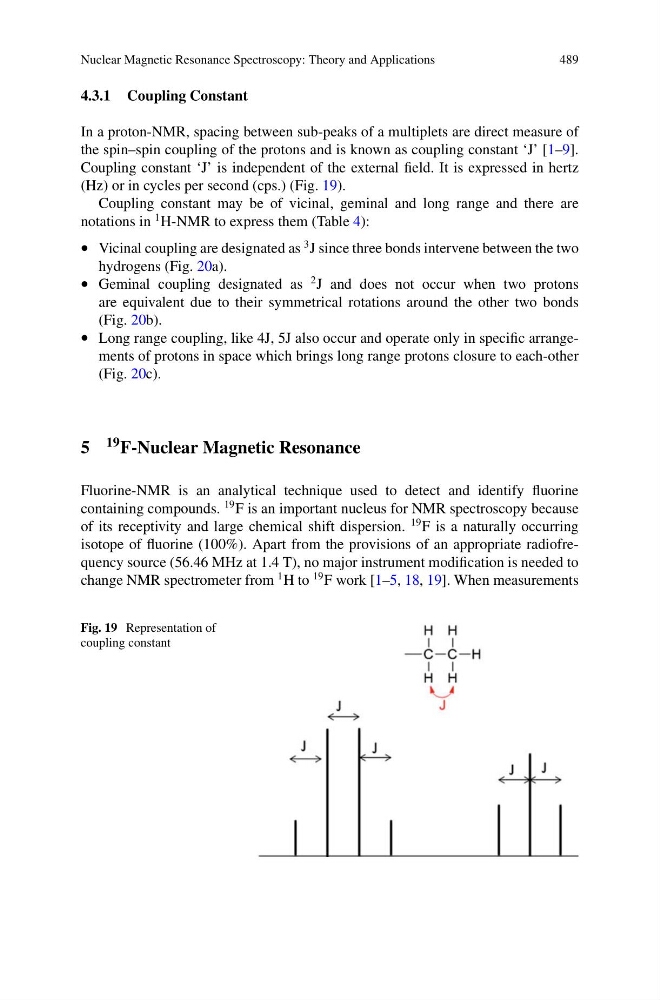
In a proton-NMR, spacing between sub-peaks of a multiplets are direct measure of
the spin–spin coupling of the protons and is known as coupling constant ‘J’ [1–9].
Coupling constant ‘J’ is independent of the external field. It is expressed in hertz
(Hz) or in cycles per second (cps.) (Fig. 19).
Coupling constant may be of vicinal, geminal and long range and there are
notations in
1 H-NMR to express them (Table 4):
• Vicinal coupling are designated as
3 J since three bonds intervene between the two
hydrogens (Fig. 20a).
• Geminal coupling designated as
2 J and does not occur when two protons
are equivalent due to their symmetrical rotations around the other two bonds
(Fig. 20b).
• Long range coupling, like 4J, 5J also occur and operate only in specific arrangements of protons in space which brings long range protons closure to each-other
(Fig. 20c).
5 19 F-Nuclear Magnetic Resonance
Fluorine-NMR is an analytical technique used to detect and identify fluorine
containing compounds.
19 F is an important nucleus for NMR spectroscopy because
of its receptivity and large chemical shift dispersion.
19 F is a naturally occurring
isotope of fluorine (100%). Apart from the provisions of an appropriate radiofrequency source (56.46 MHz at 1.4 T), no major instrument modification is needed to
change NMR spectrometer from
1 H to
19 F work [1–5, 18, 19]. When measurements
Fig. 19 Representation of
coupling constant
489
4.3.1 Coupling Constant
In a proton-NMR, spacing between sub-peaks of a multiplets are direct measure of
the spin–spin coupling of the protons and is known as coupling constant ‘J’ [1–9].
Coupling constant ‘J’ is independent of the external field. It is expressed in hertz
(Hz) or in cycles per second (cps.) (Fig. 19).
Coupling constant may be of vicinal, geminal and long range and there are
notations in
1 H-NMR to express them (Table 4):
• Vicinal coupling are designated as
3 J since three bonds intervene between the two
hydrogens (Fig. 20a).
• Geminal coupling designated as
2 J and does not occur when two protons
are equivalent due to their symmetrical rotations around the other two bonds
(Fig. 20b).
• Long range coupling, like 4J, 5J also occur and operate only in specific arrangements of protons in space which brings long range protons closure to each-other
(Fig. 20c).
5 19 F-Nuclear Magnetic Resonance
Fluorine-NMR is an analytical technique used to detect and identify fluorine
containing compounds.
19 F is an important nucleus for NMR spectroscopy because
of its receptivity and large chemical shift dispersion.
19 F is a naturally occurring
isotope of fluorine (100%). Apart from the provisions of an appropriate radiofrequency source (56.46 MHz at 1.4 T), no major instrument modification is needed to
change NMR spectrometer from
1 H to
19 F work [1–5, 18, 19]. When measurements
Fig. 19 Representation of
coupling constant