

474
M. Rashid et al.
According to Bohr’s relationship, the energy difference between two energy states
(E) is equal to energy of radiation
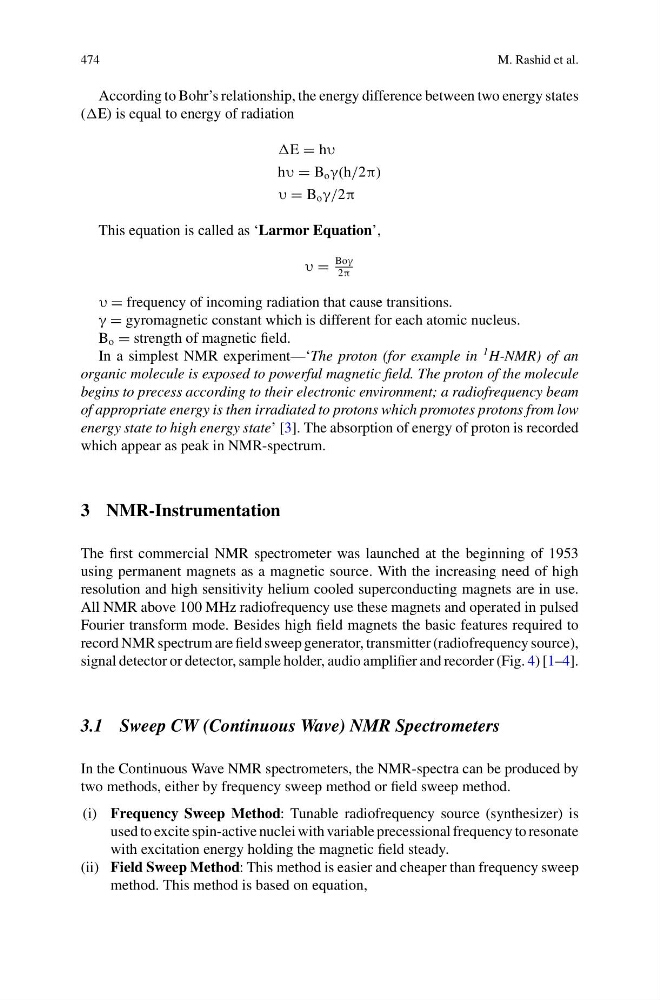
E = hυ
hυ = B o γ(h/2π)
υ = B o γ/2π
This equation is called as ‘Larmor Equation’,
υ =
Boγ
2π
υ = frequency of incoming radiation that cause transitions.
γ = gyromagnetic constant which is different for each atomic nucleus.
B o = strength of magnetic field.
In a simplest NMR experiment—‘The proton (for example in
1 H-NMR) of an
organic molecule is exposed to powerful magnetic field. The proton of the molecule
begins to precess according to their electronic environment; a radiofrequency beam
of appropriate energy is then irradiated to protons which promotes protons from low
energy state to high energy state’ [3]. The absorption of energy of proton is recorded
which appear as peak in NMR-spectrum.
3 NMR-Instrumentation
The first commercial NMR spectrometer was launched at the beginning of 1953
using permanent magnets as a magnetic source. With the increasing need of high
resolution and high sensitivity helium cooled superconducting magnets are in use.
All NMR above 100 MHz radiofrequency use these magnets and operated in pulsed
Fourier transform mode. Besides high field magnets the basic features required to
record NMR spectrum are field sweep generator, transmitter (radiofrequency source),
signal detector or detector, sample holder, audio amplifier and recorder (Fig. 4) [1–4].
3.1 Sweep CW (Continuous Wave) NMR Spectrometers
In the Continuous Wave NMR spectrometers, the NMR-spectra can be produced by
two methods, either by frequency sweep method or field sweep method.
(i) Frequency Sweep Method: Tunable radiofrequency source (synthesizer) is
used to excite spin-active nuclei with variable precessional frequency to resonate
with excitation energy holding the magnetic field steady.
(ii) Field Sweep Method: This method is easier and cheaper than frequency sweep
method. This method is based on equation,
M. Rashid et al.
According to Bohr’s relationship, the energy difference between two energy states
(E) is equal to energy of radiation
E = hυ
hυ = B o γ(h/2π)
υ = B o γ/2π
This equation is called as ‘Larmor Equation’,
υ =
Boγ
2π
υ = frequency of incoming radiation that cause transitions.
γ = gyromagnetic constant which is different for each atomic nucleus.
B o = strength of magnetic field.
In a simplest NMR experiment—‘The proton (for example in
1 H-NMR) of an
organic molecule is exposed to powerful magnetic field. The proton of the molecule
begins to precess according to their electronic environment; a radiofrequency beam
of appropriate energy is then irradiated to protons which promotes protons from low
energy state to high energy state’ [3]. The absorption of energy of proton is recorded
which appear as peak in NMR-spectrum.
3 NMR-Instrumentation
The first commercial NMR spectrometer was launched at the beginning of 1953
using permanent magnets as a magnetic source. With the increasing need of high
resolution and high sensitivity helium cooled superconducting magnets are in use.
All NMR above 100 MHz radiofrequency use these magnets and operated in pulsed
Fourier transform mode. Besides high field magnets the basic features required to
record NMR spectrum are field sweep generator, transmitter (radiofrequency source),
signal detector or detector, sample holder, audio amplifier and recorder (Fig. 4) [1–4].
3.1 Sweep CW (Continuous Wave) NMR Spectrometers
In the Continuous Wave NMR spectrometers, the NMR-spectra can be produced by
two methods, either by frequency sweep method or field sweep method.
(i) Frequency Sweep Method: Tunable radiofrequency source (synthesizer) is
used to excite spin-active nuclei with variable precessional frequency to resonate
with excitation energy holding the magnetic field steady.
(ii) Field Sweep Method: This method is easier and cheaper than frequency sweep
method. This method is based on equation,