

472
M. Rashid et al.
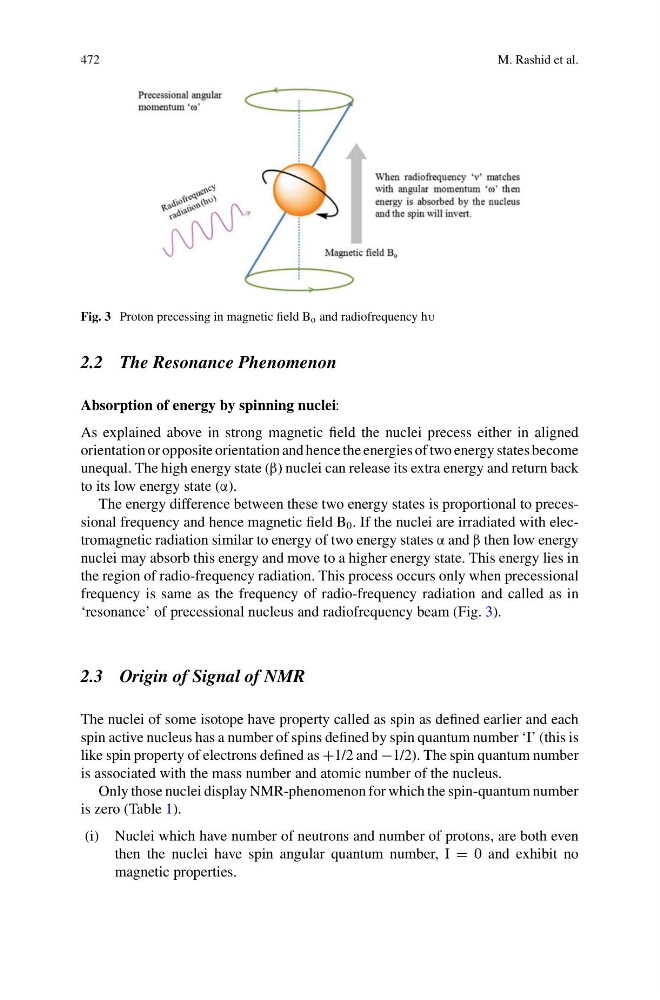
Fig. 3 Proton precessing in magnetic field B o and radiofrequency hυ
2.2 The Resonance Phenomenon
Absorption of energy by spinning nuclei:
As explained above in strong magnetic field the nuclei precess either in aligned
orientation or opposite orientation and hence the energies of two energy states become
unequal. The high energy state (β) nuclei can release its extra energy and return back
to its low energy state (α).
The energy difference between these two energy states is proportional to precessional frequency and hence magnetic field B 0 . If the nuclei are irradiated with electromagnetic radiation similar to energy of two energy states α and β then low energy
nuclei may absorb this energy and move to a higher energy state. This energy lies in
the region of radio-frequency radiation. This process occurs only when precessional
frequency is same as the frequency of radio-frequency radiation and called as in
‘resonance’ of precessional nucleus and radiofrequency beam (Fig. 3).
2.3 Origin of Signal of NMR
The nuclei of some isotope have property called as spin as defined earlier and each
spin active nucleus has a number of spins defined by spin quantum number ‘I’ (this is
like spin property of electrons defined as +1/2 and −1/2). The spin quantum number
is associated with the mass number and atomic number of the nucleus.
Only those nuclei display NMR-phenomenon for which the spin-quantum number
is zero (Table 1).
(i) Nuclei which have number of neutrons and number of protons, are both even
then the nuclei have spin angular quantum number, I = 0 and exhibit no
magnetic properties.
M. Rashid et al.
Fig. 3 Proton precessing in magnetic field B o and radiofrequency hυ
2.2 The Resonance Phenomenon
Absorption of energy by spinning nuclei:
As explained above in strong magnetic field the nuclei precess either in aligned
orientation or opposite orientation and hence the energies of two energy states become
unequal. The high energy state (β) nuclei can release its extra energy and return back
to its low energy state (α).
The energy difference between these two energy states is proportional to precessional frequency and hence magnetic field B 0 . If the nuclei are irradiated with electromagnetic radiation similar to energy of two energy states α and β then low energy
nuclei may absorb this energy and move to a higher energy state. This energy lies in
the region of radio-frequency radiation. This process occurs only when precessional
frequency is same as the frequency of radio-frequency radiation and called as in
‘resonance’ of precessional nucleus and radiofrequency beam (Fig. 3).
2.3 Origin of Signal of NMR
The nuclei of some isotope have property called as spin as defined earlier and each
spin active nucleus has a number of spins defined by spin quantum number ‘I’ (this is
like spin property of electrons defined as +1/2 and −1/2). The spin quantum number
is associated with the mass number and atomic number of the nucleus.
Only those nuclei display NMR-phenomenon for which the spin-quantum number
is zero (Table 1).
(i) Nuclei which have number of neutrons and number of protons, are both even
then the nuclei have spin angular quantum number, I = 0 and exhibit no
magnetic properties.