

Nuclear Magnetic Resonance Spectroscopy: Theory and Applications
471
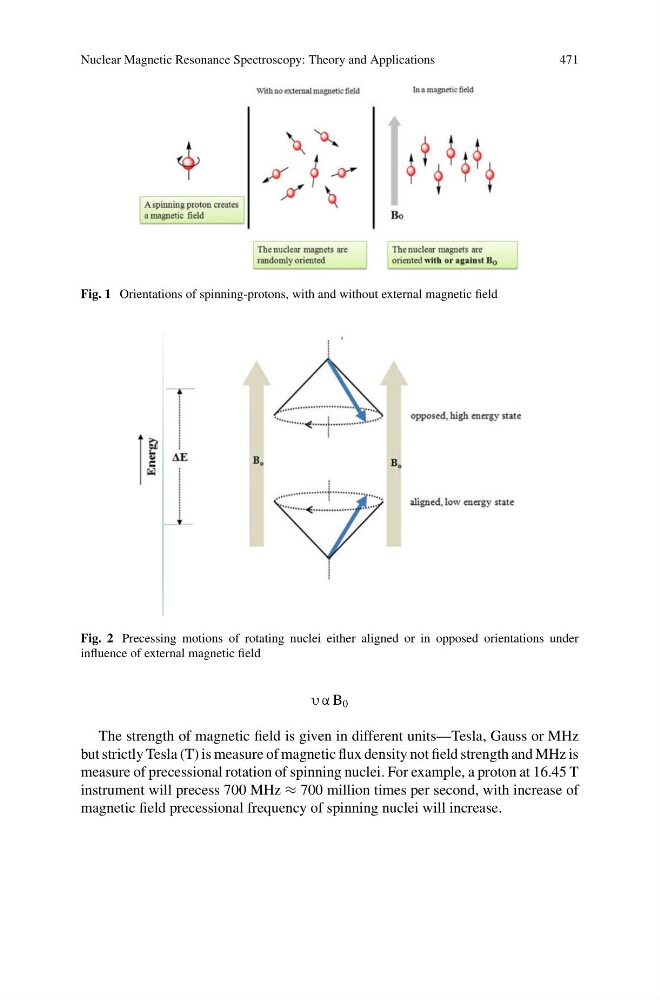
Fig. 1 Orientations of spinning-protons, with and without external magnetic field
Fig. 2 Precessing motions of rotating nuclei either aligned or in opposed orientations under
influence of external magnetic field
υ α B 0
The strength of magnetic field is given in different units—Tesla, Gauss or MHz
but strictly Tesla (T) is measure of magnetic flux density not field strength and MHz is
measure of precessional rotation of spinning nuclei. For example, a proton at 16.45 T
instrument will precess 700 MHz ≈ 700 million times per second, with increase of
magnetic field precessional frequency of spinning nuclei will increase.
471
Fig. 1 Orientations of spinning-protons, with and without external magnetic field
Fig. 2 Precessing motions of rotating nuclei either aligned or in opposed orientations under
influence of external magnetic field
υ α B 0
The strength of magnetic field is given in different units—Tesla, Gauss or MHz
but strictly Tesla (T) is measure of magnetic flux density not field strength and MHz is
measure of precessional rotation of spinning nuclei. For example, a proton at 16.45 T
instrument will precess 700 MHz ≈ 700 million times per second, with increase of
magnetic field precessional frequency of spinning nuclei will increase.