

452
D. P. Singh et al.
(I F L ) is proportional to the fraction of exciting light absorbed by the solution, i.e.,
(1–10
−
A ), where,
A is the total absorbance of the exciting light in the solution.
If the inner filter effect is prominent, it is better to use a cuvette with a smaller path
length, such as 4 mm square cuvette instead of 10 mm. The concentration of solution
used for fluorescence spectrometry should be usually 10–100 times less concentrated than that used for absorption spectrophotometry. Fluorescence spectrometry
is a very sensitive technique and concentrations of 10
−5 to 10
−7 mol/l are normally
used. Besides the concentration of the solution, the pH of a solution can also affect
the fluorescence intensity. The increase in pH causes a lowering in the maximum
fluorescence intensity.
2.3.2 Effect of Solvent
Fluorescence emission is significantly affected by promiscuous environmental factors in addition to the mutual interaction between the fluorophore and solvent [14].
The polarity of the solvent, organic/inorganic nature of the solvent, pH, temperature
and the localized concentration of the fluorescent substance in the solvent are the
main factors that affect the intensity and spectral distribution of fluorescence emission [15]. The effects of these factors change from one fluorophore to another. The
absorption and emission spectra along with the quantum yields can be remarkably
influenced if the environmental parameters of measurements are changed. In this
condition, some traditional rule of fluorescence like Kasha’s rule is not valid. The
fluorescence emission is found to be very sensitive to local interactions that occur
due to measuring environment and excited-state lifetime processes. The interactions
between the solvent and fluorophore molecules affect the energy difference between
the ground and the excited states and the solvent sensitivity to polarity is analyzed
in terms of the difference in the dipole moments of the ground and excited states.
The largest change in the dipole moment is analogous to most sensitive fluorophore.
The difference in the maximum absorption and emission wavelengths, expressed in
wavenumbers (¯ ν, in cm
−1 ) is a function of the refractive index (n) and dielectric
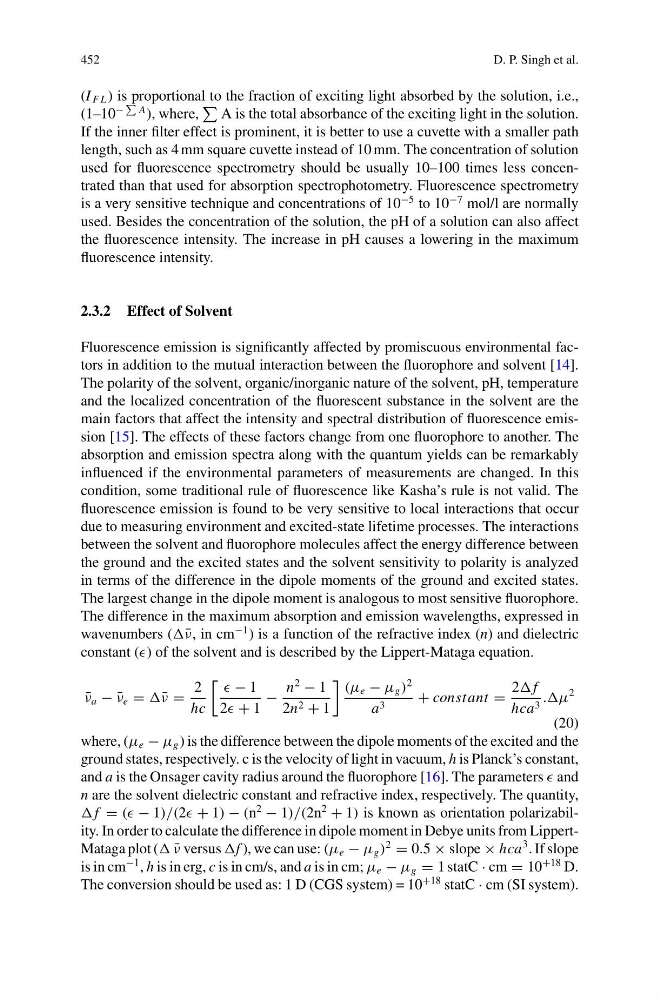
constant () of the solvent and is described by the Lippert-Mataga equation.
¯
ν a − ¯
ν e = ¯ ν =
2
hc
− 1
2 + 1
−
n
2
− 1
2n 2 + 1
(μ e − μ g )
2
a 3
+ constant =
2 f
hca 3 ..μ
2
(20)
where, (μ e − μ g ) is the difference between the dipole moments of the excited and the
ground states, respectively. c is the velocity of light in vacuum, h is Planck’s constant,
and a is the Onsager cavity radius around the fluorophore [16]. The parameters and
n are the solvent dielectric constant and refractive index, respectively. The quantity,
f = (( − 1)/(2 + 1) − (n
2
− 1)/(2n
2
+ 1) is known as orientation polarizability. In order to calculate the difference in dipole moment in Debye units from LippertMataga plot ( ¯
ν versus f ), we can use: (μ e − μ g )
2
= 0.5 × slope × hca
3 . If slope
is in cm
−1 , h is in erg, c is in cm/s, and a is in cm; μ e − μ g = 1 statC · cm = 10
+18 D.
The conversion should be used as: 1 D (CGS system) = 10
+18 statC · cm (SI system).
D. P. Singh et al.
(I F L ) is proportional to the fraction of exciting light absorbed by the solution, i.e.,
(1–10
−
A ), where,
A is the total absorbance of the exciting light in the solution.
If the inner filter effect is prominent, it is better to use a cuvette with a smaller path
length, such as 4 mm square cuvette instead of 10 mm. The concentration of solution
used for fluorescence spectrometry should be usually 10–100 times less concentrated than that used for absorption spectrophotometry. Fluorescence spectrometry
is a very sensitive technique and concentrations of 10
−5 to 10
−7 mol/l are normally
used. Besides the concentration of the solution, the pH of a solution can also affect
the fluorescence intensity. The increase in pH causes a lowering in the maximum
fluorescence intensity.
2.3.2 Effect of Solvent
Fluorescence emission is significantly affected by promiscuous environmental factors in addition to the mutual interaction between the fluorophore and solvent [14].
The polarity of the solvent, organic/inorganic nature of the solvent, pH, temperature
and the localized concentration of the fluorescent substance in the solvent are the
main factors that affect the intensity and spectral distribution of fluorescence emission [15]. The effects of these factors change from one fluorophore to another. The
absorption and emission spectra along with the quantum yields can be remarkably
influenced if the environmental parameters of measurements are changed. In this
condition, some traditional rule of fluorescence like Kasha’s rule is not valid. The
fluorescence emission is found to be very sensitive to local interactions that occur
due to measuring environment and excited-state lifetime processes. The interactions
between the solvent and fluorophore molecules affect the energy difference between
the ground and the excited states and the solvent sensitivity to polarity is analyzed
in terms of the difference in the dipole moments of the ground and excited states.
The largest change in the dipole moment is analogous to most sensitive fluorophore.
The difference in the maximum absorption and emission wavelengths, expressed in
wavenumbers (¯ ν, in cm
−1 ) is a function of the refractive index (n) and dielectric
constant () of the solvent and is described by the Lippert-Mataga equation.
¯
ν a − ¯
ν e = ¯ ν =
2
hc
− 1
2 + 1
−
n
2
− 1
2n 2 + 1
(μ e − μ g )
2
a 3
+ constant =
2 f
hca 3 ..μ
2
(20)
where, (μ e − μ g ) is the difference between the dipole moments of the excited and the
ground states, respectively. c is the velocity of light in vacuum, h is Planck’s constant,
and a is the Onsager cavity radius around the fluorophore [16]. The parameters and
n are the solvent dielectric constant and refractive index, respectively. The quantity,
f = (( − 1)/(2 + 1) − (n
2
− 1)/(2n
2
+ 1) is known as orientation polarizability. In order to calculate the difference in dipole moment in Debye units from LippertMataga plot ( ¯
ν versus f ), we can use: (μ e − μ g )
2
= 0.5 × slope × hca
3 . If slope
is in cm
−1 , h is in erg, c is in cm/s, and a is in cm; μ e − μ g = 1 statC · cm = 10
+18 D.
The conversion should be used as: 1 D (CGS system) = 10
+18 statC · cm (SI system).