

428
A. Mathur et al.
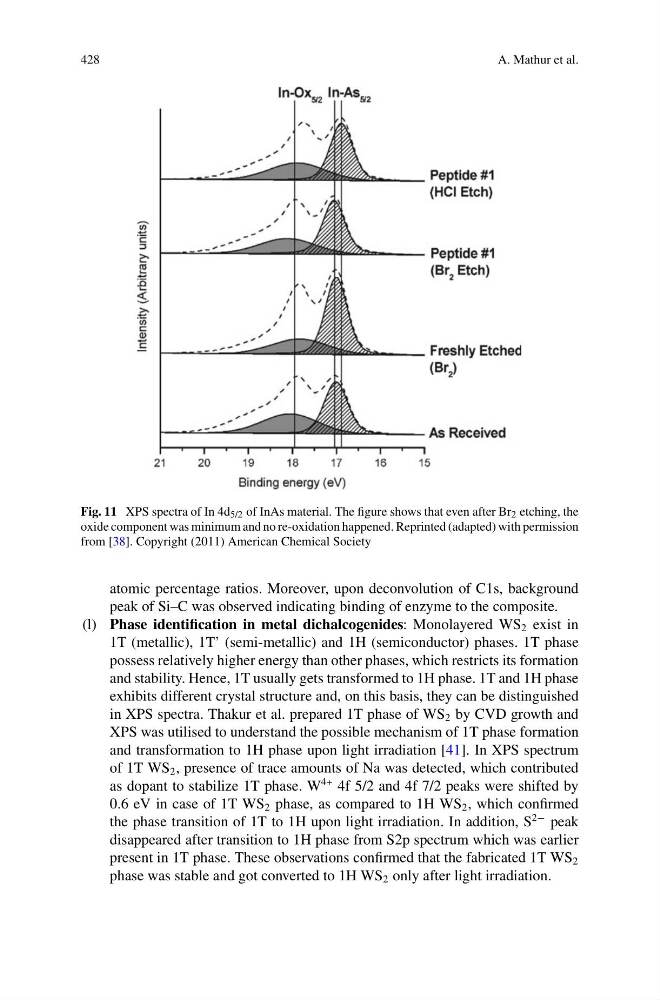
Fig. 11 XPS spectra of In 4d 5/2 of InAs material. The figure shows that even after Br 2 etching, the
oxide component was minimum and no re-oxidation happened. Reprinted (adapted) with permission
from [38]. Copyright (2011) American Chemical Society
atomic percentage ratios. Moreover, upon deconvolution of C1s, background
peak of Si–C was observed indicating binding of enzyme to the composite.
(l) Phase identification in metal dichalcogenides: Monolayered WS 2 exist in
1T (metallic), 1T’ (semi-metallic) and 1H (semiconductor) phases. 1T phase
possess relatively higher energy than other phases, which restricts its formation
and stability. Hence, 1T usually gets transformed to 1H phase. 1T and 1H phase
exhibits different crystal structure and, on this basis, they can be distinguished
in XPS spectra. Thakur et al. prepared 1T phase of WS 2 by CVD growth and
XPS was utilised to understand the possible mechanism of 1T phase formation
and transformation to 1H phase upon light irradiation [41]. In XPS spectrum
of 1T WS 2 , presence of trace amounts of Na was detected, which contributed
as dopant to stabilize 1T phase. W
4+ 4f 5/2 and 4f 7/2 peaks were shifted by
0.6 eV in case of 1T WS 2 phase, as compared to 1H WS 2 , which confirmed
the phase transition of 1T to 1H upon light irradiation. In addition, S
2− peak
disappeared after transition to 1H phase from S2p spectrum which was earlier
present in 1T phase. These observations confirmed that the fabricated 1T WS 2
phase was stable and got converted to 1H WS 2 only after light irradiation.
A. Mathur et al.
Fig. 11 XPS spectra of In 4d 5/2 of InAs material. The figure shows that even after Br 2 etching, the
oxide component was minimum and no re-oxidation happened. Reprinted (adapted) with permission
from [38]. Copyright (2011) American Chemical Society
atomic percentage ratios. Moreover, upon deconvolution of C1s, background
peak of Si–C was observed indicating binding of enzyme to the composite.
(l) Phase identification in metal dichalcogenides: Monolayered WS 2 exist in
1T (metallic), 1T’ (semi-metallic) and 1H (semiconductor) phases. 1T phase
possess relatively higher energy than other phases, which restricts its formation
and stability. Hence, 1T usually gets transformed to 1H phase. 1T and 1H phase
exhibits different crystal structure and, on this basis, they can be distinguished
in XPS spectra. Thakur et al. prepared 1T phase of WS 2 by CVD growth and
XPS was utilised to understand the possible mechanism of 1T phase formation
and transformation to 1H phase upon light irradiation [41]. In XPS spectrum
of 1T WS 2 , presence of trace amounts of Na was detected, which contributed
as dopant to stabilize 1T phase. W
4+ 4f 5/2 and 4f 7/2 peaks were shifted by
0.6 eV in case of 1T WS 2 phase, as compared to 1H WS 2 , which confirmed
the phase transition of 1T to 1H upon light irradiation. In addition, S
2− peak
disappeared after transition to 1H phase from S2p spectrum which was earlier
present in 1T phase. These observations confirmed that the fabricated 1T WS 2
phase was stable and got converted to 1H WS 2 only after light irradiation.