

Application of X-Ray Photoelectron Spectroscopy in Materials …
421
(d) To determine the relative concentration and oxidation state: XPS used
equally for single component system as well as for double and triple component systems. For example, Saquib et al. prepared ternary heterostructure
of Ag/TiO 2 /RGO for the hydrogen evolution and environmental remediation
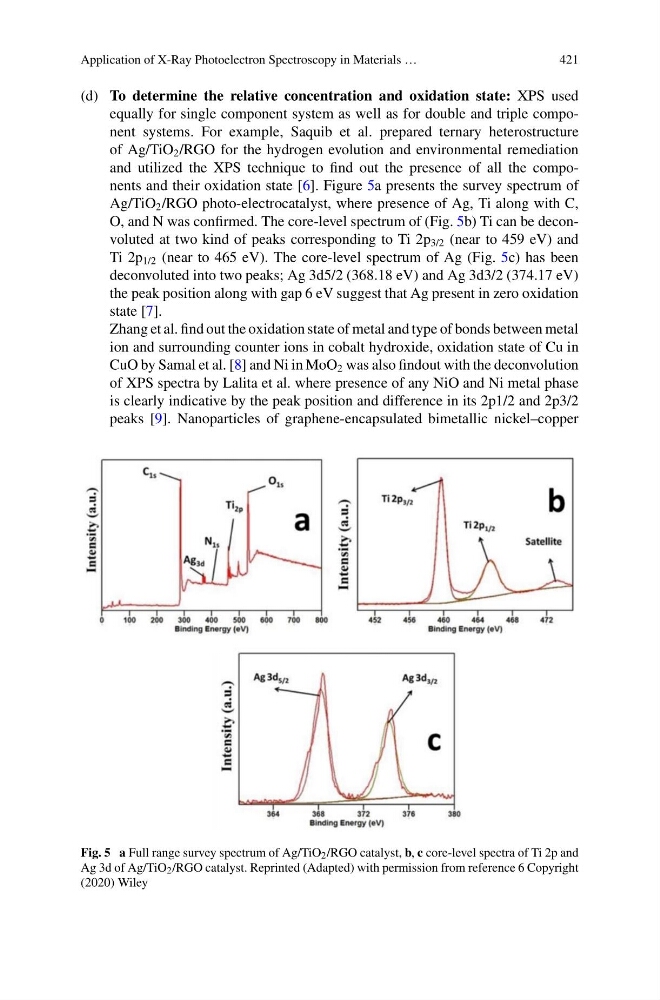
and utilized the XPS technique to find out the presence of all the components and their oxidation state [6]. Figure 5a presents the survey spectrum of
Ag/TiO 2 /RGO photo-electrocatalyst, where presence of Ag, Ti along with C,
O, and N was confirmed. The core-level spectrum of (Fig. 5b) Ti can be deconvoluted at two kind of peaks corresponding to Ti 2p 3/2 (near to 459 eV) and
Ti 2p 1/2 (near to 465 eV). The core-level spectrum of Ag (Fig. 5c) has been
deconvoluted into two peaks; Ag 3d5/2 (368.18 eV) and Ag 3d3/2 (374.17 eV)
the peak position along with gap 6 eV suggest that Ag present in zero oxidation
state [7].
Zhang et al. find out the oxidation state of metal and type of bonds between metal
ion and surrounding counter ions in cobalt hydroxide, oxidation state of Cu in
CuO by Samal et al. [8] and Ni in MoO 2 was also findout with the deconvolution
of XPS spectra by Lalita et al. where presence of any NiO and Ni metal phase
is clearly indicative by the peak position and difference in its 2p1/2 and 2p3/2
peaks [9]. Nanoparticles of graphene-encapsulated bimetallic nickel–copper
Fig. 5 a Full range survey spectrum of Ag/TiO 2 /RGO catalyst, b, c core-level spectra of Ti 2p and
Ag 3d of Ag/TiO 2 /RGO catalyst. Reprinted (Adapted) with permission from reference 6 Copyright
(2020) Wiley
421
(d) To determine the relative concentration and oxidation state: XPS used
equally for single component system as well as for double and triple component systems. For example, Saquib et al. prepared ternary heterostructure
of Ag/TiO 2 /RGO for the hydrogen evolution and environmental remediation
and utilized the XPS technique to find out the presence of all the components and their oxidation state [6]. Figure 5a presents the survey spectrum of
Ag/TiO 2 /RGO photo-electrocatalyst, where presence of Ag, Ti along with C,
O, and N was confirmed. The core-level spectrum of (Fig. 5b) Ti can be deconvoluted at two kind of peaks corresponding to Ti 2p 3/2 (near to 459 eV) and
Ti 2p 1/2 (near to 465 eV). The core-level spectrum of Ag (Fig. 5c) has been
deconvoluted into two peaks; Ag 3d5/2 (368.18 eV) and Ag 3d3/2 (374.17 eV)
the peak position along with gap 6 eV suggest that Ag present in zero oxidation
state [7].
Zhang et al. find out the oxidation state of metal and type of bonds between metal
ion and surrounding counter ions in cobalt hydroxide, oxidation state of Cu in
CuO by Samal et al. [8] and Ni in MoO 2 was also findout with the deconvolution
of XPS spectra by Lalita et al. where presence of any NiO and Ni metal phase
is clearly indicative by the peak position and difference in its 2p1/2 and 2p3/2
peaks [9]. Nanoparticles of graphene-encapsulated bimetallic nickel–copper
Fig. 5 a Full range survey spectrum of Ag/TiO 2 /RGO catalyst, b, c core-level spectra of Ti 2p and
Ag 3d of Ag/TiO 2 /RGO catalyst. Reprinted (Adapted) with permission from reference 6 Copyright
(2020) Wiley