

420
A. Mathur et al.
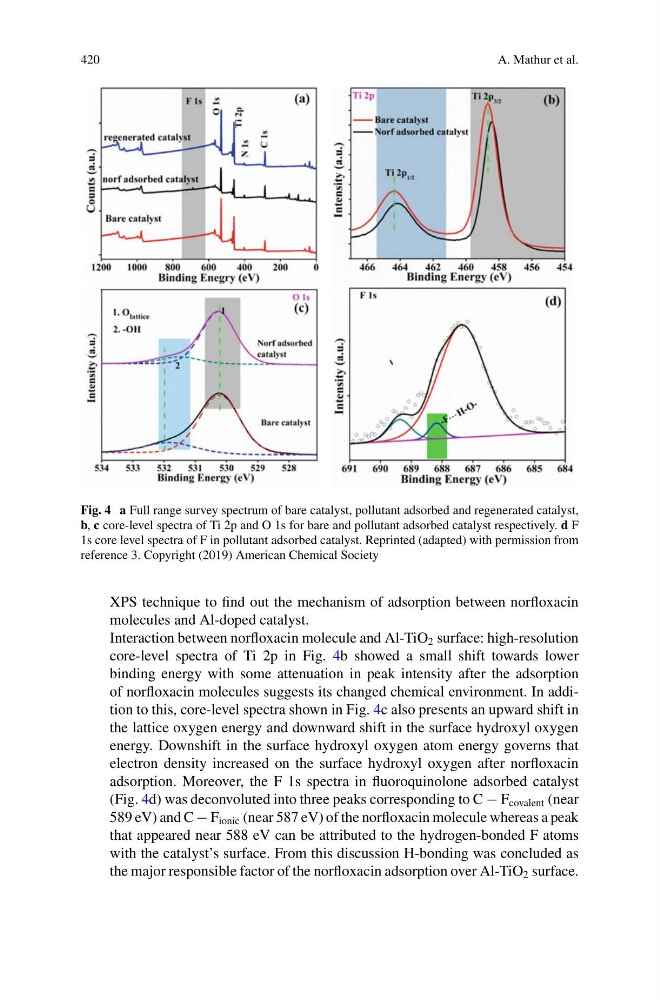
Fig. 4 a Full range survey spectrum of bare catalyst, pollutant adsorbed and regenerated catalyst,
b, c core-level spectra of Ti 2p and O 1s for bare and pollutant adsorbed catalyst respectively. d F
1s core level spectra of F in pollutant adsorbed catalyst. Reprinted (adapted) with permission from
reference 3. Copyright (2019) American Chemical Society
XPS technique to find out the mechanism of adsorption between norfloxacin
molecules and Al-doped catalyst.
Interaction between norfloxacin molecule and Al-TiO 2 surface: high-resolution
core-level spectra of Ti 2p in Fig. 4b showed a small shift towards lower
binding energy with some attenuation in peak intensity after the adsorption
of norfloxacin molecules suggests its changed chemical environment. In addition to this, core-level spectra shown in Fig. 4c also presents an upward shift in
the lattice oxygen energy and downward shift in the surface hydroxyl oxygen
energy. Downshift in the surface hydroxyl oxygen atom energy governs that
electron density increased on the surface hydroxyl oxygen after norfloxacin
adsorption. Moreover, the F 1s spectra in fluoroquinolone adsorbed catalyst
(Fig. 4d) was deconvoluted into three peaks corresponding to C − F covalent (near
589 eV) and C − F ionic (near 587 eV) of the norfloxacin molecule whereas a peak
that appeared near 588 eV can be attributed to the hydrogen-bonded F atoms
with the catalyst’s surface. From this discussion H-bonding was concluded as
the major responsible factor of the norfloxacin adsorption over Al-TiO 2 surface.
A. Mathur et al.
Fig. 4 a Full range survey spectrum of bare catalyst, pollutant adsorbed and regenerated catalyst,
b, c core-level spectra of Ti 2p and O 1s for bare and pollutant adsorbed catalyst respectively. d F
1s core level spectra of F in pollutant adsorbed catalyst. Reprinted (adapted) with permission from
reference 3. Copyright (2019) American Chemical Society
XPS technique to find out the mechanism of adsorption between norfloxacin
molecules and Al-doped catalyst.
Interaction between norfloxacin molecule and Al-TiO 2 surface: high-resolution
core-level spectra of Ti 2p in Fig. 4b showed a small shift towards lower
binding energy with some attenuation in peak intensity after the adsorption
of norfloxacin molecules suggests its changed chemical environment. In addition to this, core-level spectra shown in Fig. 4c also presents an upward shift in
the lattice oxygen energy and downward shift in the surface hydroxyl oxygen
energy. Downshift in the surface hydroxyl oxygen atom energy governs that
electron density increased on the surface hydroxyl oxygen after norfloxacin
adsorption. Moreover, the F 1s spectra in fluoroquinolone adsorbed catalyst
(Fig. 4d) was deconvoluted into three peaks corresponding to C − F covalent (near
589 eV) and C − F ionic (near 587 eV) of the norfloxacin molecule whereas a peak
that appeared near 588 eV can be attributed to the hydrogen-bonded F atoms
with the catalyst’s surface. From this discussion H-bonding was concluded as
the major responsible factor of the norfloxacin adsorption over Al-TiO 2 surface.