

Application of X-Ray Photoelectron Spectroscopy in Materials …
413
classifies them into different elements, determine their composition, etc. In general,
the peaks obtained from XPS spectrum are calibrated according to C 1s peak at
binding energy ~284.8 eV and in some cases O 1s peak at ~531.00 eV.
Principle of XPS: The configuration of ejected electron tells about the elemental
constitution, composition, etc. of the surface of sample. Quantum notations are
used to analyze the nature of ejected electrons. The notation nl j is used to describe
configuration of an electron, where
n: principle quantum number;
l: orbital angular momentum;
j: total angular momentum.
n represents the shell from where electron has been ejected, as K, L, M.. and are
written as 1, 2, 3, … l refers to sub-orbit of the electron, such as s, p, d, … It is also
written in terms of number as 1, 2, 3, … Electrons with value of l greater than 0
usually exhibit interaction between spin angular momentum (s) and orbital angular
momentum (l), also known as spin–orbit coupling. Due to this spin–orbit coupling,
the peaks split into two. The value of s can be +1/2 or −1/2. Accordingly, the value
for j becomes vector addition of l and s: j = |l + s|. Hence, for an electron from
3p shell, the XPS peaks will split into two with j value of ½ and 3/2, as a result of
addition of (−1/2 + 1) and (+1/2 + 1). Moreover, the intensity of these two peaks
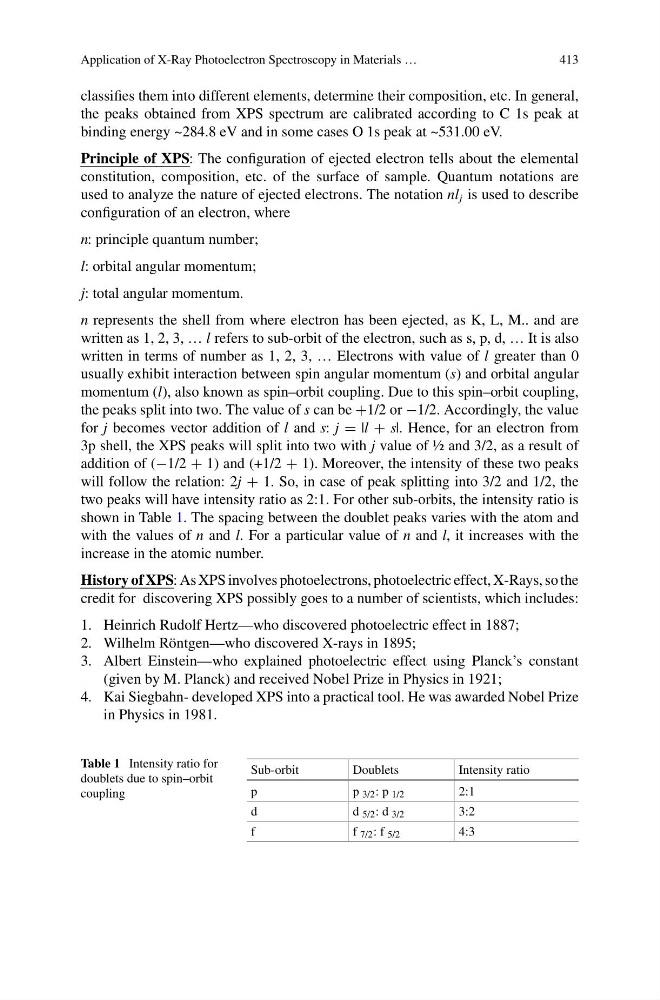
will follow the relation: 2j + 1. So, in case of peak splitting into 3/2 and 1/2, the
two peaks will have intensity ratio as 2:1. For other sub-orbits, the intensity ratio is
shown in Table 1. The spacing between the doublet peaks varies with the atom and
with the values of n and l. For a particular value of n and l, it increases with the
increase in the atomic number.
History of XPS: As XPS involves photoelectrons, photoelectric effect, X-Rays, so the
credit for discovering XPS possibly goes to a number of scientists, which includes:
1. Heinrich Rudolf Hertz—who discovered photoelectric effect in 1887;
2. Wilhelm Röntgen—who discovered X-rays in 1895;
3. Albert Einstein—who explained photoelectric effect using Planck’s constant
(given by M. Planck) and received Nobel Prize in Physics in 1921;
4. Kai Siegbahn- developed XPS into a practical tool. He was awarded Nobel Prize
in Physics in 1981.
Table 1 Intensity ratio for
doublets due to spin–orbit
coupling
Sub-orbit
Doublets
Intensity ratio
p
p 3/2 : p 1/2
2:1
d
d 5/2 : d 3/2
3:2
f
f 7/2 : f 5/2
4:3
413
classifies them into different elements, determine their composition, etc. In general,
the peaks obtained from XPS spectrum are calibrated according to C 1s peak at
binding energy ~284.8 eV and in some cases O 1s peak at ~531.00 eV.
Principle of XPS: The configuration of ejected electron tells about the elemental
constitution, composition, etc. of the surface of sample. Quantum notations are
used to analyze the nature of ejected electrons. The notation nl j is used to describe
configuration of an electron, where
n: principle quantum number;
l: orbital angular momentum;
j: total angular momentum.
n represents the shell from where electron has been ejected, as K, L, M.. and are
written as 1, 2, 3, … l refers to sub-orbit of the electron, such as s, p, d, … It is also
written in terms of number as 1, 2, 3, … Electrons with value of l greater than 0
usually exhibit interaction between spin angular momentum (s) and orbital angular
momentum (l), also known as spin–orbit coupling. Due to this spin–orbit coupling,
the peaks split into two. The value of s can be +1/2 or −1/2. Accordingly, the value
for j becomes vector addition of l and s: j = |l + s|. Hence, for an electron from
3p shell, the XPS peaks will split into two with j value of ½ and 3/2, as a result of
addition of (−1/2 + 1) and (+1/2 + 1). Moreover, the intensity of these two peaks
will follow the relation: 2j + 1. So, in case of peak splitting into 3/2 and 1/2, the
two peaks will have intensity ratio as 2:1. For other sub-orbits, the intensity ratio is
shown in Table 1. The spacing between the doublet peaks varies with the atom and
with the values of n and l. For a particular value of n and l, it increases with the
increase in the atomic number.
History of XPS: As XPS involves photoelectrons, photoelectric effect, X-Rays, so the
credit for discovering XPS possibly goes to a number of scientists, which includes:
1. Heinrich Rudolf Hertz—who discovered photoelectric effect in 1887;
2. Wilhelm Röntgen—who discovered X-rays in 1895;
3. Albert Einstein—who explained photoelectric effect using Planck’s constant
(given by M. Planck) and received Nobel Prize in Physics in 1921;
4. Kai Siegbahn- developed XPS into a practical tool. He was awarded Nobel Prize
in Physics in 1981.
Table 1 Intensity ratio for
doublets due to spin–orbit
coupling
Sub-orbit
Doublets
Intensity ratio
p
p 3/2 : p 1/2
2:1
d
d 5/2 : d 3/2
3:2
f
f 7/2 : f 5/2
4:3