

412
A. Mathur et al.
1 Introduction
Present world focuses on the development of new materials for sustainable development. It is important to synthesize materials which has the functionalities that
can be used to achieve targeted performances. X-Ray Photoelectron Spectroscopy
(XPS) or Electron Spectroscopy is one such techniques which can be utilized to
explore the surface nature of the catalysts both ex-situ and in-situ ways. Electron
Spectroscopy for Chemical Analysis (ESCA) is a popular non-invasive technique to
study the surface properties of materials. It provides information about the surface
nature, elemental composition, oxidation state, chemical environment, defect sites,
etc. In case of thin films, it also conveys the thickness of the film, uniformity of the
film, and gives details about the variance on the chemical composition throughout the
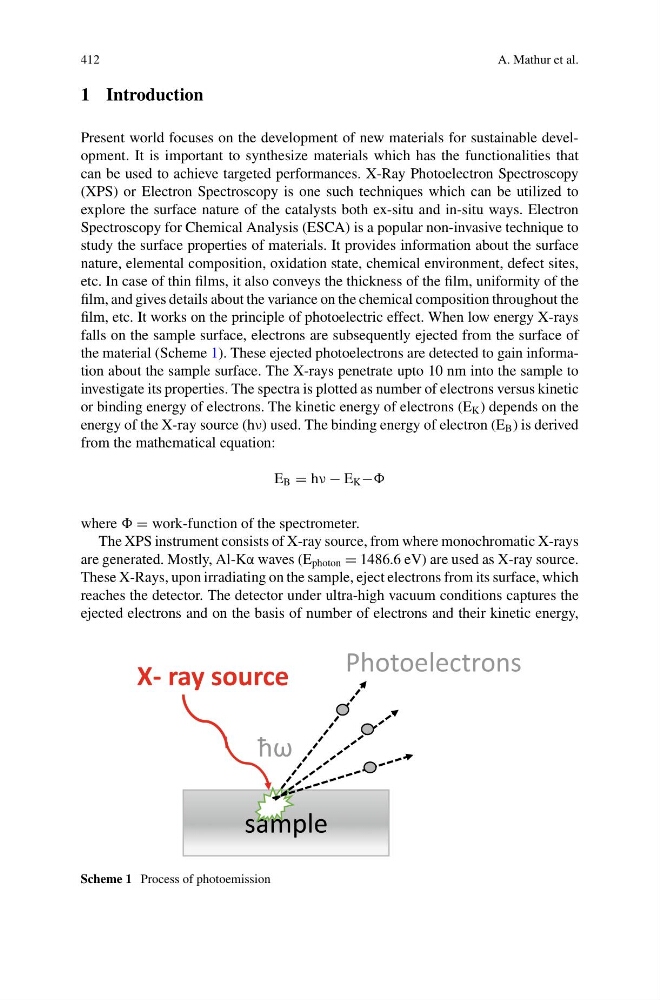
film, etc. It works on the principle of photoelectric effect. When low energy X-rays
falls on the sample surface, electrons are subsequently ejected from the surface of
the material (Scheme 1). These ejected photoelectrons are detected to gain information about the sample surface. The X-rays penetrate upto 10 nm into the sample to
investigate its properties. The spectra is plotted as number of electrons versus kinetic
or binding energy of electrons. The kinetic energy of electrons (E K ) depends on the
energy of the X-ray source (hν) used. The binding energy of electron (E B ) is derived
from the mathematical equation:
E B = hν − E K −
where = work-function of the spectrometer.
The XPS instrument consists of X-ray source, from where monochromatic X-rays
are generated. Mostly, Al-Kα waves (E photon = 1486.6 eV) are used as X-ray source.
These X-Rays, upon irradiating on the sample, eject electrons from its surface, which
reaches the detector. The detector under ultra-high vacuum conditions captures the
ejected electrons and on the basis of number of electrons and their kinetic energy,
Scheme 1 Process of photoemission
A. Mathur et al.
1 Introduction
Present world focuses on the development of new materials for sustainable development. It is important to synthesize materials which has the functionalities that
can be used to achieve targeted performances. X-Ray Photoelectron Spectroscopy
(XPS) or Electron Spectroscopy is one such techniques which can be utilized to
explore the surface nature of the catalysts both ex-situ and in-situ ways. Electron
Spectroscopy for Chemical Analysis (ESCA) is a popular non-invasive technique to
study the surface properties of materials. It provides information about the surface
nature, elemental composition, oxidation state, chemical environment, defect sites,
etc. In case of thin films, it also conveys the thickness of the film, uniformity of the
film, and gives details about the variance on the chemical composition throughout the
film, etc. It works on the principle of photoelectric effect. When low energy X-rays
falls on the sample surface, electrons are subsequently ejected from the surface of
the material (Scheme 1). These ejected photoelectrons are detected to gain information about the sample surface. The X-rays penetrate upto 10 nm into the sample to
investigate its properties. The spectra is plotted as number of electrons versus kinetic
or binding energy of electrons. The kinetic energy of electrons (E K ) depends on the
energy of the X-ray source (hν) used. The binding energy of electron (E B ) is derived
from the mathematical equation:
E B = hν − E K −
where = work-function of the spectrometer.
The XPS instrument consists of X-ray source, from where monochromatic X-rays
are generated. Mostly, Al-Kα waves (E photon = 1486.6 eV) are used as X-ray source.
These X-Rays, upon irradiating on the sample, eject electrons from its surface, which
reaches the detector. The detector under ultra-high vacuum conditions captures the
ejected electrons and on the basis of number of electrons and their kinetic energy,
Scheme 1 Process of photoemission