

26
H. Kaur et al.
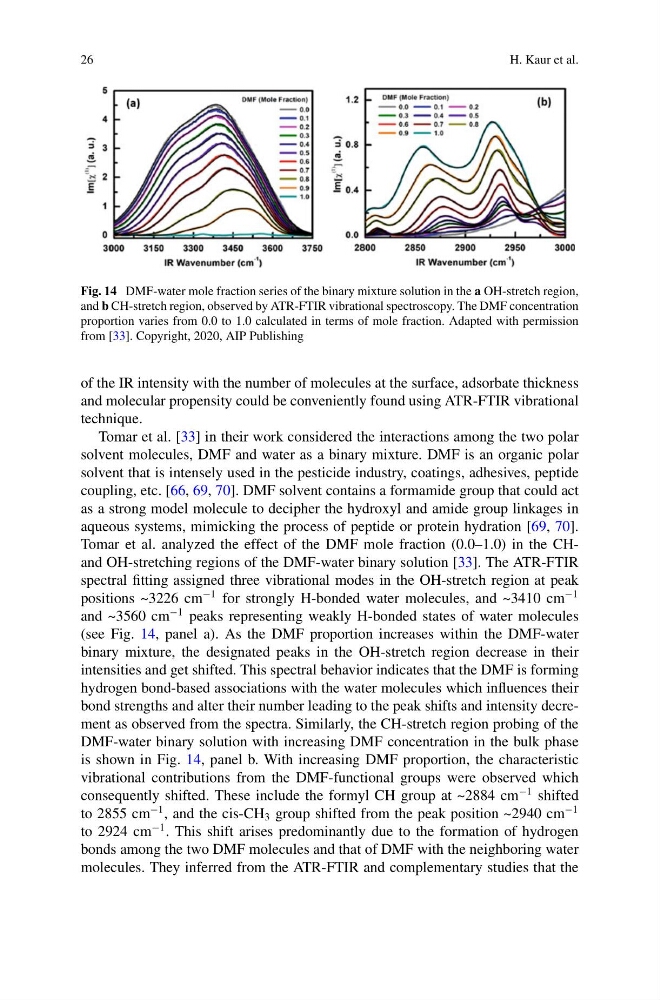
Fig. 14 DMF-water mole fraction series of the binary mixture solution in the a OH-stretch region,
and b CH-stretch region, observed by ATR-FTIR vibrational spectroscopy. The DMF concentration
proportion varies from 0.0 to 1.0 calculated in terms of mole fraction. Adapted with permission
from [33]. Copyright, 2020, AIP Publishing
of the IR intensity with the number of molecules at the surface, adsorbate thickness
and molecular propensity could be conveniently found using ATR-FTIR vibrational
technique.
Tomar et al. [33] in their work considered the interactions among the two polar
solvent molecules, DMF and water as a binary mixture. DMF is an organic polar
solvent that is intensely used in the pesticide industry, coatings, adhesives, peptide
coupling, etc. [66, 69, 70]. DMF solvent contains a formamide group that could act
as a strong model molecule to decipher the hydroxyl and amide group linkages in
aqueous systems, mimicking the process of peptide or protein hydration [69, 70].
Tomar et al. analyzed the effect of the DMF mole fraction (0.0–1.0) in the CHand OH-stretching regions of the DMF-water binary solution [33]. The ATR-FTIR
spectral fitting assigned three vibrational modes in the OH-stretch region at peak
positions ~3226 cm
−1 for strongly H-bonded water molecules, and ~3410 cm
−1
and ~3560 cm
−1 peaks representing weakly H-bonded states of water molecules
(see Fig. 14, panel a). As the DMF proportion increases within the DMF-water
binary mixture, the designated peaks in the OH-stretch region decrease in their
intensities and get shifted. This spectral behavior indicates that the DMF is forming
hydrogen bond-based associations with the water molecules which influences their
bond strengths and alter their number leading to the peak shifts and intensity decrement as observed from the spectra. Similarly, the CH-stretch region probing of the
DMF-water binary solution with increasing DMF concentration in the bulk phase
is shown in Fig. 14, panel b. With increasing DMF proportion, the characteristic
vibrational contributions from the DMF-functional groups were observed which
consequently shifted. These include the formyl CH group at ~2884 cm
−1 shifted
to 2855 cm
−1 , and the cis-CH 3 group shifted from the peak position ~2940 cm
−1
to 2924 cm
−1 . This shift arises predominantly due to the formation of hydrogen
bonds among the two DMF molecules and that of DMF with the neighboring water
molecules. They inferred from the ATR-FTIR and complementary studies that the
H. Kaur et al.
Fig. 14 DMF-water mole fraction series of the binary mixture solution in the a OH-stretch region,
and b CH-stretch region, observed by ATR-FTIR vibrational spectroscopy. The DMF concentration
proportion varies from 0.0 to 1.0 calculated in terms of mole fraction. Adapted with permission
from [33]. Copyright, 2020, AIP Publishing
of the IR intensity with the number of molecules at the surface, adsorbate thickness
and molecular propensity could be conveniently found using ATR-FTIR vibrational
technique.
Tomar et al. [33] in their work considered the interactions among the two polar
solvent molecules, DMF and water as a binary mixture. DMF is an organic polar
solvent that is intensely used in the pesticide industry, coatings, adhesives, peptide
coupling, etc. [66, 69, 70]. DMF solvent contains a formamide group that could act
as a strong model molecule to decipher the hydroxyl and amide group linkages in
aqueous systems, mimicking the process of peptide or protein hydration [69, 70].
Tomar et al. analyzed the effect of the DMF mole fraction (0.0–1.0) in the CHand OH-stretching regions of the DMF-water binary solution [33]. The ATR-FTIR
spectral fitting assigned three vibrational modes in the OH-stretch region at peak
positions ~3226 cm
−1 for strongly H-bonded water molecules, and ~3410 cm
−1
and ~3560 cm
−1 peaks representing weakly H-bonded states of water molecules
(see Fig. 14, panel a). As the DMF proportion increases within the DMF-water
binary mixture, the designated peaks in the OH-stretch region decrease in their
intensities and get shifted. This spectral behavior indicates that the DMF is forming
hydrogen bond-based associations with the water molecules which influences their
bond strengths and alter their number leading to the peak shifts and intensity decrement as observed from the spectra. Similarly, the CH-stretch region probing of the
DMF-water binary solution with increasing DMF concentration in the bulk phase
is shown in Fig. 14, panel b. With increasing DMF proportion, the characteristic
vibrational contributions from the DMF-functional groups were observed which
consequently shifted. These include the formyl CH group at ~2884 cm
−1 shifted
to 2855 cm
−1 , and the cis-CH 3 group shifted from the peak position ~2940 cm
−1
to 2924 cm
−1 . This shift arises predominantly due to the formation of hydrogen
bonds among the two DMF molecules and that of DMF with the neighboring water
molecules. They inferred from the ATR-FTIR and complementary studies that the