

400
P. Singh et al.
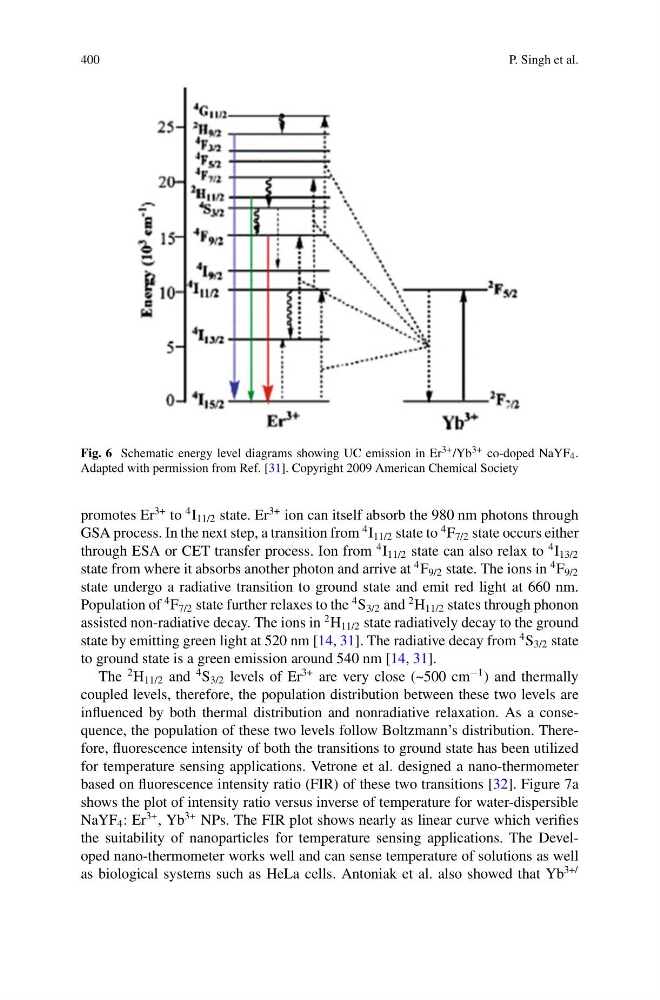
Fig. 6 Schematic energy level diagrams showing UC emission in Er 3+ /Yb 3+ co-doped NaYF 4 .
Adapted with permission from Ref. [31]. Copyright 2009 American Chemical Society
promotes Er
3+ to
4 I 11/2 state. Er
3+ ion can itself absorb the 980 nm photons through
GSA process. In the next step, a transition from
4 I 11/2 state to
4 F 7/2 state occurs either
through ESA or CET transfer process. Ion from
4 I 11/2 state can also relax to
4 I 13/2
state from where it absorbs another photon and arrive at
4 F 9/2 state. The ions in
4 F 9/2
state undergo a radiative transition to ground state and emit red light at 660 nm.
Population of
4 F 7/2 state further relaxes to the
4 S 3/2 and
2 H 11/2 states through phonon
assisted non-radiative decay. The ions in
2 H 11/2 state radiatively decay to the ground
state by emitting green light at 520 nm [14, 31]. The radiative decay from
4 S 3/2 state
to ground state is a green emission around 540 nm [14, 31].
The
2 H 11/2 and
4 S 3/2 levels of Er
3+ are very close (~500 cm
−1 ) and thermally
coupled levels, therefore, the population distribution between these two levels are
influenced by both thermal distribution and nonradiative relaxation. As a consequence, the population of these two levels follow Boltzmann’s distribution. Therefore, fluorescence intensity of both the transitions to ground state has been utilized
for temperature sensing applications. Vetrone et al. designed a nano-thermometer
based on fluorescence intensity ratio (FIR) of these two transitions [32]. Figure 7a
shows the plot of intensity ratio versus inverse of temperature for water-dispersible
NaYF 4 : Er
3+ , Yb
3+ NPs. The FIR plot shows nearly as linear curve which verifies
the suitability of nanoparticles for temperature sensing applications. The Developed nano-thermometer works well and can sense temperature of solutions as well
as biological systems such as HeLa cells. Antoniak et al. also showed that Yb
3+/
P. Singh et al.
Fig. 6 Schematic energy level diagrams showing UC emission in Er 3+ /Yb 3+ co-doped NaYF 4 .
Adapted with permission from Ref. [31]. Copyright 2009 American Chemical Society
promotes Er
3+ to
4 I 11/2 state. Er
3+ ion can itself absorb the 980 nm photons through
GSA process. In the next step, a transition from
4 I 11/2 state to
4 F 7/2 state occurs either
through ESA or CET transfer process. Ion from
4 I 11/2 state can also relax to
4 I 13/2
state from where it absorbs another photon and arrive at
4 F 9/2 state. The ions in
4 F 9/2
state undergo a radiative transition to ground state and emit red light at 660 nm.
Population of
4 F 7/2 state further relaxes to the
4 S 3/2 and
2 H 11/2 states through phonon
assisted non-radiative decay. The ions in
2 H 11/2 state radiatively decay to the ground
state by emitting green light at 520 nm [14, 31]. The radiative decay from
4 S 3/2 state
to ground state is a green emission around 540 nm [14, 31].
The
2 H 11/2 and
4 S 3/2 levels of Er
3+ are very close (~500 cm
−1 ) and thermally
coupled levels, therefore, the population distribution between these two levels are
influenced by both thermal distribution and nonradiative relaxation. As a consequence, the population of these two levels follow Boltzmann’s distribution. Therefore, fluorescence intensity of both the transitions to ground state has been utilized
for temperature sensing applications. Vetrone et al. designed a nano-thermometer
based on fluorescence intensity ratio (FIR) of these two transitions [32]. Figure 7a
shows the plot of intensity ratio versus inverse of temperature for water-dispersible
NaYF 4 : Er
3+ , Yb
3+ NPs. The FIR plot shows nearly as linear curve which verifies
the suitability of nanoparticles for temperature sensing applications. The Developed nano-thermometer works well and can sense temperature of solutions as well
as biological systems such as HeLa cells. Antoniak et al. also showed that Yb
3+/