

Photon Upconversion Spectroscopy
399
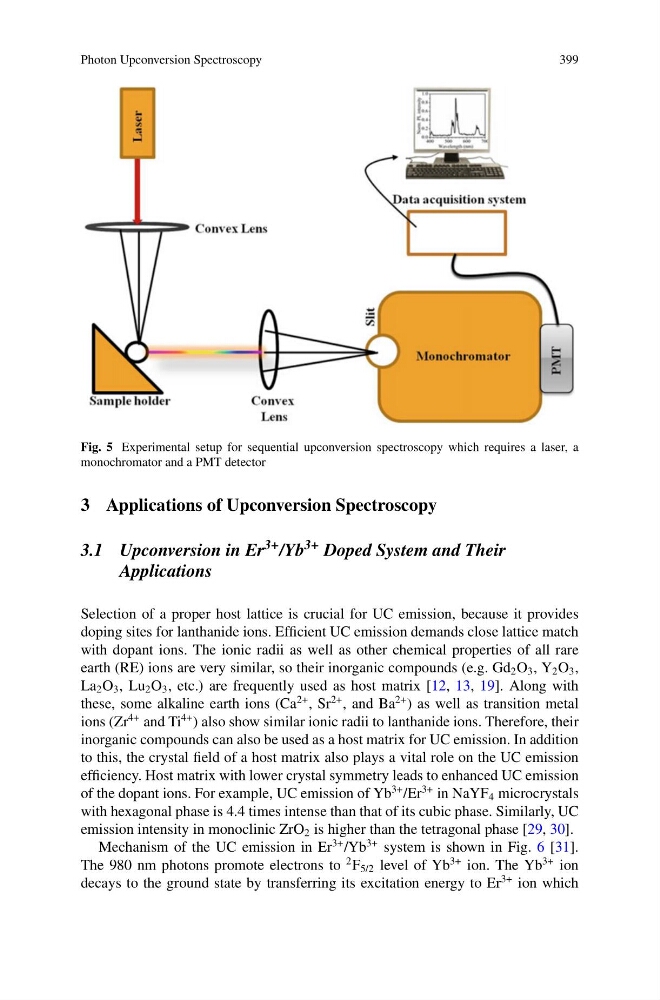
Fig. 5 Experimental setup for sequential upconversion spectroscopy which requires a laser, a
monochromator and a PMT detector
3 Applications of Upconversion Spectroscopy
3.1 Upconversion in Er 3+ /Yb 3+ Doped System and Their
Applications
Selection of a proper host lattice is crucial for UC emission, because it provides
doping sites for lanthanide ions. Efficient UC emission demands close lattice match
with dopant ions. The ionic radii as well as other chemical properties of all rare
earth (RE) ions are very similar, so their inorganic compounds (e.g. Gd 2 O 3 , Y 2 O 3 ,
La 2 O 3 , Lu 2 O 3 , etc.) are frequently used as host matrix [12, 13, 19]. Along with
these, some alkaline earth ions (Ca
2+ , Sr
2+ , and Ba
2+ ) as well as transition metal
ions (Zr
4+ and Ti
4+ ) also show similar ionic radii to lanthanide ions. Therefore, their
inorganic compounds can also be used as a host matrix for UC emission. In addition
to this, the crystal field of a host matrix also plays a vital role on the UC emission
efficiency. Host matrix with lower crystal symmetry leads to enhanced UC emission
of the dopant ions. For example, UC emission of Yb
3+ /Er
3+ in NaYF 4 microcrystals
with hexagonal phase is 4.4 times intense than that of its cubic phase. Similarly, UC
emission intensity in monoclinic ZrO 2 is higher than the tetragonal phase [29, 30].
Mechanism of the UC emission in Er
3+ /Yb
3+ system is shown in Fig. 6 [31].
The 980 nm photons promote electrons to
2 F 5/2 level of Yb
3+ ion. The Yb
3+ ion
decays to the ground state by transferring its excitation energy to Er
3+ ion which
399
Fig. 5 Experimental setup for sequential upconversion spectroscopy which requires a laser, a
monochromator and a PMT detector
3 Applications of Upconversion Spectroscopy
3.1 Upconversion in Er 3+ /Yb 3+ Doped System and Their
Applications
Selection of a proper host lattice is crucial for UC emission, because it provides
doping sites for lanthanide ions. Efficient UC emission demands close lattice match
with dopant ions. The ionic radii as well as other chemical properties of all rare
earth (RE) ions are very similar, so their inorganic compounds (e.g. Gd 2 O 3 , Y 2 O 3 ,
La 2 O 3 , Lu 2 O 3 , etc.) are frequently used as host matrix [12, 13, 19]. Along with
these, some alkaline earth ions (Ca
2+ , Sr
2+ , and Ba
2+ ) as well as transition metal
ions (Zr
4+ and Ti
4+ ) also show similar ionic radii to lanthanide ions. Therefore, their
inorganic compounds can also be used as a host matrix for UC emission. In addition
to this, the crystal field of a host matrix also plays a vital role on the UC emission
efficiency. Host matrix with lower crystal symmetry leads to enhanced UC emission
of the dopant ions. For example, UC emission of Yb
3+ /Er
3+ in NaYF 4 microcrystals
with hexagonal phase is 4.4 times intense than that of its cubic phase. Similarly, UC
emission intensity in monoclinic ZrO 2 is higher than the tetragonal phase [29, 30].
Mechanism of the UC emission in Er
3+ /Yb
3+ system is shown in Fig. 6 [31].
The 980 nm photons promote electrons to
2 F 5/2 level of Yb
3+ ion. The Yb
3+ ion
decays to the ground state by transferring its excitation energy to Er
3+ ion which