

356
A. L. Chakraborty and A. Roy
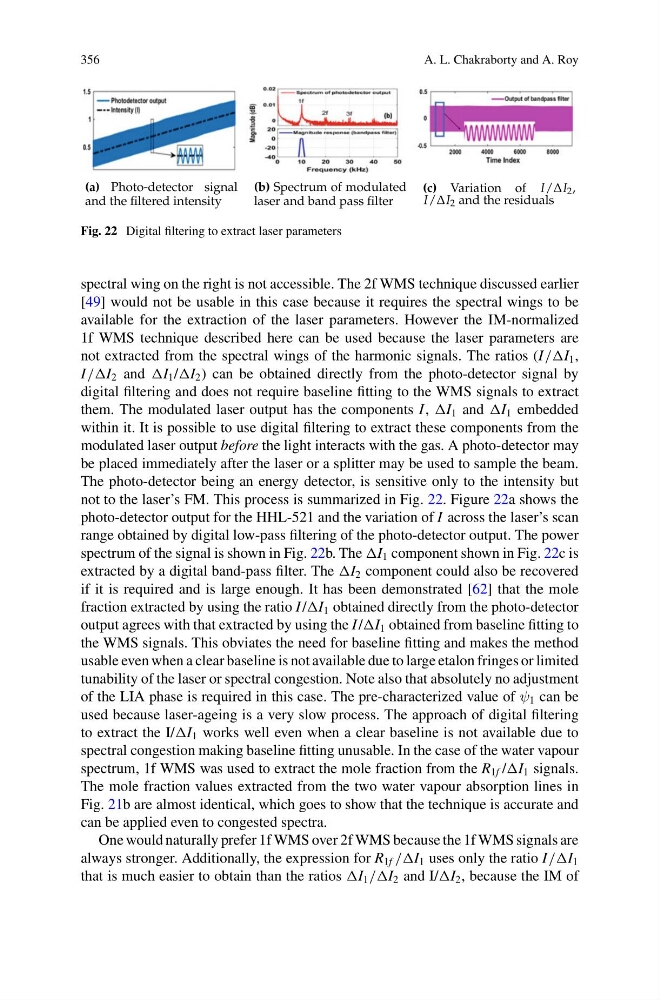
Fig. 22 Digital filtering to extract laser parameters
spectral wing on the right is not accessible. The 2f WMS technique discussed earlier
[49] would not be usable in this case because it requires the spectral wings to be
available for the extraction of the laser parameters. However the IM-normalized
1f WMS technique described here can be used because the laser parameters are
not extracted from the spectral wings of the harmonic signals. The ratios (I //I 1 ,
I //I 2 and 1 / 2 ) can be obtained directly from the photo-detector signal by
digital filtering and does not require baseline fitting to the WMS signals to extract
them. The modulated laser output has the components I , 1 and 1 embedded
within it. It is possible to use digital filtering to extract these components from the
modulated laser output before the light interacts with the gas. A photo-detector may
be placed immediately after the laser or a splitter may be used to sample the beam.
The photo-detector being an energy detector, is sensitive only to the intensity but
not to the laser’s FM. This process is summarized in Fig. 22. Figure 22a shows the
photo-detector output for the HHL-521 and the variation of I across the laser’s scan
range obtained by digital low-pass filtering of the photo-detector output. The power
spectrum of the signal is shown in Fig. 22b. The 1 component shown in Fig. 22c is
extracted by a digital band-pass filter. The 2 component could also be recovered
if it is required and is large enough. It has been demonstrated [62] that the mole
fraction extracted by using the ratio I / 1 obtained directly from the photo-detector
output agrees with that extracted by using the I / 1 obtained from baseline fitting to
the WMS signals. This obviates the need for baseline fitting and makes the method
usable even when a clear baseline is not available due to large etalon fringes or limited
tunability of the laser or spectral congestion. Note also that absolutely no adjustment
of the LIA phase is required in this case. The pre-characterized value of ψ 1 can be
used because laser-ageing is a very slow process. The approach of digital filtering
to extract the I/ 1 works well even when a clear baseline is not available due to
spectral congestion making baseline fitting unusable. In the case of the water vapour
spectrum, 1f WMS was used to extract the mole fraction from the R 1f / 1 signals.
The mole fraction values extracted from the two water vapour absorption lines in
Fig. 21b are almost identical, which goes to show that the technique is accurate and
can be applied even to congested spectra.
One would naturally prefer 1f WMS over 2f WMS because the 1f WMS signals are
always stronger. Additionally, the expression for R 1f //I 1 uses only the ratio I //I 1
that is much easier to obtain than the ratios 1 //I 2 and I/ 2 , because the IM of
A. L. Chakraborty and A. Roy
Fig. 22 Digital filtering to extract laser parameters
spectral wing on the right is not accessible. The 2f WMS technique discussed earlier
[49] would not be usable in this case because it requires the spectral wings to be
available for the extraction of the laser parameters. However the IM-normalized
1f WMS technique described here can be used because the laser parameters are
not extracted from the spectral wings of the harmonic signals. The ratios (I //I 1 ,
I //I 2 and 1 / 2 ) can be obtained directly from the photo-detector signal by
digital filtering and does not require baseline fitting to the WMS signals to extract
them. The modulated laser output has the components I , 1 and 1 embedded
within it. It is possible to use digital filtering to extract these components from the
modulated laser output before the light interacts with the gas. A photo-detector may
be placed immediately after the laser or a splitter may be used to sample the beam.
The photo-detector being an energy detector, is sensitive only to the intensity but
not to the laser’s FM. This process is summarized in Fig. 22. Figure 22a shows the
photo-detector output for the HHL-521 and the variation of I across the laser’s scan
range obtained by digital low-pass filtering of the photo-detector output. The power
spectrum of the signal is shown in Fig. 22b. The 1 component shown in Fig. 22c is
extracted by a digital band-pass filter. The 2 component could also be recovered
if it is required and is large enough. It has been demonstrated [62] that the mole
fraction extracted by using the ratio I / 1 obtained directly from the photo-detector
output agrees with that extracted by using the I / 1 obtained from baseline fitting to
the WMS signals. This obviates the need for baseline fitting and makes the method
usable even when a clear baseline is not available due to large etalon fringes or limited
tunability of the laser or spectral congestion. Note also that absolutely no adjustment
of the LIA phase is required in this case. The pre-characterized value of ψ 1 can be
used because laser-ageing is a very slow process. The approach of digital filtering
to extract the I/ 1 works well even when a clear baseline is not available due to
spectral congestion making baseline fitting unusable. In the case of the water vapour
spectrum, 1f WMS was used to extract the mole fraction from the R 1f / 1 signals.
The mole fraction values extracted from the two water vapour absorption lines in
Fig. 21b are almost identical, which goes to show that the technique is accurate and
can be applied even to congested spectra.
One would naturally prefer 1f WMS over 2f WMS because the 1f WMS signals are
always stronger. Additionally, the expression for R 1f //I 1 uses only the ratio I //I 1
that is much easier to obtain than the ratios 1 //I 2 and I/ 2 , because the IM of