

Wavelength Modulation Spectroscopy
349
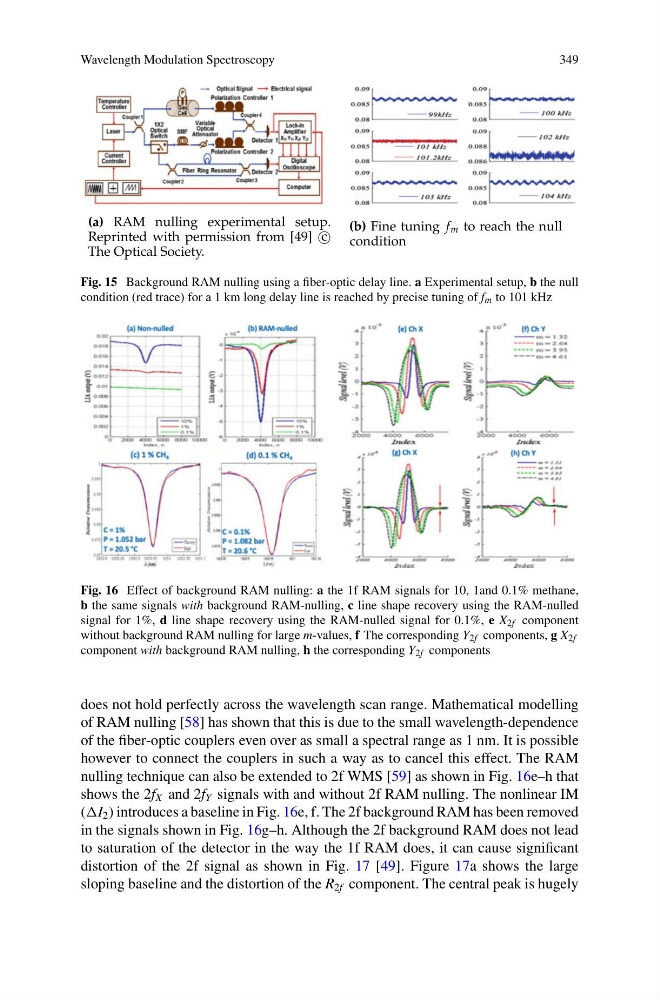
Fig. 15 Background RAM nulling using a fiber-optic delay line. a Experimental setup, b the null
condition (red trace) for a 1 km long delay line is reached by precise tuning of f m to 101 kHz
Fig. 16 Effect of background RAM nulling: a the 1f RAM signals for 10, 1and 0.1% methane,
b the same signals with background RAM-nulling, c line shape recovery using the RAM-nulled
signal for 1%, d line shape recovery using the RAM-nulled signal for 0.1%, e X 2f component
without background RAM nulling for large m-values, f The corresponding Y 2f components, g X 2f
component with background RAM nulling, h the corresponding Y 2f components
does not hold perfectly across the wavelength scan range. Mathematical modelling
of RAM nulling [58] has shown that this is due to the small wavelength-dependence
of the fiber-optic couplers even over as small a spectral range as 1 nm. It is possible
however to connect the couplers in such a way as to cancel this effect. The RAM
nulling technique can also be extended to 2f WMS [59] as shown in Fig. 16e–h that
shows the 2f X and 2f Y signals with and without 2f RAM nulling. The nonlinear IM
( 2 ) introduces a baseline in Fig. 16e, f. The 2f background RAM has been removed
in the signals shown in Fig. 16g–h. Although the 2f background RAM does not lead
to saturation of the detector in the way the 1f RAM does, it can cause significant
distortion of the 2f signal as shown in Fig. 17 [49]. Figure 17a shows the large
sloping baseline and the distortion of the R 2f component. The central peak is hugely
349
Fig. 15 Background RAM nulling using a fiber-optic delay line. a Experimental setup, b the null
condition (red trace) for a 1 km long delay line is reached by precise tuning of f m to 101 kHz
Fig. 16 Effect of background RAM nulling: a the 1f RAM signals for 10, 1and 0.1% methane,
b the same signals with background RAM-nulling, c line shape recovery using the RAM-nulled
signal for 1%, d line shape recovery using the RAM-nulled signal for 0.1%, e X 2f component
without background RAM nulling for large m-values, f The corresponding Y 2f components, g X 2f
component with background RAM nulling, h the corresponding Y 2f components
does not hold perfectly across the wavelength scan range. Mathematical modelling
of RAM nulling [58] has shown that this is due to the small wavelength-dependence
of the fiber-optic couplers even over as small a spectral range as 1 nm. It is possible
however to connect the couplers in such a way as to cancel this effect. The RAM
nulling technique can also be extended to 2f WMS [59] as shown in Fig. 16e–h that
shows the 2f X and 2f Y signals with and without 2f RAM nulling. The nonlinear IM
( 2 ) introduces a baseline in Fig. 16e, f. The 2f background RAM has been removed
in the signals shown in Fig. 16g–h. Although the 2f background RAM does not lead
to saturation of the detector in the way the 1f RAM does, it can cause significant
distortion of the 2f signal as shown in Fig. 17 [49]. Figure 17a shows the large
sloping baseline and the distortion of the R 2f component. The central peak is hugely