

344
A. L. Chakraborty and A. Roy
rather than the X or Y components individually because no phase adjustment is
required in this case. The same approach is also used for 1f WMS as explained later.
The crucial aspect of a practical TDLS system design is accurate knowledge of the
variation of the laser parameters I , I 1 , I 2 , ψ 1 , ψ 2 and ν across the wavelength
scan. Equations 23–26 show that the simulation of 1f WMS and 2f WMS signals
requires several Fourier coefficients (H 0 , H 1 , H 2 , H 3 and H 4 ) to be simulated as
well as the laser parameters (I , I 1 , I 2 , ψ 1 , ψ 2 ) to be accurately determined. The
distorting effect of the IM must be included in the simulation of R 2f for accurate gas
parameter extraction. The established method of estimating the mole fraction as well
as the pressure is to first generate a simulated R 2f signal by using the spectroscopic
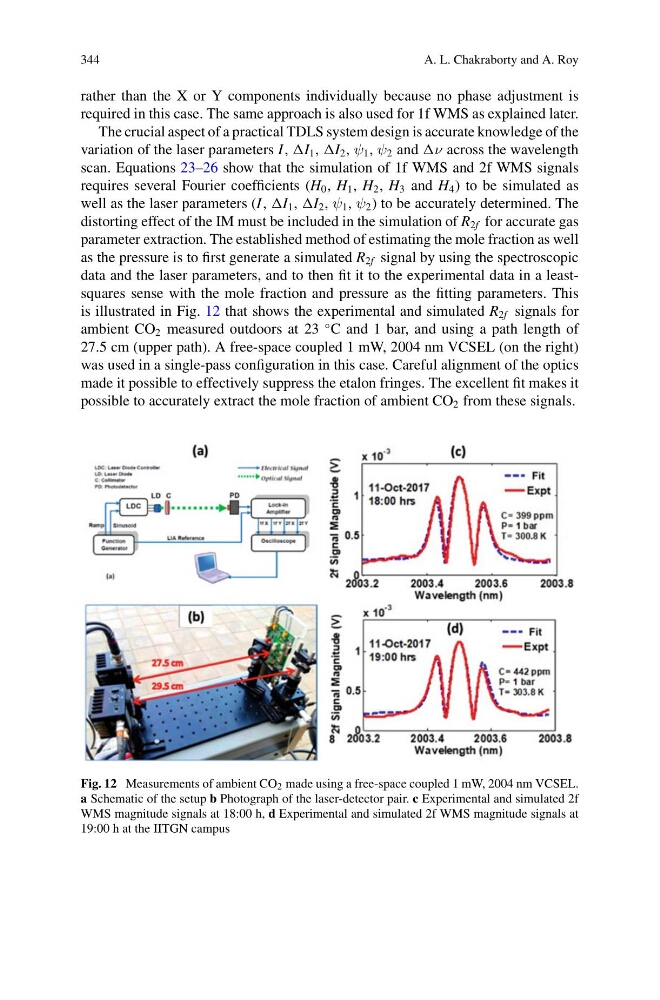
data and the laser parameters, and to then fit it to the experimental data in a leastsquares sense with the mole fraction and pressure as the fitting parameters. This
is illustrated in Fig. 12 that shows the experimental and simulated R 2f signals for
ambient CO 2 measured outdoors at 23
◦ C and 1 bar, and using a path length of
27.5 cm (upper path). A free-space coupled 1 mW, 2004 nm VCSEL (on the right)
was used in a single-pass configuration in this case. Careful alignment of the optics
made it possible to effectively suppress the etalon fringes. The excellent fit makes it
possible to accurately extract the mole fraction of ambient CO 2 from these signals.
Fig. 12 Measurements of ambient CO 2 made using a free-space coupled 1 mW, 2004 nm VCSEL.
a Schematic of the setup b Photograph of the laser-detector pair. c Experimental and simulated 2f
WMS magnitude signals at 18:00 h, d Experimental and simulated 2f WMS magnitude signals at
19:00 h at the IITGN campus
A. L. Chakraborty and A. Roy
rather than the X or Y components individually because no phase adjustment is
required in this case. The same approach is also used for 1f WMS as explained later.
The crucial aspect of a practical TDLS system design is accurate knowledge of the
variation of the laser parameters I , I 1 , I 2 , ψ 1 , ψ 2 and ν across the wavelength
scan. Equations 23–26 show that the simulation of 1f WMS and 2f WMS signals
requires several Fourier coefficients (H 0 , H 1 , H 2 , H 3 and H 4 ) to be simulated as
well as the laser parameters (I , I 1 , I 2 , ψ 1 , ψ 2 ) to be accurately determined. The
distorting effect of the IM must be included in the simulation of R 2f for accurate gas
parameter extraction. The established method of estimating the mole fraction as well
as the pressure is to first generate a simulated R 2f signal by using the spectroscopic
data and the laser parameters, and to then fit it to the experimental data in a leastsquares sense with the mole fraction and pressure as the fitting parameters. This
is illustrated in Fig. 12 that shows the experimental and simulated R 2f signals for
ambient CO 2 measured outdoors at 23
◦ C and 1 bar, and using a path length of
27.5 cm (upper path). A free-space coupled 1 mW, 2004 nm VCSEL (on the right)
was used in a single-pass configuration in this case. Careful alignment of the optics
made it possible to effectively suppress the etalon fringes. The excellent fit makes it
possible to accurately extract the mole fraction of ambient CO 2 from these signals.
Fig. 12 Measurements of ambient CO 2 made using a free-space coupled 1 mW, 2004 nm VCSEL.
a Schematic of the setup b Photograph of the laser-detector pair. c Experimental and simulated 2f
WMS magnitude signals at 18:00 h, d Experimental and simulated 2f WMS magnitude signals at
19:00 h at the IITGN campus