

340
A. L. Chakraborty and A. Roy
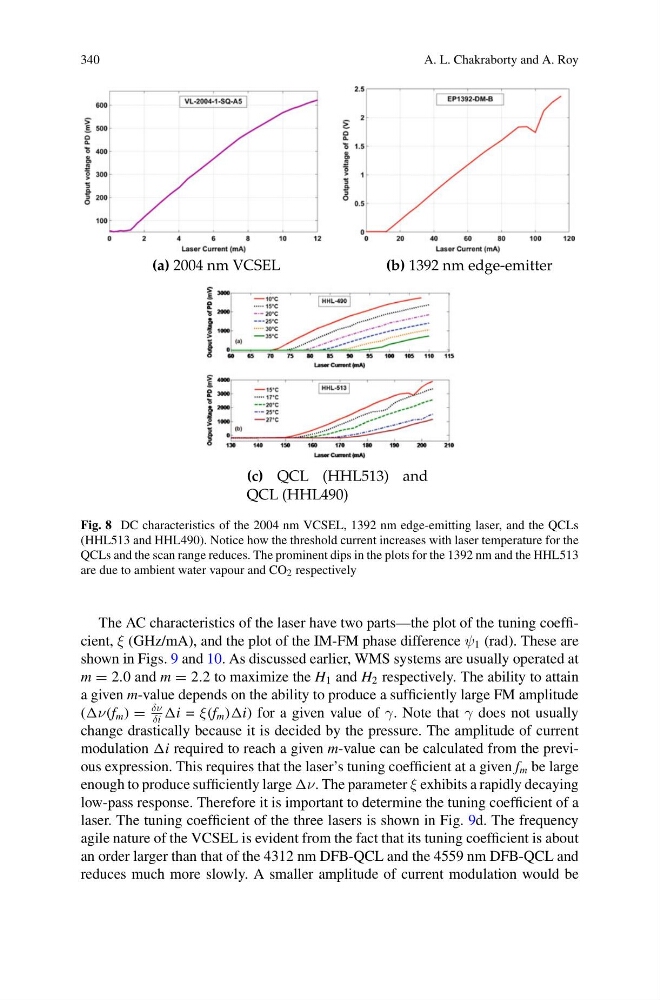
Fig. 8 DC characteristics of the 2004 nm VCSEL, 1392 nm edge-emitting laser, and the QCLs
(HHL513 and HHL490). Notice how the threshold current increases with laser temperature for the
QCLs and the scan range reduces. The prominent dips in the plots for the 1392 nm and the HHL513
are due to ambient water vapour and CO 2 respectively
The AC characteristics of the laser have two parts—the plot of the tuning coefficient, ξ (GHz/mA), and the plot of the IM-FM phase difference ψ 1 (rad). These are
shown in Figs. 9 and 10. As discussed earlier, WMS systems are usually operated at
m = 2.0 and m = 2.2 to maximize the H 1 and H 2 respectively. The ability to attain
a given m-value depends on the ability to produce a sufficiently large FM amplitude
( m ) =
δν
δi
= ξ(f m ))i) for a given value of γ. Note that γ does not usually
change drastically because it is decided by the pressure. The amplitude of current
modulation required to reach a given m-value can be calculated from the previous expression. This requires that the laser’s tuning coefficient at a given f m be large
enough to produce sufficiently large The parameter ξ exhibits a rapidly decaying
low-pass response. Therefore it is important to determine the tuning coefficient of a
laser. The tuning coefficient of the three lasers is shown in Fig. 9d. The frequency
agile nature of the VCSEL is evident from the fact that its tuning coefficient is about
an order larger than that of the 4312 nm DFB-QCL and the 4559 nm DFB-QCL and
reduces much more slowly. A smaller amplitude of current modulation would be
A. L. Chakraborty and A. Roy
Fig. 8 DC characteristics of the 2004 nm VCSEL, 1392 nm edge-emitting laser, and the QCLs
(HHL513 and HHL490). Notice how the threshold current increases with laser temperature for the
QCLs and the scan range reduces. The prominent dips in the plots for the 1392 nm and the HHL513
are due to ambient water vapour and CO 2 respectively
The AC characteristics of the laser have two parts—the plot of the tuning coefficient, ξ (GHz/mA), and the plot of the IM-FM phase difference ψ 1 (rad). These are
shown in Figs. 9 and 10. As discussed earlier, WMS systems are usually operated at
m = 2.0 and m = 2.2 to maximize the H 1 and H 2 respectively. The ability to attain
a given m-value depends on the ability to produce a sufficiently large FM amplitude
( m ) =
δν
δi
= ξ(f m ))i) for a given value of γ. Note that γ does not usually
change drastically because it is decided by the pressure. The amplitude of current
modulation required to reach a given m-value can be calculated from the previous expression. This requires that the laser’s tuning coefficient at a given f m be large
enough to produce sufficiently large The parameter ξ exhibits a rapidly decaying
low-pass response. Therefore it is important to determine the tuning coefficient of a
laser. The tuning coefficient of the three lasers is shown in Fig. 9d. The frequency
agile nature of the VCSEL is evident from the fact that its tuning coefficient is about
an order larger than that of the 4312 nm DFB-QCL and the 4559 nm DFB-QCL and
reduces much more slowly. A smaller amplitude of current modulation would be