

Wavelength Modulation Spectroscopy
339
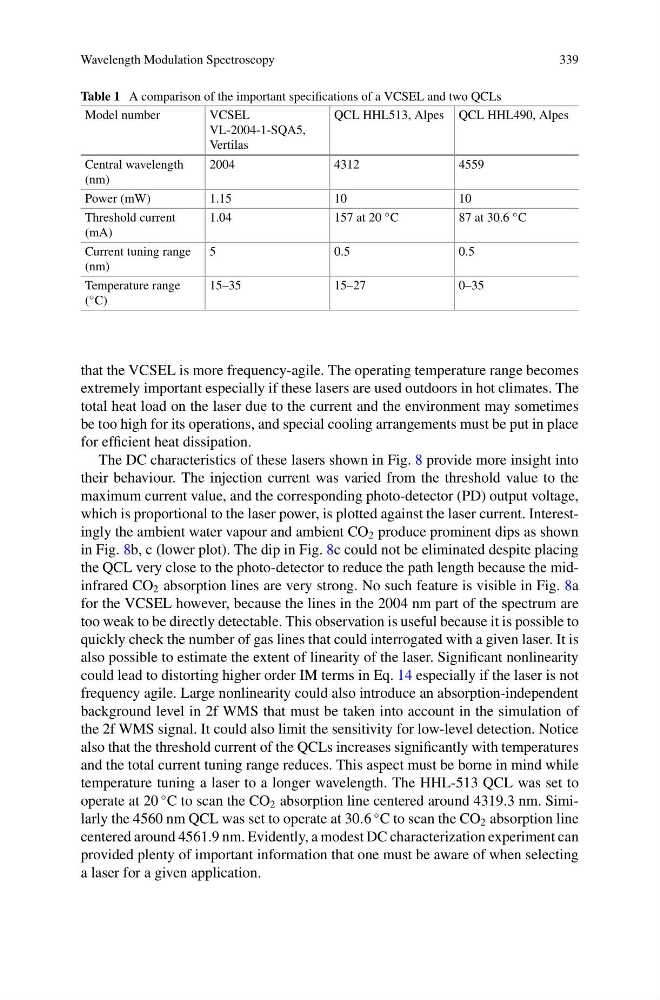
Table 1 A comparison of the important specifications of a VCSEL and two QCLs
Model number
VCSEL
VL-2004-1-SQA5,
Vertilas
QCL HHL513, Alpes QCL HHL490, Alpes
Central wavelength
(nm)
2004
4312
4559
Power (mW)
1.15
10
10
Threshold current
(mA)
1.04
157 at 20 ◦ C
87 at 30.6 ◦ C
Current tuning range
(nm)
5
0.5
0.5
Temperature range
( ◦ C)
15–35
15–27
0–35
that the VCSEL is more frequency-agile. The operating temperature range becomes
extremely important especially if these lasers are used outdoors in hot climates. The
total heat load on the laser due to the current and the environment may sometimes
be too high for its operations, and special cooling arrangements must be put in place
for efficient heat dissipation.
The DC characteristics of these lasers shown in Fig. 8 provide more insight into
their behaviour. The injection current was varied from the threshold value to the
maximum current value, and the corresponding photo-detector (PD) output voltage,
which is proportional to the laser power, is plotted against the laser current. Interestingly the ambient water vapour and ambient CO 2 produce prominent dips as shown
in Fig. 8b, c (lower plot). The dip in Fig. 8c could not be eliminated despite placing
the QCL very close to the photo-detector to reduce the path length because the midinfrared CO 2 absorption lines are very strong. No such feature is visible in Fig. 8a
for the VCSEL however, because the lines in the 2004 nm part of the spectrum are
too weak to be directly detectable. This observation is useful because it is possible to
quickly check the number of gas lines that could interrogated with a given laser. It is
also possible to estimate the extent of linearity of the laser. Significant nonlinearity
could lead to distorting higher order IM terms in Eq. 14 especially if the laser is not
frequency agile. Large nonlinearity could also introduce an absorption-independent
background level in 2f WMS that must be taken into account in the simulation of
the 2f WMS signal. It could also limit the sensitivity for low-level detection. Notice
also that the threshold current of the QCLs increases significantly with temperatures
and the total current tuning range reduces. This aspect must be borne in mind while
temperature tuning a laser to a longer wavelength. The HHL-513 QCL was set to
operate at 20
◦ C to scan the CO 2 absorption line centered around 4319.3 nm. Similarly the 4560 nm QCL was set to operate at 30.6
◦ C to scan the CO 2 absorption line
centered around 4561.9 nm. Evidently, a modest DC characterization experiment can
provided plenty of important information that one must be aware of when selecting
a laser for a given application.
339
Table 1 A comparison of the important specifications of a VCSEL and two QCLs
Model number
VCSEL
VL-2004-1-SQA5,
Vertilas
QCL HHL513, Alpes QCL HHL490, Alpes
Central wavelength
(nm)
2004
4312
4559
Power (mW)
1.15
10
10
Threshold current
(mA)
1.04
157 at 20 ◦ C
87 at 30.6 ◦ C
Current tuning range
(nm)
5
0.5
0.5
Temperature range
( ◦ C)
15–35
15–27
0–35
that the VCSEL is more frequency-agile. The operating temperature range becomes
extremely important especially if these lasers are used outdoors in hot climates. The
total heat load on the laser due to the current and the environment may sometimes
be too high for its operations, and special cooling arrangements must be put in place
for efficient heat dissipation.
The DC characteristics of these lasers shown in Fig. 8 provide more insight into
their behaviour. The injection current was varied from the threshold value to the
maximum current value, and the corresponding photo-detector (PD) output voltage,
which is proportional to the laser power, is plotted against the laser current. Interestingly the ambient water vapour and ambient CO 2 produce prominent dips as shown
in Fig. 8b, c (lower plot). The dip in Fig. 8c could not be eliminated despite placing
the QCL very close to the photo-detector to reduce the path length because the midinfrared CO 2 absorption lines are very strong. No such feature is visible in Fig. 8a
for the VCSEL however, because the lines in the 2004 nm part of the spectrum are
too weak to be directly detectable. This observation is useful because it is possible to
quickly check the number of gas lines that could interrogated with a given laser. It is
also possible to estimate the extent of linearity of the laser. Significant nonlinearity
could lead to distorting higher order IM terms in Eq. 14 especially if the laser is not
frequency agile. Large nonlinearity could also introduce an absorption-independent
background level in 2f WMS that must be taken into account in the simulation of
the 2f WMS signal. It could also limit the sensitivity for low-level detection. Notice
also that the threshold current of the QCLs increases significantly with temperatures
and the total current tuning range reduces. This aspect must be borne in mind while
temperature tuning a laser to a longer wavelength. The HHL-513 QCL was set to
operate at 20
◦ C to scan the CO 2 absorption line centered around 4319.3 nm. Similarly the 4560 nm QCL was set to operate at 30.6
◦ C to scan the CO 2 absorption line
centered around 4561.9 nm. Evidently, a modest DC characterization experiment can
provided plenty of important information that one must be aware of when selecting
a laser for a given application.