

332
A. L. Chakraborty and A. Roy
3 Direct Detection
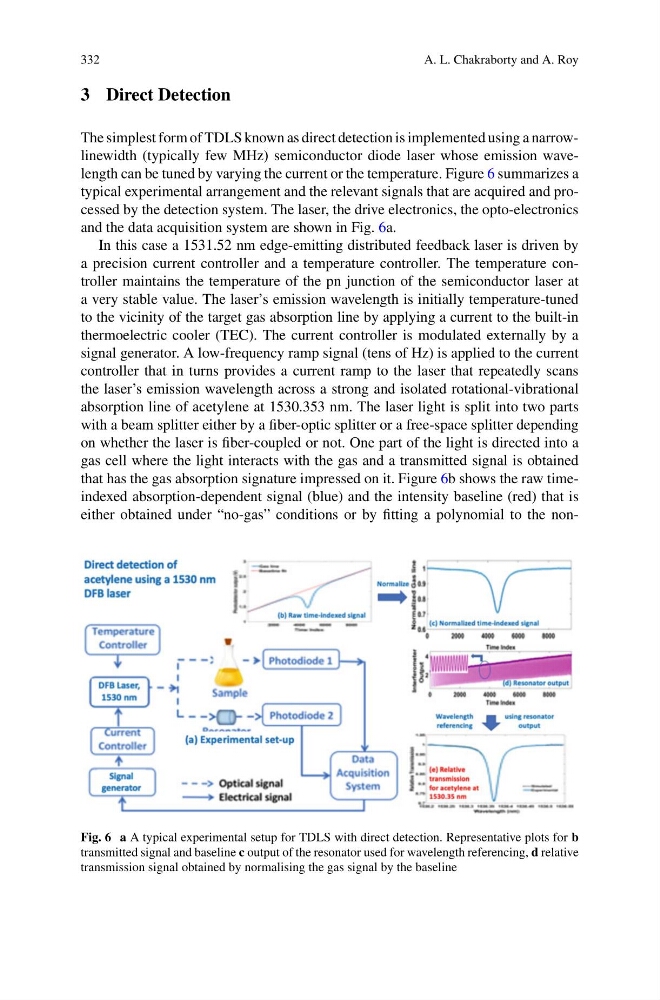
The simplest form of TDLS known as direct detection is implemented using a narrowlinewidth (typically few MHz) semiconductor diode laser whose emission wavelength can be tuned by varying the current or the temperature. Figure 6 summarizes a
typical experimental arrangement and the relevant signals that are acquired and processed by the detection system. The laser, the drive electronics, the opto-electronics
and the data acquisition system are shown in Fig. 6a.
In this case a 1531.52 nm edge-emitting distributed feedback laser is driven by
a precision current controller and a temperature controller. The temperature controller maintains the temperature of the pn junction of the semiconductor laser at
a very stable value. The laser’s emission wavelength is initially temperature-tuned
to the vicinity of the target gas absorption line by applying a current to the built-in
thermoelectric cooler (TEC). The current controller is modulated externally by a
signal generator. A low-frequency ramp signal (tens of Hz) is applied to the current
controller that in turns provides a current ramp to the laser that repeatedly scans
the laser’s emission wavelength across a strong and isolated rotational-vibrational
absorption line of acetylene at 1530.353 nm. The laser light is split into two parts
with a beam splitter either by a fiber-optic splitter or a free-space splitter depending
on whether the laser is fiber-coupled or not. One part of the light is directed into a
gas cell where the light interacts with the gas and a transmitted signal is obtained
that has the gas absorption signature impressed on it. Figure 6b shows the raw timeindexed absorption-dependent signal (blue) and the intensity baseline (red) that is
either obtained under “no-gas” conditions or by fitting a polynomial to the nonFig. 6 a A typical experimental setup for TDLS with direct detection. Representative plots for b
transmitted signal and baseline c output of the resonator used for wavelength referencing, d relative
transmission signal obtained by normalising the gas signal by the baseline
A. L. Chakraborty and A. Roy
3 Direct Detection
The simplest form of TDLS known as direct detection is implemented using a narrowlinewidth (typically few MHz) semiconductor diode laser whose emission wavelength can be tuned by varying the current or the temperature. Figure 6 summarizes a
typical experimental arrangement and the relevant signals that are acquired and processed by the detection system. The laser, the drive electronics, the opto-electronics
and the data acquisition system are shown in Fig. 6a.
In this case a 1531.52 nm edge-emitting distributed feedback laser is driven by
a precision current controller and a temperature controller. The temperature controller maintains the temperature of the pn junction of the semiconductor laser at
a very stable value. The laser’s emission wavelength is initially temperature-tuned
to the vicinity of the target gas absorption line by applying a current to the built-in
thermoelectric cooler (TEC). The current controller is modulated externally by a
signal generator. A low-frequency ramp signal (tens of Hz) is applied to the current
controller that in turns provides a current ramp to the laser that repeatedly scans
the laser’s emission wavelength across a strong and isolated rotational-vibrational
absorption line of acetylene at 1530.353 nm. The laser light is split into two parts
with a beam splitter either by a fiber-optic splitter or a free-space splitter depending
on whether the laser is fiber-coupled or not. One part of the light is directed into a
gas cell where the light interacts with the gas and a transmitted signal is obtained
that has the gas absorption signature impressed on it. Figure 6b shows the raw timeindexed absorption-dependent signal (blue) and the intensity baseline (red) that is
either obtained under “no-gas” conditions or by fitting a polynomial to the nonFig. 6 a A typical experimental setup for TDLS with direct detection. Representative plots for b
transmitted signal and baseline c output of the resonator used for wavelength referencing, d relative
transmission signal obtained by normalising the gas signal by the baseline