

Improving the Signal Strength and Detection Limits …
315
each measurement. The light from the plasma was collected using a UV-grade collection optics at 45
◦ geometry with respect to the sample surface, and subsequently
re-directed to an echelle spectrograph coupled with an ICCD detector (Andor iStar
DH334T-18U-03) through an optical fiber cable having a core diameter of 400 µm. In
order to achieve optimum time-gated LIBS spectra, the ICCD detector was properly
synchronized with a photodiode using an oscilloscope.
Each LIBS and NELIBS spectra were obtained in a single shot mode at ambient
conditions. In the case of NELIBS, a 0.5 µl drop of Ag nanoparticle colloidal solution (0.025 mg/ml in aqueous buffer solution, Sigma Aldrich) having a particle size
10 nm was deposited on different locations on a brass substrate. When the solution
evaporates, the Ag particles adhere to the brass substrate with a maximum circular
area of 2 mm radius. The laser pulses were focused exactly inside the circle of the
deposited NPs, where their distribution is more homogeneous than that of the edges.
3 Results
In order to evaluate the nanoparticle enhancement LIBS spectrum, a couple of spectra
were taken from pure brass and Ag nanoparticle treated brass surface. Each spectrum
shown here is an average of 5 consecutive single-shot spectra with a pulse energy
of 90 mJ. Gate delay and gate width of 1000 ns and 4 µs, respectively, were used to
minimize the interference from the background continuum and to acquire optimum
emissions from the plasma plume.
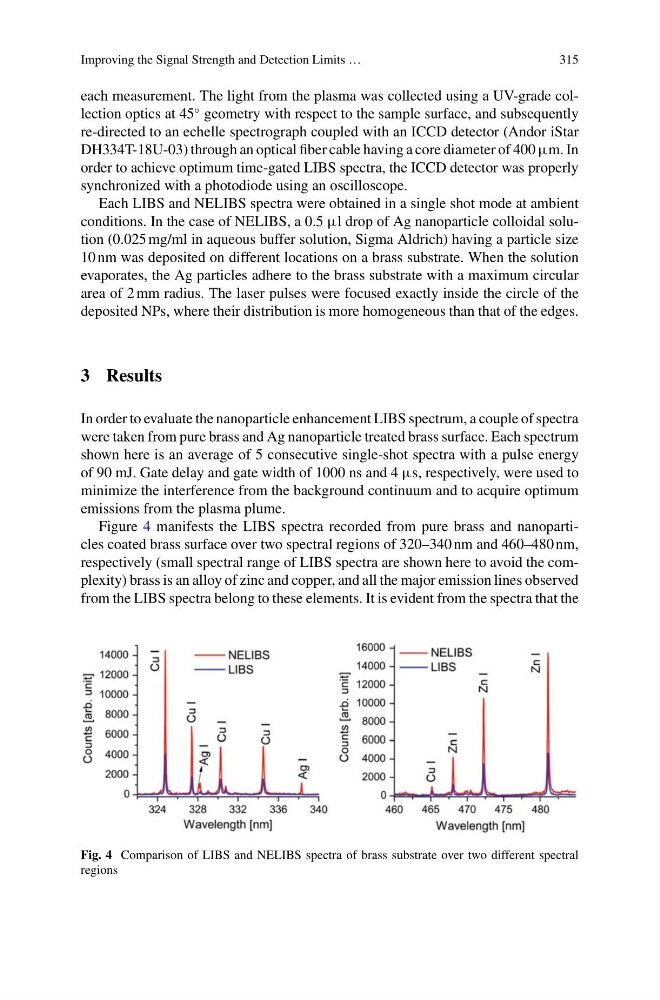
Figure 4 manifests the LIBS spectra recorded from pure brass and nanoparticles coated brass surface over two spectral regions of 320–340 nm and 460–480 nm,
respectively (small spectral range of LIBS spectra are shown here to avoid the complexity) brass is an alloy of zinc and copper, and all the major emission lines observed
from the LIBS spectra belong to these elements. It is evident from the spectra that the
Fig. 4 Comparison of LIBS and NELIBS spectra of brass substrate over two different spectral
regions
315
each measurement. The light from the plasma was collected using a UV-grade collection optics at 45
◦ geometry with respect to the sample surface, and subsequently
re-directed to an echelle spectrograph coupled with an ICCD detector (Andor iStar
DH334T-18U-03) through an optical fiber cable having a core diameter of 400 µm. In
order to achieve optimum time-gated LIBS spectra, the ICCD detector was properly
synchronized with a photodiode using an oscilloscope.
Each LIBS and NELIBS spectra were obtained in a single shot mode at ambient
conditions. In the case of NELIBS, a 0.5 µl drop of Ag nanoparticle colloidal solution (0.025 mg/ml in aqueous buffer solution, Sigma Aldrich) having a particle size
10 nm was deposited on different locations on a brass substrate. When the solution
evaporates, the Ag particles adhere to the brass substrate with a maximum circular
area of 2 mm radius. The laser pulses were focused exactly inside the circle of the
deposited NPs, where their distribution is more homogeneous than that of the edges.
3 Results
In order to evaluate the nanoparticle enhancement LIBS spectrum, a couple of spectra
were taken from pure brass and Ag nanoparticle treated brass surface. Each spectrum
shown here is an average of 5 consecutive single-shot spectra with a pulse energy
of 90 mJ. Gate delay and gate width of 1000 ns and 4 µs, respectively, were used to
minimize the interference from the background continuum and to acquire optimum
emissions from the plasma plume.
Figure 4 manifests the LIBS spectra recorded from pure brass and nanoparticles coated brass surface over two spectral regions of 320–340 nm and 460–480 nm,
respectively (small spectral range of LIBS spectra are shown here to avoid the complexity) brass is an alloy of zinc and copper, and all the major emission lines observed
from the LIBS spectra belong to these elements. It is evident from the spectra that the
Fig. 4 Comparison of LIBS and NELIBS spectra of brass substrate over two different spectral
regions