

302
A. Maity et al.
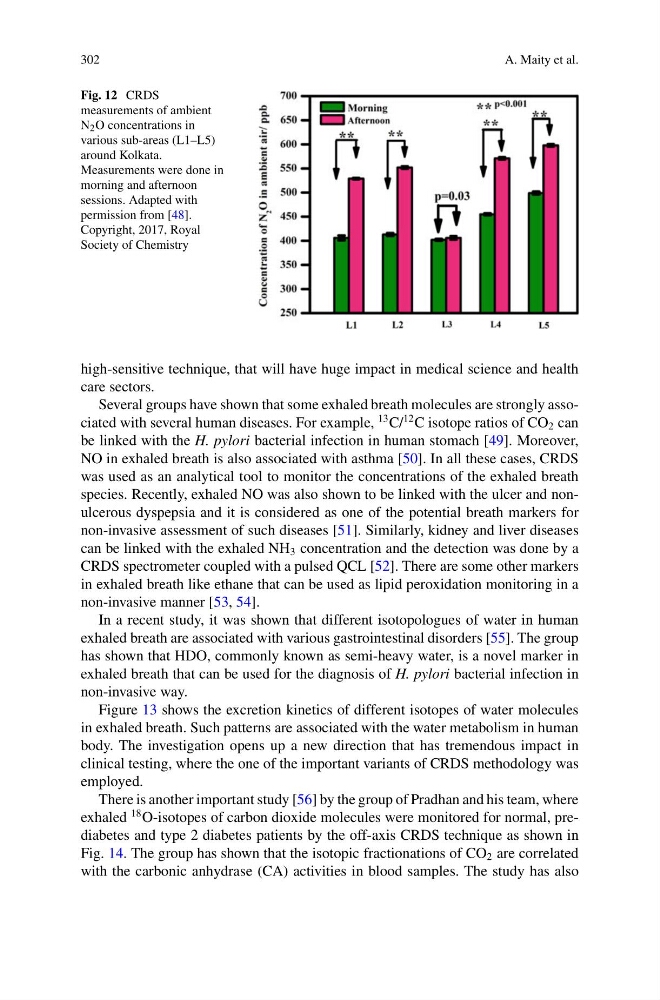
Fig. 12 CRDS
measurements of ambient
N 2 O concentrations in
various sub-areas (L1–L5)
around Kolkata.
Measurements were done in
morning and afternoon
sessions. Adapted with
permission from [48].
Copyright, 2017, Royal
Society of Chemistry
high-sensitive technique, that will have huge impact in medical science and health
care sectors.
Several groups have shown that some exhaled breath molecules are strongly associated with several human diseases. For example,
13 C/
12 C isotope ratios of CO 2 can
be linked with the H. pylori bacterial infection in human stomach [49]. Moreover,
NO in exhaled breath is also associated with asthma [50]. In all these cases, CRDS
was used as an analytical tool to monitor the concentrations of the exhaled breath
species. Recently, exhaled NO was also shown to be linked with the ulcer and nonulcerous dyspepsia and it is considered as one of the potential breath markers for
non-invasive assessment of such diseases [51]. Similarly, kidney and liver diseases
can be linked with the exhaled NH 3 concentration and the detection was done by a
CRDS spectrometer coupled with a pulsed QCL [52]. There are some other markers
in exhaled breath like ethane that can be used as lipid peroxidation monitoring in a
non-invasive manner [53, 54].
In a recent study, it was shown that different isotopologues of water in human
exhaled breath are associated with various gastrointestinal disorders [55]. The group
has shown that HDO, commonly known as semi-heavy water, is a novel marker in
exhaled breath that can be used for the diagnosis of H. pylori bacterial infection in
non-invasive way.
Figure 13 shows the excretion kinetics of different isotopes of water molecules
in exhaled breath. Such patterns are associated with the water metabolism in human
body. The investigation opens up a new direction that has tremendous impact in
clinical testing, where the one of the important variants of CRDS methodology was
employed.
There is another important study [56] by the group of Pradhan and his team, where
exhaled
18 O-isotopes of carbon dioxide molecules were monitored for normal, prediabetes and type 2 diabetes patients by the off-axis CRDS technique as shown in
Fig. 14. The group has shown that the isotopic fractionations of CO 2 are correlated
with the carbonic anhydrase (CA) activities in blood samples. The study has also
A. Maity et al.
Fig. 12 CRDS
measurements of ambient
N 2 O concentrations in
various sub-areas (L1–L5)
around Kolkata.
Measurements were done in
morning and afternoon
sessions. Adapted with
permission from [48].
Copyright, 2017, Royal
Society of Chemistry
high-sensitive technique, that will have huge impact in medical science and health
care sectors.
Several groups have shown that some exhaled breath molecules are strongly associated with several human diseases. For example,
13 C/
12 C isotope ratios of CO 2 can
be linked with the H. pylori bacterial infection in human stomach [49]. Moreover,
NO in exhaled breath is also associated with asthma [50]. In all these cases, CRDS
was used as an analytical tool to monitor the concentrations of the exhaled breath
species. Recently, exhaled NO was also shown to be linked with the ulcer and nonulcerous dyspepsia and it is considered as one of the potential breath markers for
non-invasive assessment of such diseases [51]. Similarly, kidney and liver diseases
can be linked with the exhaled NH 3 concentration and the detection was done by a
CRDS spectrometer coupled with a pulsed QCL [52]. There are some other markers
in exhaled breath like ethane that can be used as lipid peroxidation monitoring in a
non-invasive manner [53, 54].
In a recent study, it was shown that different isotopologues of water in human
exhaled breath are associated with various gastrointestinal disorders [55]. The group
has shown that HDO, commonly known as semi-heavy water, is a novel marker in
exhaled breath that can be used for the diagnosis of H. pylori bacterial infection in
non-invasive way.
Figure 13 shows the excretion kinetics of different isotopes of water molecules
in exhaled breath. Such patterns are associated with the water metabolism in human
body. The investigation opens up a new direction that has tremendous impact in
clinical testing, where the one of the important variants of CRDS methodology was
employed.
There is another important study [56] by the group of Pradhan and his team, where
exhaled
18 O-isotopes of carbon dioxide molecules were monitored for normal, prediabetes and type 2 diabetes patients by the off-axis CRDS technique as shown in
Fig. 14. The group has shown that the isotopic fractionations of CO 2 are correlated
with the carbonic anhydrase (CA) activities in blood samples. The study has also