

Cavity Ring-Down Spectroscopy
301
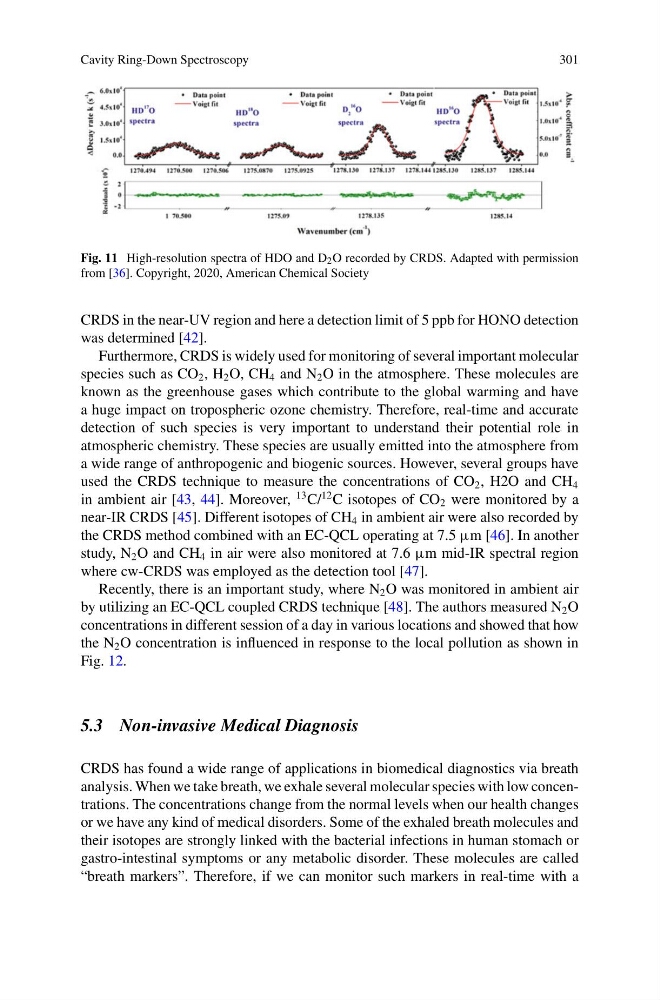
Fig. 11 High-resolution spectra of HDO and D 2 O recorded by CRDS. Adapted with permission
from [36]. Copyright, 2020, American Chemical Society
CRDS in the near-UV region and here a detection limit of 5 ppb for HONO detection
was determined [42].
Furthermore, CRDS is widely used for monitoring of several important molecular
species such as CO 2 , H 2 O, CH 4 and N 2 O in the atmosphere. These molecules are
known as the greenhouse gases which contribute to the global warming and have
a huge impact on tropospheric ozone chemistry. Therefore, real-time and accurate
detection of such species is very important to understand their potential role in
atmospheric chemistry. These species are usually emitted into the atmosphere from
a wide range of anthropogenic and biogenic sources. However, several groups have
used the CRDS technique to measure the concentrations of CO 2 , H2O and CH 4
in ambient air [43, 44]. Moreover,
13 C/
12 C isotopes of CO 2 were monitored by a
near-IR CRDS [45]. Different isotopes of CH 4 in ambient air were also recorded by
the CRDS method combined with an EC-QCL operating at 7.5 μm [46]. In another
study, N 2 O and CH 4 in air were also monitored at 7.6 μm mid-IR spectral region
where cw-CRDS was employed as the detection tool [47].
Recently, there is an important study, where N 2 O was monitored in ambient air
by utilizing an EC-QCL coupled CRDS technique [48]. The authors measured N 2 O
concentrations in different session of a day in various locations and showed that how
the N 2 O concentration is influenced in response to the local pollution as shown in
Fig. 12.
5.3 Non-invasive Medical Diagnosis
CRDS has found a wide range of applications in biomedical diagnostics via breath
analysis. When we take breath, we exhale several molecular species with low concentrations. The concentrations change from the normal levels when our health changes
or we have any kind of medical disorders. Some of the exhaled breath molecules and
their isotopes are strongly linked with the bacterial infections in human stomach or
gastro-intestinal symptoms or any metabolic disorder. These molecules are called
“breath markers”. Therefore, if we can monitor such markers in real-time with a
301
Fig. 11 High-resolution spectra of HDO and D 2 O recorded by CRDS. Adapted with permission
from [36]. Copyright, 2020, American Chemical Society
CRDS in the near-UV region and here a detection limit of 5 ppb for HONO detection
was determined [42].
Furthermore, CRDS is widely used for monitoring of several important molecular
species such as CO 2 , H 2 O, CH 4 and N 2 O in the atmosphere. These molecules are
known as the greenhouse gases which contribute to the global warming and have
a huge impact on tropospheric ozone chemistry. Therefore, real-time and accurate
detection of such species is very important to understand their potential role in
atmospheric chemistry. These species are usually emitted into the atmosphere from
a wide range of anthropogenic and biogenic sources. However, several groups have
used the CRDS technique to measure the concentrations of CO 2 , H2O and CH 4
in ambient air [43, 44]. Moreover,
13 C/
12 C isotopes of CO 2 were monitored by a
near-IR CRDS [45]. Different isotopes of CH 4 in ambient air were also recorded by
the CRDS method combined with an EC-QCL operating at 7.5 μm [46]. In another
study, N 2 O and CH 4 in air were also monitored at 7.6 μm mid-IR spectral region
where cw-CRDS was employed as the detection tool [47].
Recently, there is an important study, where N 2 O was monitored in ambient air
by utilizing an EC-QCL coupled CRDS technique [48]. The authors measured N 2 O
concentrations in different session of a day in various locations and showed that how
the N 2 O concentration is influenced in response to the local pollution as shown in
Fig. 12.
5.3 Non-invasive Medical Diagnosis
CRDS has found a wide range of applications in biomedical diagnostics via breath
analysis. When we take breath, we exhale several molecular species with low concentrations. The concentrations change from the normal levels when our health changes
or we have any kind of medical disorders. Some of the exhaled breath molecules and
their isotopes are strongly linked with the bacterial infections in human stomach or
gastro-intestinal symptoms or any metabolic disorder. These molecules are called
“breath markers”. Therefore, if we can monitor such markers in real-time with a