

Cavity Ring-Down Spectroscopy
295
4 Some Important Variants of CRDS
CRDS technique has recently been modified by several research groups and as a
result, several variants of this technique are available to improve its sensitivity and
detection strategy. Different strategies also assist to couple the laser frequency and
cavity modes in a more efficient way in the optical cavity. Here, we describe some of
the recent developments of the important variants of the CRDS technique and their
potential applications.
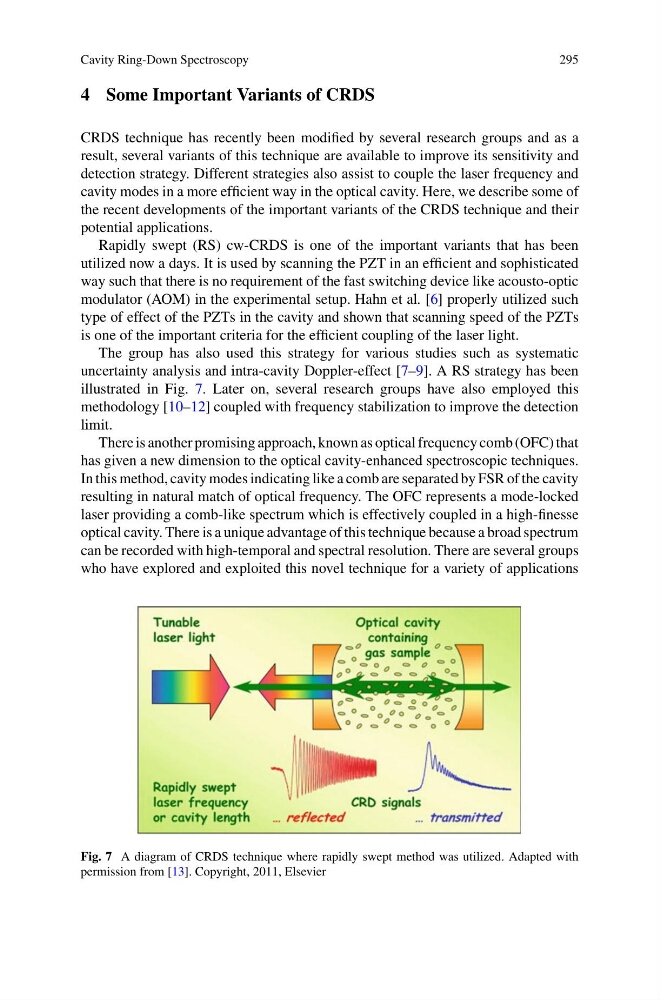
Rapidly swept (RS) cw-CRDS is one of the important variants that has been
utilized now a days. It is used by scanning the PZT in an efficient and sophisticated
way such that there is no requirement of the fast switching device like acousto-optic
modulator (AOM) in the experimental setup. Hahn et al. [6] properly utilized such
type of effect of the PZTs in the cavity and shown that scanning speed of the PZTs
is one of the important criteria for the efficient coupling of the laser light.
The group has also used this strategy for various studies such as systematic
uncertainty analysis and intra-cavity Doppler-effect [7–9]. A RS strategy has been
illustrated in Fig. 7. Later on, several research groups have also employed this
methodology [10–12] coupled with frequency stabilization to improve the detection
limit.
There is another promising approach, known as optical frequency comb (OFC) that
has given a new dimension to the optical cavity-enhanced spectroscopic techniques.
In this method, cavity modes indicating like a comb are separated by FSR of the cavity
resulting in natural match of optical frequency. The OFC represents a mode-locked
laser providing a comb-like spectrum which is effectively coupled in a high-finesse
optical cavity. There is a unique advantage of this technique because a broad spectrum
can be recorded with high-temporal and spectral resolution. There are several groups
who have explored and exploited this novel technique for a variety of applications
Fig. 7 A diagram of CRDS technique where rapidly swept method was utilized. Adapted with
permission from [13]. Copyright, 2011, Elsevier
295
4 Some Important Variants of CRDS
CRDS technique has recently been modified by several research groups and as a
result, several variants of this technique are available to improve its sensitivity and
detection strategy. Different strategies also assist to couple the laser frequency and
cavity modes in a more efficient way in the optical cavity. Here, we describe some of
the recent developments of the important variants of the CRDS technique and their
potential applications.
Rapidly swept (RS) cw-CRDS is one of the important variants that has been
utilized now a days. It is used by scanning the PZT in an efficient and sophisticated
way such that there is no requirement of the fast switching device like acousto-optic
modulator (AOM) in the experimental setup. Hahn et al. [6] properly utilized such
type of effect of the PZTs in the cavity and shown that scanning speed of the PZTs
is one of the important criteria for the efficient coupling of the laser light.
The group has also used this strategy for various studies such as systematic
uncertainty analysis and intra-cavity Doppler-effect [7–9]. A RS strategy has been
illustrated in Fig. 7. Later on, several research groups have also employed this
methodology [10–12] coupled with frequency stabilization to improve the detection
limit.
There is another promising approach, known as optical frequency comb (OFC) that
has given a new dimension to the optical cavity-enhanced spectroscopic techniques.
In this method, cavity modes indicating like a comb are separated by FSR of the cavity
resulting in natural match of optical frequency. The OFC represents a mode-locked
laser providing a comb-like spectrum which is effectively coupled in a high-finesse
optical cavity. There is a unique advantage of this technique because a broad spectrum
can be recorded with high-temporal and spectral resolution. There are several groups
who have explored and exploited this novel technique for a variety of applications
Fig. 7 A diagram of CRDS technique where rapidly swept method was utilized. Adapted with
permission from [13]. Copyright, 2011, Elsevier