

278
P. Madhusudhan et al.
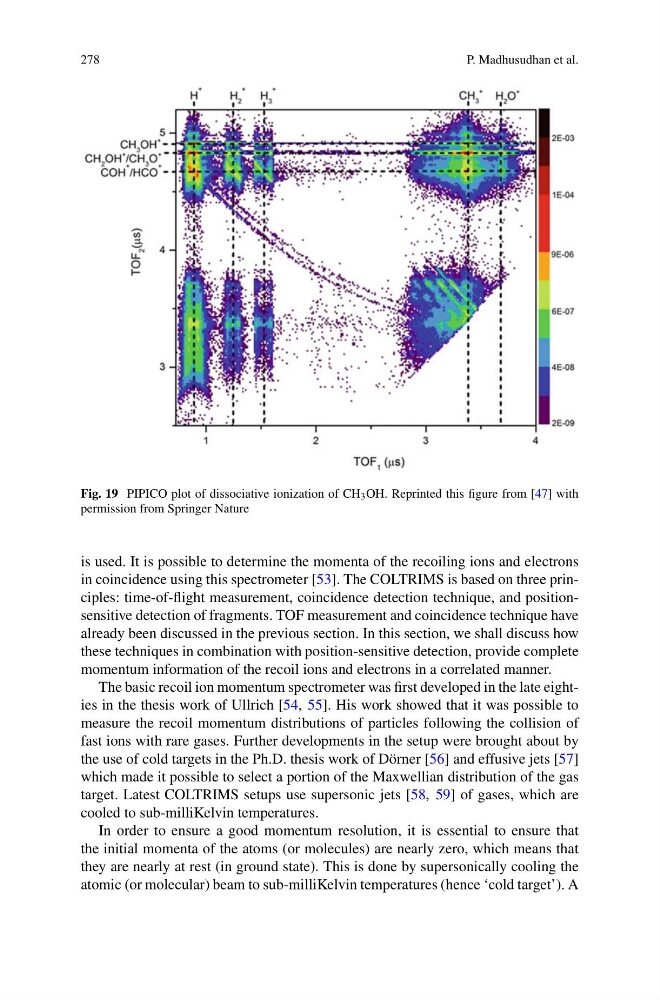
Fig. 19 PIPICO plot of dissociative ionization of CH 3 OH. Reprinted this figure from [47] with
permission from Springer Nature
is used. It is possible to determine the momenta of the recoiling ions and electrons
in coincidence using this spectrometer [53]. The COLTRIMS is based on three principles: time-of-flight measurement, coincidence detection technique, and positionsensitive detection of fragments. TOF measurement and coincidence technique have
already been discussed in the previous section. In this section, we shall discuss how
these techniques in combination with position-sensitive detection, provide complete
momentum information of the recoil ions and electrons in a correlated manner.
The basic recoil ion momentum spectrometer was first developed in the late eighties in the thesis work of Ullrich [54, 55]. His work showed that it was possible to
measure the recoil momentum distributions of particles following the collision of
fast ions with rare gases. Further developments in the setup were brought about by
the use of cold targets in the Ph.D. thesis work of Dörner [56] and effusive jets [57]
which made it possible to select a portion of the Maxwellian distribution of the gas
target. Latest COLTRIMS setups use supersonic jets [58, 59] of gases, which are
cooled to sub-milliKelvin temperatures.
In order to ensure a good momentum resolution, it is essential to ensure that
the initial momenta of the atoms (or molecules) are nearly zero, which means that
they are nearly at rest (in ground state). This is done by supersonically cooling the
atomic (or molecular) beam to sub-milliKelvin temperatures (hence ‘cold target’). A
P. Madhusudhan et al.
Fig. 19 PIPICO plot of dissociative ionization of CH 3 OH. Reprinted this figure from [47] with
permission from Springer Nature
is used. It is possible to determine the momenta of the recoiling ions and electrons
in coincidence using this spectrometer [53]. The COLTRIMS is based on three principles: time-of-flight measurement, coincidence detection technique, and positionsensitive detection of fragments. TOF measurement and coincidence technique have
already been discussed in the previous section. In this section, we shall discuss how
these techniques in combination with position-sensitive detection, provide complete
momentum information of the recoil ions and electrons in a correlated manner.
The basic recoil ion momentum spectrometer was first developed in the late eighties in the thesis work of Ullrich [54, 55]. His work showed that it was possible to
measure the recoil momentum distributions of particles following the collision of
fast ions with rare gases. Further developments in the setup were brought about by
the use of cold targets in the Ph.D. thesis work of Dörner [56] and effusive jets [57]
which made it possible to select a portion of the Maxwellian distribution of the gas
target. Latest COLTRIMS setups use supersonic jets [58, 59] of gases, which are
cooled to sub-milliKelvin temperatures.
In order to ensure a good momentum resolution, it is essential to ensure that
the initial momenta of the atoms (or molecules) are nearly zero, which means that
they are nearly at rest (in ground state). This is done by supersonically cooling the
atomic (or molecular) beam to sub-milliKelvin temperatures (hence ‘cold target’). A