

Tip-Enhanced Raman Spectroscopy
229
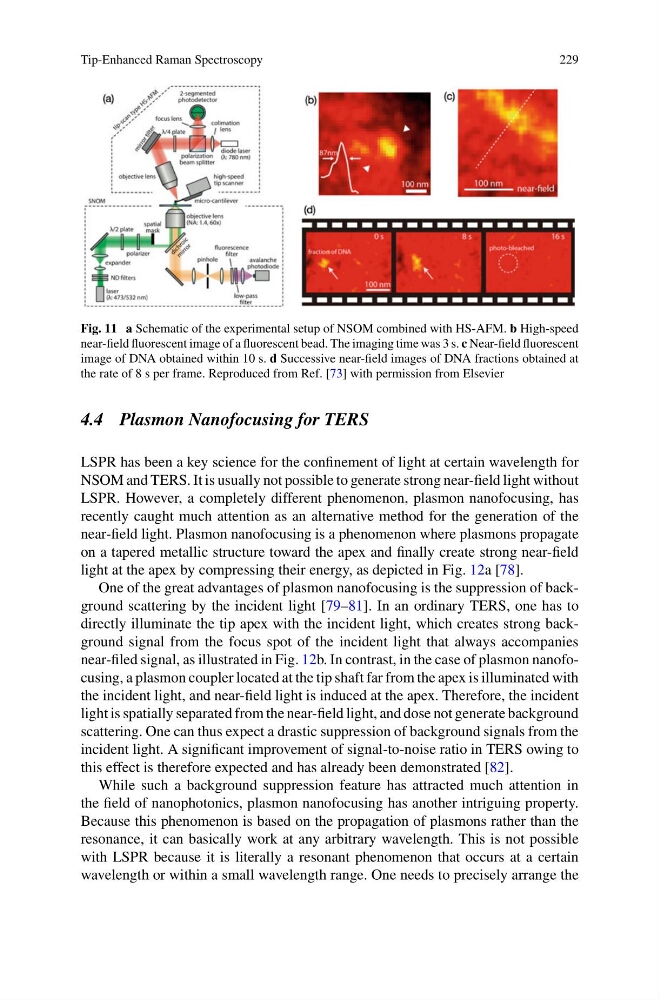
Fig. 11 a Schematic of the experimental setup of NSOM combined with HS-AFM. b High-speed
near-field fluorescent image of a fluorescent bead. The imaging time was 3 s. c Near-field fluorescent
image of DNA obtained within 10 s. d Successive near-field images of DNA fractions obtained at
the rate of 8 s per frame. Reproduced from Ref. [73] with permission from Elsevier
4.4 Plasmon Nanofocusing for TERS
LSPR has been a key science for the confinement of light at certain wavelength for
NSOM and TERS. It is usually not possible to generate strong near-field light without
LSPR. However, a completely different phenomenon, plasmon nanofocusing, has
recently caught much attention as an alternative method for the generation of the
near-field light. Plasmon nanofocusing is a phenomenon where plasmons propagate
on a tapered metallic structure toward the apex and finally create strong near-field
light at the apex by compressing their energy, as depicted in Fig. 12a [78].
One of the great advantages of plasmon nanofocusing is the suppression of background scattering by the incident light [79–81]. In an ordinary TERS, one has to
directly illuminate the tip apex with the incident light, which creates strong background signal from the focus spot of the incident light that always accompanies
near-filed signal, as illustrated in Fig. 12b. In contrast, in the case of plasmon nanofocusing, a plasmon coupler located at the tip shaft far from the apex is illuminated with
the incident light, and near-field light is induced at the apex. Therefore, the incident
light is spatially separated from the near-field light, and dose not generate background
scattering. One can thus expect a drastic suppression of background signals from the
incident light. A significant improvement of signal-to-noise ratio in TERS owing to
this effect is therefore expected and has already been demonstrated [82].
While such a background suppression feature has attracted much attention in
the field of nanophotonics, plasmon nanofocusing has another intriguing property.
Because this phenomenon is based on the propagation of plasmons rather than the
resonance, it can basically work at any arbitrary wavelength. This is not possible
with LSPR because it is literally a resonant phenomenon that occurs at a certain
wavelength or within a small wavelength range. One needs to precisely arrange the
229
Fig. 11 a Schematic of the experimental setup of NSOM combined with HS-AFM. b High-speed
near-field fluorescent image of a fluorescent bead. The imaging time was 3 s. c Near-field fluorescent
image of DNA obtained within 10 s. d Successive near-field images of DNA fractions obtained at
the rate of 8 s per frame. Reproduced from Ref. [73] with permission from Elsevier
4.4 Plasmon Nanofocusing for TERS
LSPR has been a key science for the confinement of light at certain wavelength for
NSOM and TERS. It is usually not possible to generate strong near-field light without
LSPR. However, a completely different phenomenon, plasmon nanofocusing, has
recently caught much attention as an alternative method for the generation of the
near-field light. Plasmon nanofocusing is a phenomenon where plasmons propagate
on a tapered metallic structure toward the apex and finally create strong near-field
light at the apex by compressing their energy, as depicted in Fig. 12a [78].
One of the great advantages of plasmon nanofocusing is the suppression of background scattering by the incident light [79–81]. In an ordinary TERS, one has to
directly illuminate the tip apex with the incident light, which creates strong background signal from the focus spot of the incident light that always accompanies
near-filed signal, as illustrated in Fig. 12b. In contrast, in the case of plasmon nanofocusing, a plasmon coupler located at the tip shaft far from the apex is illuminated with
the incident light, and near-field light is induced at the apex. Therefore, the incident
light is spatially separated from the near-field light, and dose not generate background
scattering. One can thus expect a drastic suppression of background signals from the
incident light. A significant improvement of signal-to-noise ratio in TERS owing to
this effect is therefore expected and has already been demonstrated [82].
While such a background suppression feature has attracted much attention in
the field of nanophotonics, plasmon nanofocusing has another intriguing property.
Because this phenomenon is based on the propagation of plasmons rather than the
resonance, it can basically work at any arbitrary wavelength. This is not possible
with LSPR because it is literally a resonant phenomenon that occurs at a certain
wavelength or within a small wavelength range. One needs to precisely arrange the