

202
B. P. Majee and A. K. Mishra
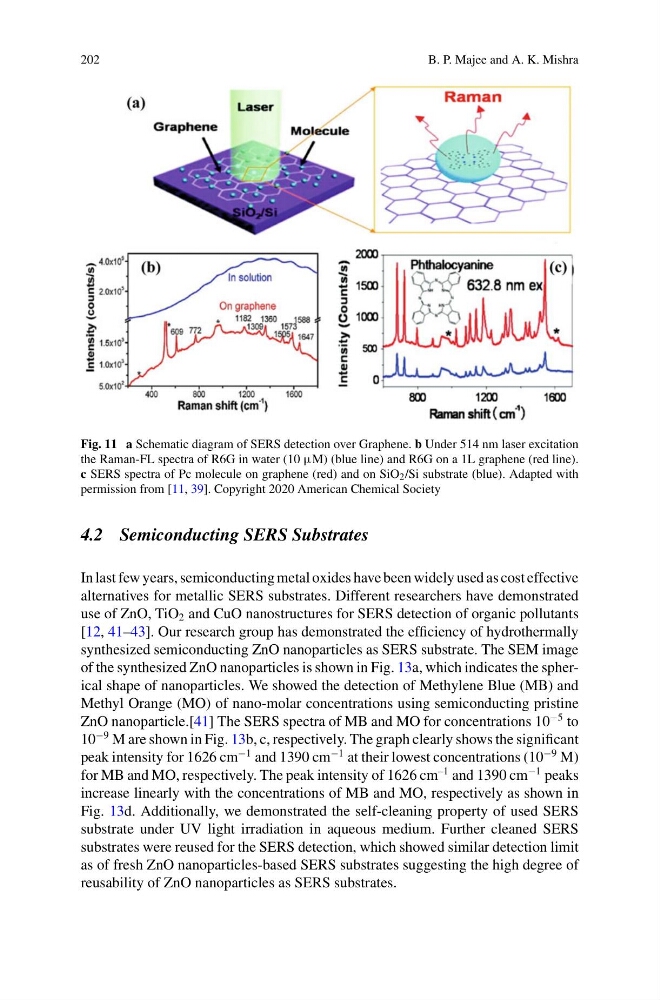
Fig. 11 a Schematic diagram of SERS detection over Graphene. b Under 514 nm laser excitation
the Raman-FL spectra of R6G in water (10 μM) (blue line) and R6G on a 1L graphene (red line).
c SERS spectra of Pc molecule on graphene (red) and on SiO 2 /Si substrate (blue). Adapted with
permission from [11, 39]. Copyright 2020 American Chemical Society
4.2 Semiconducting SERS Substrates
In last few years, semiconducting metal oxides have been widely used as cost effective
alternatives for metallic SERS substrates. Different researchers have demonstrated
use of ZnO, TiO 2 and CuO nanostructures for SERS detection of organic pollutants
[12, 41–43]. Our research group has demonstrated the efficiency of hydrothermally
synthesized semiconducting ZnO nanoparticles as SERS substrate. The SEM image
of the synthesized ZnO nanoparticles is shown in Fig. 13a, which indicates the spherical shape of nanoparticles. We showed the detection of Methylene Blue (MB) and
Methyl Orange (MO) of nano-molar concentrations using semiconducting pristine
ZnO nanoparticle.[41] The SERS spectra of MB and MO for concentrations 10
−5 to
10
−9 M are shown in Fig. 13b, c, respectively. The graph clearly shows the significant
peak intensity for 1626 cm
−1 and 1390 cm
−1 at their lowest concentrations (10
−9 M)
for MB and MO, respectively. The peak intensity of 1626 cm
–1 and 1390 cm
−1 peaks
increase linearly with the concentrations of MB and MO, respectively as shown in
Fig. 13d. Additionally, we demonstrated the self-cleaning property of used SERS
substrate under UV light irradiation in aqueous medium. Further cleaned SERS
substrates were reused for the SERS detection, which showed similar detection limit
as of fresh ZnO nanoparticles-based SERS substrates suggesting the high degree of
reusability of ZnO nanoparticles as SERS substrates.
B. P. Majee and A. K. Mishra
Fig. 11 a Schematic diagram of SERS detection over Graphene. b Under 514 nm laser excitation
the Raman-FL spectra of R6G in water (10 μM) (blue line) and R6G on a 1L graphene (red line).
c SERS spectra of Pc molecule on graphene (red) and on SiO 2 /Si substrate (blue). Adapted with
permission from [11, 39]. Copyright 2020 American Chemical Society
4.2 Semiconducting SERS Substrates
In last few years, semiconducting metal oxides have been widely used as cost effective
alternatives for metallic SERS substrates. Different researchers have demonstrated
use of ZnO, TiO 2 and CuO nanostructures for SERS detection of organic pollutants
[12, 41–43]. Our research group has demonstrated the efficiency of hydrothermally
synthesized semiconducting ZnO nanoparticles as SERS substrate. The SEM image
of the synthesized ZnO nanoparticles is shown in Fig. 13a, which indicates the spherical shape of nanoparticles. We showed the detection of Methylene Blue (MB) and
Methyl Orange (MO) of nano-molar concentrations using semiconducting pristine
ZnO nanoparticle.[41] The SERS spectra of MB and MO for concentrations 10
−5 to
10
−9 M are shown in Fig. 13b, c, respectively. The graph clearly shows the significant
peak intensity for 1626 cm
−1 and 1390 cm
−1 at their lowest concentrations (10
−9 M)
for MB and MO, respectively. The peak intensity of 1626 cm
–1 and 1390 cm
−1 peaks
increase linearly with the concentrations of MB and MO, respectively as shown in
Fig. 13d. Additionally, we demonstrated the self-cleaning property of used SERS
substrate under UV light irradiation in aqueous medium. Further cleaned SERS
substrates were reused for the SERS detection, which showed similar detection limit
as of fresh ZnO nanoparticles-based SERS substrates suggesting the high degree of
reusability of ZnO nanoparticles as SERS substrates.