

174
D. K. Pandey et al.
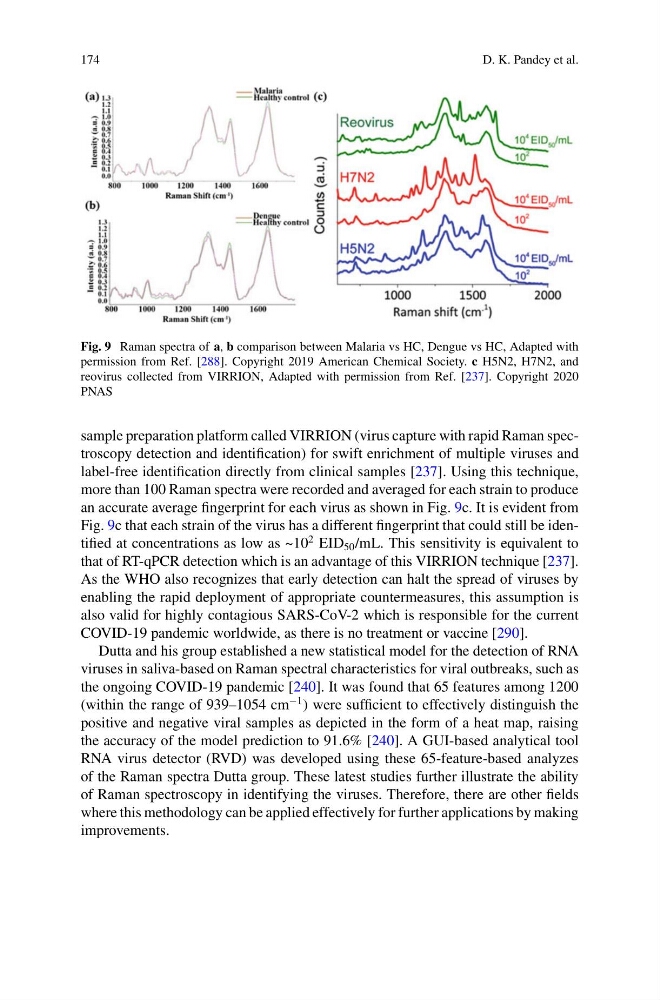
Fig. 9 Raman spectra of a, b comparison between Malaria vs HC, Dengue vs HC, Adapted with
permission from Ref. [288]. Copyright 2019 American Chemical Society. c H5N2, H7N2, and
reovirus collected from VIRRION, Adapted with permission from Ref. [237]. Copyright 2020
PNAS
sample preparation platform called VIRRION (virus capture with rapid Raman spectroscopy detection and identification) for swift enrichment of multiple viruses and
label-free identification directly from clinical samples [237]. Using this technique,
more than 100 Raman spectra were recorded and averaged for each strain to produce
an accurate average fingerprint for each virus as shown in Fig. 9c. It is evident from
Fig. 9c that each strain of the virus has a different fingerprint that could still be identified at concentrations as low as ~10
2 EID 50 /mL. This sensitivity is equivalent to
that of RT-qPCR detection which is an advantage of this VIRRION technique [237].
As the WHO also recognizes that early detection can halt the spread of viruses by
enabling the rapid deployment of appropriate countermeasures, this assumption is
also valid for highly contagious SARS-CoV-2 which is responsible for the current
COVID-19 pandemic worldwide, as there is no treatment or vaccine [290].
Dutta and his group established a new statistical model for the detection of RNA
viruses in saliva-based on Raman spectral characteristics for viral outbreaks, such as
the ongoing COVID-19 pandemic [240]. It was found that 65 features among 1200
(within the range of 939–1054 cm
−1 ) were sufficient to effectively distinguish the
positive and negative viral samples as depicted in the form of a heat map, raising
the accuracy of the model prediction to 91.6% [240]. A GUI-based analytical tool
RNA virus detector (RVD) was developed using these 65-feature-based analyzes
of the Raman spectra Dutta group. These latest studies further illustrate the ability
of Raman spectroscopy in identifying the viruses. Therefore, there are other fields
where this methodology can be applied effectively for further applications by making
improvements.
D. K. Pandey et al.
Fig. 9 Raman spectra of a, b comparison between Malaria vs HC, Dengue vs HC, Adapted with
permission from Ref. [288]. Copyright 2019 American Chemical Society. c H5N2, H7N2, and
reovirus collected from VIRRION, Adapted with permission from Ref. [237]. Copyright 2020
PNAS
sample preparation platform called VIRRION (virus capture with rapid Raman spectroscopy detection and identification) for swift enrichment of multiple viruses and
label-free identification directly from clinical samples [237]. Using this technique,
more than 100 Raman spectra were recorded and averaged for each strain to produce
an accurate average fingerprint for each virus as shown in Fig. 9c. It is evident from
Fig. 9c that each strain of the virus has a different fingerprint that could still be identified at concentrations as low as ~10
2 EID 50 /mL. This sensitivity is equivalent to
that of RT-qPCR detection which is an advantage of this VIRRION technique [237].
As the WHO also recognizes that early detection can halt the spread of viruses by
enabling the rapid deployment of appropriate countermeasures, this assumption is
also valid for highly contagious SARS-CoV-2 which is responsible for the current
COVID-19 pandemic worldwide, as there is no treatment or vaccine [290].
Dutta and his group established a new statistical model for the detection of RNA
viruses in saliva-based on Raman spectral characteristics for viral outbreaks, such as
the ongoing COVID-19 pandemic [240]. It was found that 65 features among 1200
(within the range of 939–1054 cm
−1 ) were sufficient to effectively distinguish the
positive and negative viral samples as depicted in the form of a heat map, raising
the accuracy of the model prediction to 91.6% [240]. A GUI-based analytical tool
RNA virus detector (RVD) was developed using these 65-feature-based analyzes
of the Raman spectra Dutta group. These latest studies further illustrate the ability
of Raman spectroscopy in identifying the viruses. Therefore, there are other fields
where this methodology can be applied effectively for further applications by making
improvements.