

Overview of Raman Spectroscopy: Fundamental to Applications
159
structure in pristine and mixture form, as well as in bio-molecules. The simplest
and fundamental structure of the water molecule reveals the significant interesting
physical properties which have been studied most extensively among all known
liquids [20, 31, 32]. Raman spectroscopy among the spectroscopic techniques is
suitable to study the vibrationally-averaged structure (V-structure) of water and its
dynamics (both in bulk and confined state) which reflects the orientation of water
molecule due to its smaller observation time τ = 10
−13
− 10
−14 s compared to
the relaxation time of rotational rearrangement τ r of water molecules in the liquid
phase τ r = 10
−11
− 10
−12 s [31, 33–36]. The liquid water consists of a random,
three-dimensional HB network spanning a broad range of O–H•••O HB angles and
distances [37]. Raman scattering from liquid water consists of intermolecular fluctuation bands in low-frequency regions due to the interaction of water molecules
via hydrogen bonds, a ν 2 (bending) band close to 1645 cm
−1 , a combination of
bending and libration bands (ν 2 + ν L ) are close to 2100 cm
−1 , and a broad band
of OH stretching vibration was obtained between 2800 and 3400 cm
−1 [38–43].
The OH/OD stretch band at 2800–3800 cm
−1 is especially insightful on the Raman
spectra of water regarding the structure since it is prone to water molecules in local
environments [44, 45]. The OH/OD stretch bands act as a marker band for the phase
transition of the water from solid to liquid and gas phase, where the main peak shifts
from ~3150 cm
−1 (normal ice) to ~3420 cm
−1 (liquid water) and then the transition
to gas vapor leads the shifting to ~3650 cm
−1 . Carey and Korenowski have deconvoluted this broad band into five Gaussian fitted center frequencies [46]. Whereas
Zhelyaskov et al. using Fourier deconvolution divided the OH spectra into three
anisotropic and four isotropic components and Li et al. decomposed the contour
into four components [47, 48]. Li and colleagues revealed that the Raman spectra
of water could be deconvoluted into five Gaussian components attributed to water
molecules coupled entirely or partially with a hydrogen bond [49]. Sun categorized
local water molecule HB by deconvolving the OH stretch band into five Gaussian subbands of Raman peak attributed to DA (single donor-single acceptor), DAA (single
donor-double acceptor), DDA (double donor-single acceptor), and DDAA (double
donor-double accepter) and free OH [50]. On the contrary, Djuriˇ ckovi´ c et al. argued
that matching the spectrum was futile and studied the actual spectra clearly without
any deconvolution [51]. The perception that liquid water has partially hydrogenbonded (distorted) and absolute hydrogen-bonded (tetrahedral) configurations, that
are strengthened despite confounding studies to compellingly illustrate the details
derived through spectral analysis. Overall, liquid water is categorized as a tetrahedral
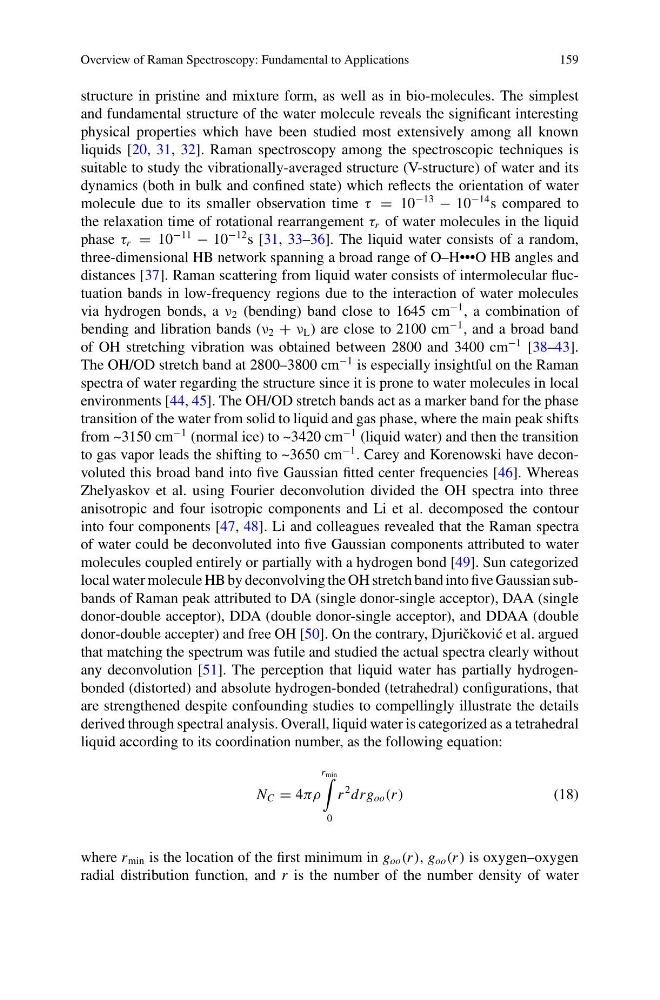
liquid according to its coordination number, as the following equation:
N C = 4πρ
r min
0
r
2 drg oo (r )
(18)
where r min is the location of the first minimum in g oo (r ), g oo (r ) is oxygen–oxygen
radial distribution function, and r is the number of the number density of water
159
structure in pristine and mixture form, as well as in bio-molecules. The simplest
and fundamental structure of the water molecule reveals the significant interesting
physical properties which have been studied most extensively among all known
liquids [20, 31, 32]. Raman spectroscopy among the spectroscopic techniques is
suitable to study the vibrationally-averaged structure (V-structure) of water and its
dynamics (both in bulk and confined state) which reflects the orientation of water
molecule due to its smaller observation time τ = 10
−13
− 10
−14 s compared to
the relaxation time of rotational rearrangement τ r of water molecules in the liquid
phase τ r = 10
−11
− 10
−12 s [31, 33–36]. The liquid water consists of a random,
three-dimensional HB network spanning a broad range of O–H•••O HB angles and
distances [37]. Raman scattering from liquid water consists of intermolecular fluctuation bands in low-frequency regions due to the interaction of water molecules
via hydrogen bonds, a ν 2 (bending) band close to 1645 cm
−1 , a combination of
bending and libration bands (ν 2 + ν L ) are close to 2100 cm
−1 , and a broad band
of OH stretching vibration was obtained between 2800 and 3400 cm
−1 [38–43].
The OH/OD stretch band at 2800–3800 cm
−1 is especially insightful on the Raman
spectra of water regarding the structure since it is prone to water molecules in local
environments [44, 45]. The OH/OD stretch bands act as a marker band for the phase
transition of the water from solid to liquid and gas phase, where the main peak shifts
from ~3150 cm
−1 (normal ice) to ~3420 cm
−1 (liquid water) and then the transition
to gas vapor leads the shifting to ~3650 cm
−1 . Carey and Korenowski have deconvoluted this broad band into five Gaussian fitted center frequencies [46]. Whereas
Zhelyaskov et al. using Fourier deconvolution divided the OH spectra into three
anisotropic and four isotropic components and Li et al. decomposed the contour
into four components [47, 48]. Li and colleagues revealed that the Raman spectra
of water could be deconvoluted into five Gaussian components attributed to water
molecules coupled entirely or partially with a hydrogen bond [49]. Sun categorized
local water molecule HB by deconvolving the OH stretch band into five Gaussian subbands of Raman peak attributed to DA (single donor-single acceptor), DAA (single
donor-double acceptor), DDA (double donor-single acceptor), and DDAA (double
donor-double accepter) and free OH [50]. On the contrary, Djuriˇ ckovi´ c et al. argued
that matching the spectrum was futile and studied the actual spectra clearly without
any deconvolution [51]. The perception that liquid water has partially hydrogenbonded (distorted) and absolute hydrogen-bonded (tetrahedral) configurations, that
are strengthened despite confounding studies to compellingly illustrate the details
derived through spectral analysis. Overall, liquid water is categorized as a tetrahedral
liquid according to its coordination number, as the following equation:
N C = 4πρ
r min
0
r
2 drg oo (r )
(18)
where r min is the location of the first minimum in g oo (r ), g oo (r ) is oxygen–oxygen
radial distribution function, and r is the number of the number density of water