

Overview of Raman Spectroscopy: Fundamental to Applications
151
Here, α ρσ is the polarizability tensor, during the transition from ith state to the jth
state, K 0 defines the irradiance of the incident radiation and ε 0 is the permittivity of
vacuum. In general, the Raman scattering is recorded for the Stokes scattering and
in some special cases, the anti-Stokes scattering is also analyzed.
2.3 Selection Rules for Raman Scattering
The necessary condition for the Raman active transition is the non-zero change in
polarizability of the molecule, during the transition from one state to another. Moreover, the selection rules also reveal whether the transition takes place or forbidden.
Let us consider the total wavefunction of the ground state vibration (ψ
0
vib ), which
exhibits the fundamental transition to the first excited state (ψ
j=1
vib ). The transition
can be written as
ψ
0
vib → ψ
j=1
vib
(12)
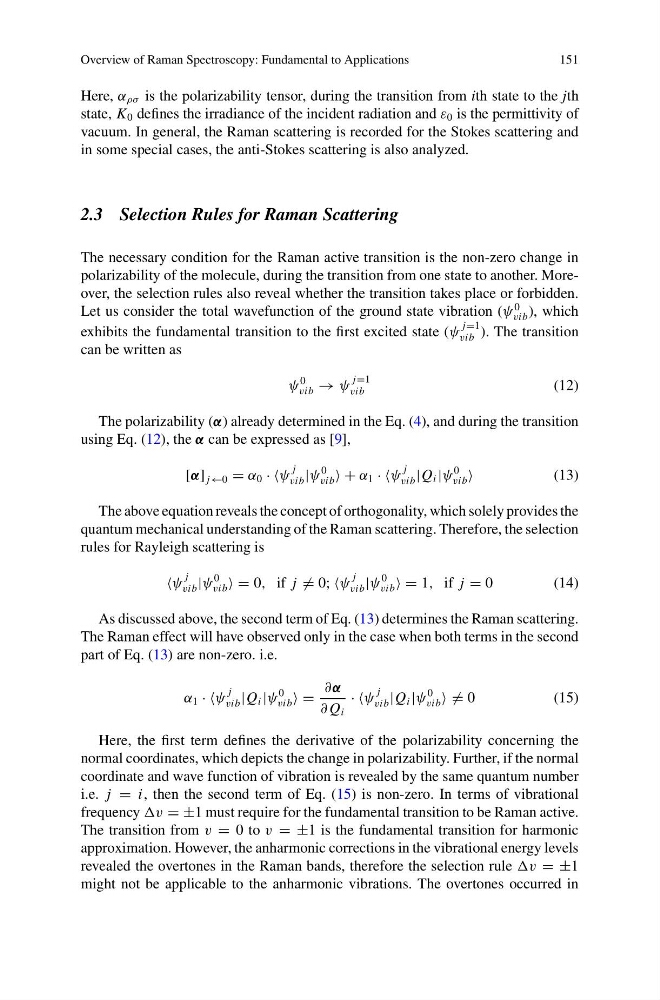
The polarizability (α) already determined in the Eq. (4), and during the transition
using Eq. (12), the α can be expressed as [9],
[α] j←0 = α 0 · ·ψ
j
vib |ψ
0
vib + α 1 · ·ψ
j
vib |Q i |ψ
0
vib
(13)
The above equation reveals the concept of orthogonality, which solely provides the
quantum mechanical understanding of the Raman scattering. Therefore, the selection
rules for Rayleigh scattering is
ψ
j
vib |ψ
0
vib = 0, if j = 0; ;ψ
j
vib |ψ
0
vib = 1, if j = 0
( 1 4 )
As discussed above, the second term of Eq. (13) determines the Raman scattering.
The Raman effect will have observed only in the case when both terms in the second
part of Eq. (13) are non-zero. i.e.
α 1 · ·ψ
j
vib |Q i |ψ
0
vib =
∂α
∂ Q i
· ·ψ
j
vib |Q i |ψ
0
vib = 0
(15)
Here, the first term defines the derivative of the polarizability concerning the
normal coordinates, which depicts the change in polarizability. Further, if the normal
coordinate and wave function of vibration is revealed by the same quantum number
i.e. j = i, then the second term of Eq. (15) is non-zero. In terms of vibrational
frequency v = ±1 must require for the fundamental transition to be Raman active.
The transition from v = 0 to v = ±1 is the fundamental transition for harmonic
approximation. However, the anharmonic corrections in the vibrational energy levels
revealed the overtones in the Raman bands, therefore the selection rule v = ±1
might not be applicable to the anharmonic vibrations. The overtones occurred in
151
Here, α ρσ is the polarizability tensor, during the transition from ith state to the jth
state, K 0 defines the irradiance of the incident radiation and ε 0 is the permittivity of
vacuum. In general, the Raman scattering is recorded for the Stokes scattering and
in some special cases, the anti-Stokes scattering is also analyzed.
2.3 Selection Rules for Raman Scattering
The necessary condition for the Raman active transition is the non-zero change in
polarizability of the molecule, during the transition from one state to another. Moreover, the selection rules also reveal whether the transition takes place or forbidden.
Let us consider the total wavefunction of the ground state vibration (ψ
0
vib ), which
exhibits the fundamental transition to the first excited state (ψ
j=1
vib ). The transition
can be written as
ψ
0
vib → ψ
j=1
vib
(12)
The polarizability (α) already determined in the Eq. (4), and during the transition
using Eq. (12), the α can be expressed as [9],
[α] j←0 = α 0 · ·ψ
j
vib |ψ
0
vib + α 1 · ·ψ
j
vib |Q i |ψ
0
vib
(13)
The above equation reveals the concept of orthogonality, which solely provides the
quantum mechanical understanding of the Raman scattering. Therefore, the selection
rules for Rayleigh scattering is
ψ
j
vib |ψ
0
vib = 0, if j = 0; ;ψ
j
vib |ψ
0
vib = 1, if j = 0
( 1 4 )
As discussed above, the second term of Eq. (13) determines the Raman scattering.
The Raman effect will have observed only in the case when both terms in the second
part of Eq. (13) are non-zero. i.e.
α 1 · ·ψ
j
vib |Q i |ψ
0
vib =
∂α
∂ Q i
· ·ψ
j
vib |Q i |ψ
0
vib = 0
(15)
Here, the first term defines the derivative of the polarizability concerning the
normal coordinates, which depicts the change in polarizability. Further, if the normal
coordinate and wave function of vibration is revealed by the same quantum number
i.e. j = i, then the second term of Eq. (15) is non-zero. In terms of vibrational
frequency v = ±1 must require for the fundamental transition to be Raman active.
The transition from v = 0 to v = ±1 is the fundamental transition for harmonic
approximation. However, the anharmonic corrections in the vibrational energy levels
revealed the overtones in the Raman bands, therefore the selection rule v = ±1
might not be applicable to the anharmonic vibrations. The overtones occurred in