

150
D. K. Pandey et al.
The above equation reveals the three cases: (i) The total energy of the molecule
before and after the collision is the same (E = E
), further gives v
= v. This
suggests that the photon energy is not changed after the collision, which gives the
Rayleigh scattering of the molecule. (ii) E > E
and v
= v + v. This might
happen when the molecule is already in the excited state due to the thermal energy
and transfers the energy to the photon. This phenomenon is known as the anti-Stokes
Raman scattering. (iii) The molecule absorbs the energy from an incident photon and
the final energy of molecule increases after the collision, i.e. E
> E and further,
v
= v − v. This is determined as the Stokes Raman scattering. Here, v is the
frequency difference of incident and scattered photon, which is the characteristic
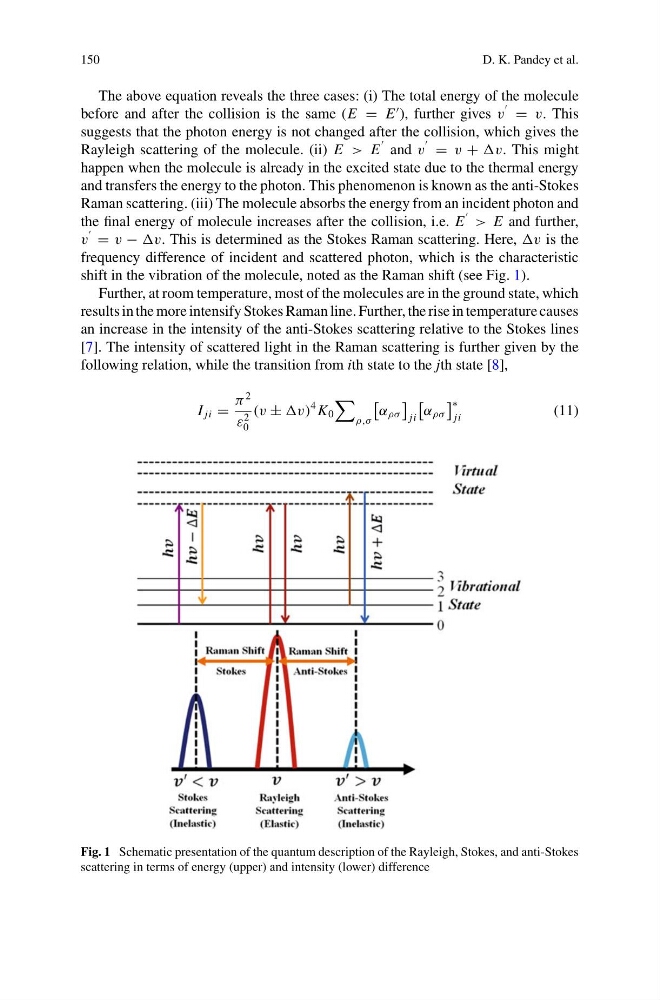
shift in the vibration of the molecule, noted as the Raman shift (see Fig. 1).
Further, at room temperature, most of the molecules are in the ground state, which
results in the more intensify Stokes Raman line. Further, the rise in temperature causes
an increase in the intensity of the anti-Stokes scattering relative to the Stokes lines
[7]. The intensity of scattered light in the Raman scattering is further given by the
following relation, while the transition from ith state to the jth state [8],
I ji =
π
2
ε
2
0
(v ± v)
4 K 0
ρ,σ
α ρσ
ji
α ρσ
∗
ji
(11)
Fig. 1 Schematic presentation of the quantum description of the Rayleigh, Stokes, and anti-Stokes
scattering in terms of energy (upper) and intensity (lower) difference
D. K. Pandey et al.
The above equation reveals the three cases: (i) The total energy of the molecule
before and after the collision is the same (E = E
), further gives v
= v. This
suggests that the photon energy is not changed after the collision, which gives the
Rayleigh scattering of the molecule. (ii) E > E
and v
= v + v. This might
happen when the molecule is already in the excited state due to the thermal energy
and transfers the energy to the photon. This phenomenon is known as the anti-Stokes
Raman scattering. (iii) The molecule absorbs the energy from an incident photon and
the final energy of molecule increases after the collision, i.e. E
> E and further,
v
= v − v. This is determined as the Stokes Raman scattering. Here, v is the
frequency difference of incident and scattered photon, which is the characteristic
shift in the vibration of the molecule, noted as the Raman shift (see Fig. 1).
Further, at room temperature, most of the molecules are in the ground state, which
results in the more intensify Stokes Raman line. Further, the rise in temperature causes
an increase in the intensity of the anti-Stokes scattering relative to the Stokes lines
[7]. The intensity of scattered light in the Raman scattering is further given by the
following relation, while the transition from ith state to the jth state [8],
I ji =
π
2
ε
2
0
(v ± v)
4 K 0
ρ,σ
α ρσ
ji
α ρσ
∗
ji
(11)
Fig. 1 Schematic presentation of the quantum description of the Rayleigh, Stokes, and anti-Stokes
scattering in terms of energy (upper) and intensity (lower) difference